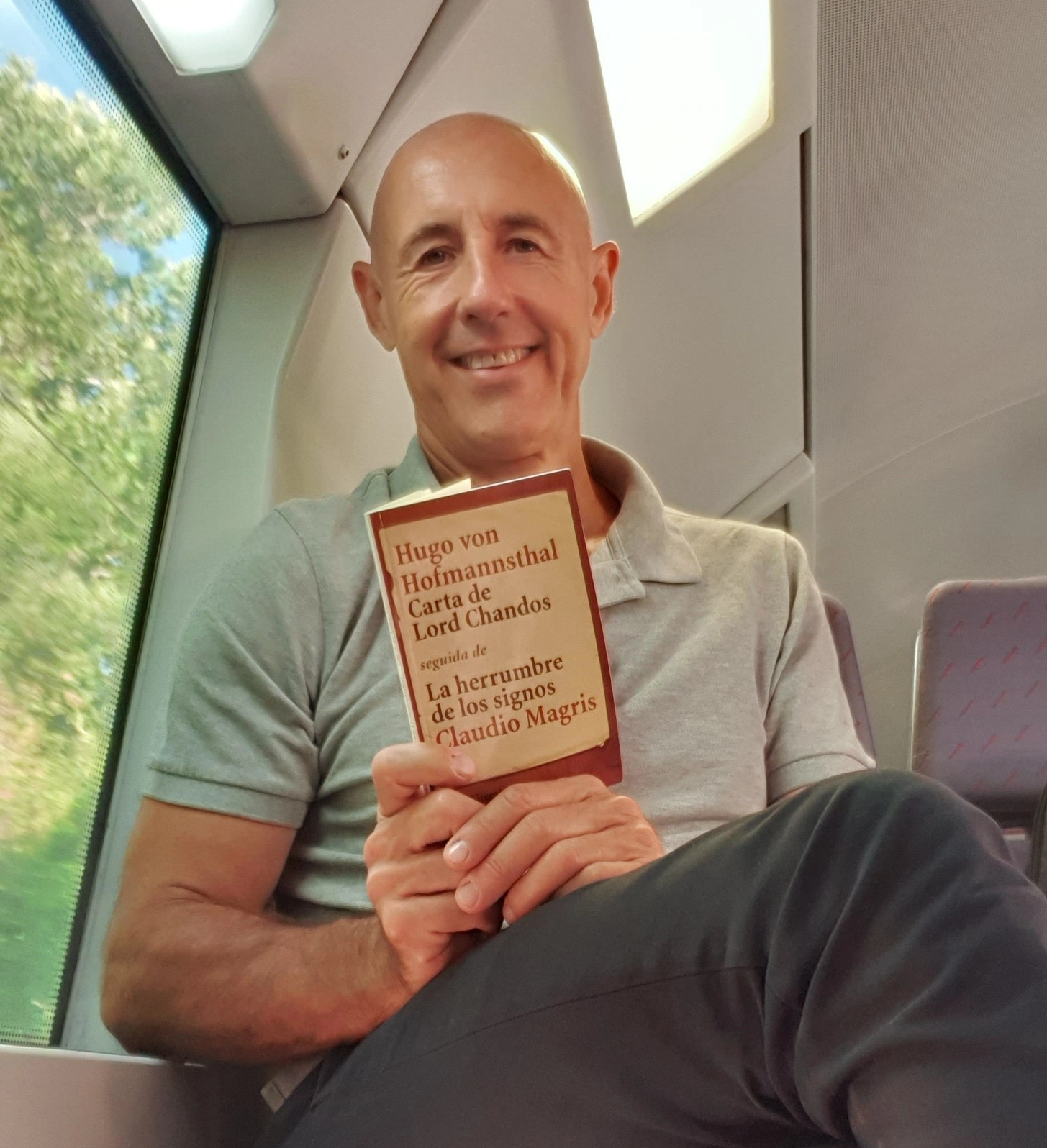
Mahler, Roth, von Hofmannsthal, and Magris, fin de siècle Vienna and the fall of the Austro-Hungarian empire.

Lord Chandos on a train

A couple of years ago I wrote about Mahler and Joseph Roth and the coincidence that they both lived in the turn of the Century Vienna. It was very much a gut feeling post (you can read it here) since I am not a history scholar, even less an Austro-Hungarian history scholar specializing in the fall of the empire.

What you read on the Camino is very important. I usually choose spiritually enlightening books. (The Book of Job, Gemma Simmonds The Way of Ignatius A Prayer Journey through Lent (she was my sister’s teacher!), Willigis Jager The Wave is the Sea, even a collection of Zen stories!) They also have to be physically light and small due to backpacking requirements. This year under my friend Paco’s recommendation I took an intellectually challenging book: Hugo von Hofmannsthal Ein Brief (Brief des Lord Chandos) – Letter to Lord Chandos followed by Claudio Magris’ analysis of the Letter in La Lettera Di Lord Chandos.

Hofmannsthal’s (fictional) letter from Lord Chandos to Francis Bacon is a short (22 pages) but fascinating essay on language. Magris’ analysis of the letter is a mind-blowing tour de force of fin de siècle Vienna and the fall of the Austro-Hungarian empire and what was to follow in Europe. After a master’s and a PhD in literature, I was surprised to find that this is by far the densest reading I have ever encountered. It is rich, thick -but readable- and chock full of references: Kafka, Wittgenstein, Heidegger, Freud, and Nietzsche (obviously), Borges, Saussure, Kubrick, Eco, Pasolini, Plato, Seneca, and Cicero, Roth, Kierkegaard, Klee, Van Gogh… and a whole bunch of other names I confess I have no clue who they are. But the point is that Magris explains in philosophical and existential detail the fall of the Austro-Hungarian Empire, turn of the Century Vienna and what would follow in postmodern Europe. It was also very rewarding to read a real essay on what I wrote as a hack blog post…

In conclusion, this is a short, small book, perfect for travelling but dense and rich and glorious academic reading! Enjoy, you are welcome!

PS: If you want to read more about Chandos check out this article:

Greaney, Patrick. “On the Chaos in Chandos: Hofmannsthal on Modernity’s Threshold.” MLN 129.3 (2014): 563-573.

Greece again (five years later)

My love for Greece started during my first visit there in 1985. Since then I have returned a few times and enjoyed it every single minute. It is easy for me to remember the last time I went to Greece because it was the Summer right before my father died, 2015. This time was a bit different.

My love for Greece is very much in the Romantic vein, like Lord Byron, Wordsworth, Coleridge, Keats or Shelley. Maybe even in a philosophical vein like Socrates and Plato, like the Stoics. In Greece you are transported to the origins of our Western civilization, our education, our way of thinking, dare I say, we haven’t even improved that much the concept of Democracy… other than the obvious -although we might even be regressing on that front since it looks like the state of Florida will not allow convicted felons to vote, as if they were not citizens.

The special aspect to this visit was that I arrived by boat! (see previous post). Our first stop was Methoni. This village sits on the farthest South Western corner of the Peloponnese (the mainland) and is therefore a strategic location for anybody passing by. Because of this strategic location, there has been a castle there since Medieval times. During the Venetian expansion they took over the Ionian sea, up to and including Methoni, building or re-building the tower which manages to be strong yet elegant at the same time. Later, the Ottoman Empire took over, and they added their characteristic Byzantine “touch”. Eventually the town and the castle passed hands a few more times as it saw action during the Turkish invasion and World War II. In this fortress in Ottoman times Cervantes was held captive after his participation in the Battle of Lepanto.

Right between the castle walls with its Venetian coat of arms -The winged lion of St. Mark’s- and the beach is the lovely Methoni Beach Hotel, where Efi served us a couple of delicious Gin and Tonics! Since we had swam ashore, we were lucky to find a generous fisherman that gave us a lift to the boat. Even though he was a Barça fan and that he did not like Real Madrid, I am grateful for the lift.

Our next stop was a couple of “fingers” over, the quiet little island of Elafonisos, with a great wild beach at Simos. Unfortunately, we did not have time to explore the shore.

The next day we sailed by the amazing Monemvasia, a massive island plateau with a fortified village. It is reminiscent of the Israeli Masada fortress! But our destination was the island of Spetses. We arrived at the lovely cove of Zogeria, with its obligatory chapel and beach restaurant (what in Spain is called a chiringuito). A short motorboat jump away is the main town of Dapia with its old and new harbor. The village sits -like most Greek island villages- on the slope of the hill. Fortunately, only residents can have cars on the island, but still everybody moves around on dusty old scooters and quads with the occasional golf cart or electric runabouts.

Due to the relative proximity to Athens (there are a few high-speed passenger ferries from Piraeus), Spetses is one of the popular getaway islands for Athenians to weekend. Think Martha’s Vineyard or Nantucket for Bostonians. This influx of well to do Athenians leads to nice restaurants and shops, with the downside being higher prices and some crowding.

The village is well distributed and has all the requirements of a nice Greek town -and then some:

  • A cute shopping street
  • A grand, old-school hotel: the Poseidonion
  • Great fish restaurants on the harbor
  • Coffee shops
  • Old churches
  • A fantastic bar with the biggest collection of Scotch I have ever seen, and old Rock and Roll!
  • It even has a couple of museums, the Spetses museum which chronicles the history of the town and the small but rich Bouboulina museum. This museum in housed in Bouboulina’s grand 19th C house downtown. She was the first woman ever to have been named Admiral for her continued fight for the independence of Greece. If you are in Spetses it is worth the short visit.

On my last day, my dear friend Matthieu came to lunch on his lovely Boston Whaler motorboat and we went to his house on the mainland village of Tolo. The next day, after a nice dinner by the sea, it was time for me to return to Madrid. Just like that, my short visit was over. But I cannot wait to return to my spiritual home.

The Job Search Part II, looking for jobs in secondary schools.

Since I had taught high school for seven years before embarking on my PhD., I knew I loved working with that age group and in my heart of hearts I understood I was to go back to teaching them.

Back in 2011, in case I didn’t get accepted into a doctoral program, I contacted Southern Teachers Agency to help me look for teaching jobs in the South. I loved working with them, although I did get into UNC. So this time around I contacted them again, and I could not be happier with how they worked with me to find the perfect job. In fact, Southern Teachers was the only venue I used to seriously look for a job teaching secondary school Spanish.

Things took off right from the time I signed up with them. I did a very promising Skype interview in November with a boy’s boarding school in the mountains of North Carolina. During Christmas break, an all girls school in Chattanooga Tennessee booked me to go interview with them as soon as I got back stateside, which I did. They put me up in a beautiful hotel in downtown Chattanooga, and the morning of the interview I was picked up by the head of facilities,  which I found a very telling gesture. Unfortunately, things did not pan out that well later, as I was pretty much abandoned halfway through lunch to walk myself out of the school, disappointing. In January, Southern Teachers held a job fair in Washington DC, which coincided with me having to do some paperwork at the Spanish Consulate (that story is for a different blog entry). During this fair I met and spoke with many schools all over the South, but my most rewarding conversation was with a school in Florida. Our pedagogical ideologies clicked right in place, I was very impressed that there was a school that was not obsessed with AP exams, “we tolerate them” was their precise wording, preferred not working with textbooks, and so on. My cup of tea precisely.

As winter progressed I had many phone and Skype interviews, I also had to take days off to go interview at schools. This, besides requiring a lot of time, was unneeded in many cases, like when I had to teach a sample class at a school in Charlotte, North Carolina only to not be hired because “I did not use technology”. Of course this was what they call a “tablet school” where every student has a tablet and thus they are slaves, victims, to the technology. It did not help that they had given me a really bad unit to teach, with very little “meat” and a bunch of vocab – which I am against, vocab is hard to memorize and easy to forget. I was a bit disappointed at first that they rejected me, but when I realized that the best teachers in history: Socrates, Plato, and Jesus only had a stick in the sand as technology, I realized it was not me who was in the wrong. The plus side of these school visits was that I got to visit many places I did not know: Chattanooga Tennessee, Charlotte (twice), Asheville NC, and eventually Naples Florida, for that school I had been so impressed with at the job fair.

During my dissertation defense, after many interviews, and with a few offers on the table, Seacrest Country Day School in Naples Florida left me a message with an offer. Against all prognostications, that was where, surprisingly, my heart had been since that original chat in January.