Celebrating a quinquennium of Film Club; Paul Thomas Anderson.

PTA collage

When my dear friend (and old student) Guille invited me to join Film Club, I would never have guessed we would have made it to five years, and now, here we are! Happy 5th birthday, Film Club!

Film Club works by having the four members rotate in choosing a theme for the month. We then select four films within that genre/theme/director/actor, etc., and, after viewing the films, we meet to discuss them.

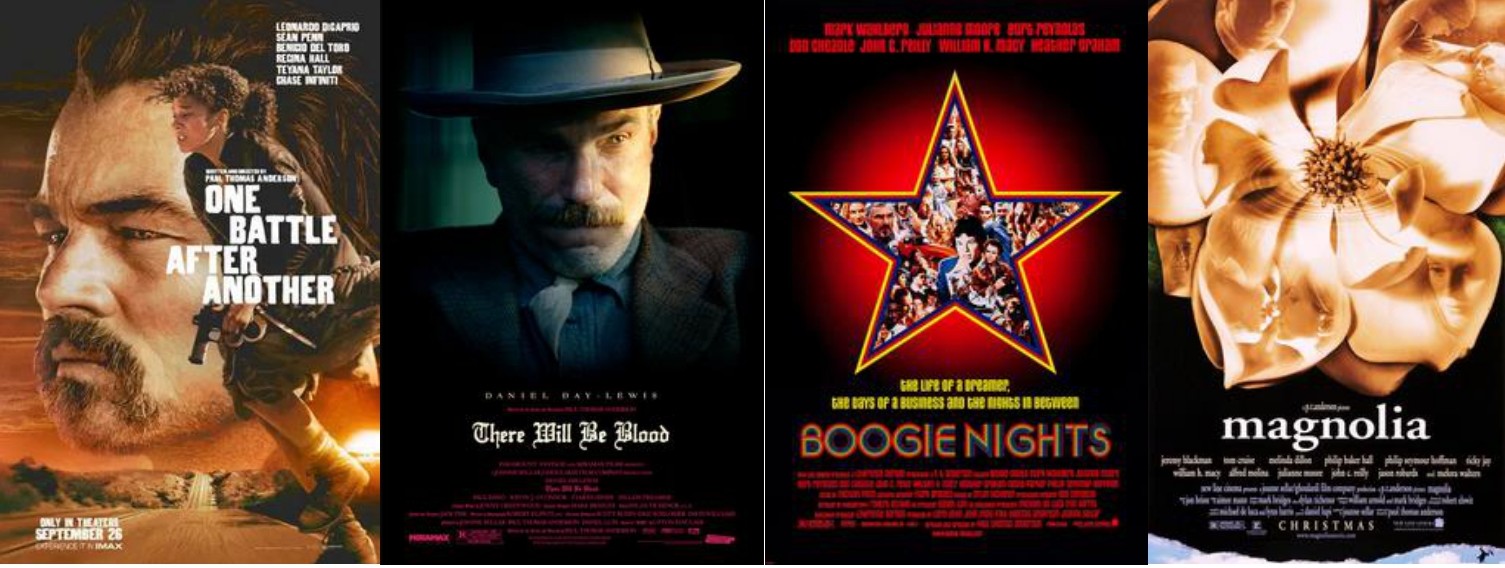
We recently spent a month exploring the work of Paul Thomas Anderson, watching Boogie Nights, Magnolia, There Will Be Blood, and the recent One Battle After Another. Although every month is special and enriching, this month was mind-blowing!

Boogie Nights (1997), in my opinion, was the weakest one of the lot, maybe because it is the oldest. Still, an amazing cast that works beautifully together —Burt Reynolds, are you kidding me? Here you see the seeds of what will become PTA’s signature moves.

I remember seeing Magnolia (1999) alone in a long-ago-lost movie theatre in Madrid (Cine Bogart) and being amazed at the cris-crossing narrative, Tom Cruise’s performance, Julianne Moore (who also nailed it (metaphorically, and literally, if you know what I mean) in Boogie Nights), and Philip Seymour Hoffman, among others.

There Will Be Blood (2007), I also saw when it came out, and I remember being amazed at Daniel Day-Lewis’s performance, but then again, who wouldn’t be? This is a masterpiece of cinema. With Daniel Day-Lewis, you do not need the clutter of layering narratives; he takes care of the film, based on a Upton Sinclair novel.

Finally, the very recent —I only missed it in theaters by a few days— One Battle After Another, with a flawless performance by Leo DiCaprio, although (sorry, spoiler alert) Sean Penn unexpectedly ends up stealing the film. This film beautifully encapsulates PTA’s evolution, masterfully blending drama with subtle comedic hits. The film shows a more mature, minimalist approach, ditching the multiple story lines to focus on the protagonist and antagonist (you figure out which one is which!)

There is a driving thread in all those films; they all deal with family, particularly messed-up families (Which I would dare say is most of them!): surrogate families, broken families, children adopted for profit (literally), etc. Paul Thomas Anderson, if you are reading this, I have a therapist who is probably cheaper than making all those films….

Here is to another five years of Film Club!

The old cine Bogart in Madrid

Film news (revisiting Iñárritu and Tarantino, and discovering Penn)

PC: The Top 100 Project

PC: The Top 100 Project

After many years of not watching any films, I am slowly catching up on my film viewing. This Christmas break was particularly fruitful in that respect.

When I thought of writing about my recent film experiences, I realized I have actually used this blog for a total of seven posts about the seventh art (my readers love my humor). Antonioyrocinante started in 2011 but my first film post is not until 2015 (which proves my film viewing drought). If you are so inclined, you are welcome to look up my posts on:

The Man Who Killed Don Quixote by brilliant ex-Monty Python Terry Gilliam

Almodovar

Wes Anderson’s Castello Cavalcanti (technically an ad for Prada)

Jojo Rabbit, a satire on Nazis

Torrente, el brazo tonto de la ley

Casablanca

Wes (Anderson) and Woody (Allen)

My recent “discoveries” have been from some of my favorite auteurs and a new one!

I have been a fan of Alejandro Iñárritu since his 2000 Amores Perros and have not missed any of his films: 21 Grams, Babel, Rudo y Cursi, Biutiful, Birdman and The Revenant.

On the Tarantino front I am lagging a bit, not having seen his last two works The Hateful Eight (2015) and Once Upon a Time in Hollywood (2019). I did, however, recently view Inglourious Basterds and loved it! What I enjoy about Tarantino is the almost comic book graphic aspect. While Almodovar plays with color to imbue his films with texture and depth, Tarantino uses them to contrast the scene, which tend to be very dramatically framed – like they would be in a comic book. Other films like The 300, Sin City or some of the super hero genre use this comic book approach, but in these cases it is very much a literal use of comic book visuals.

From a narrative perspective Iñárritu tends to use overlapping and intersecting stories, whereas Tarantino bets for a more twisty turny story. Either way, the viewer is in for a roller coaster ride!

One key element all of these directors share – and I did mention it before on my Woody Allen post- is their abilities to squeeze the maximum out of their actors. For example: Tarantino with DiCaprio or Brad Pitt in Django Unchained and Inglourious Basterds, and Iñárritu with Michael Keaton or Javier Bardem in Birdman and Biutiful.

My recent discovery (although the movie dates back to 2007, sorry) has been Sean Penn as a director. It is not unusual for intelligent, restless actors to get behind the camera, and Penn is no exception. Into the Wild is a straightforward enough story with a proper beginning, middle and ending, but Penn does a great job of telling that story, creating suspense and emotion. Although I have not read Jon Krakauer’s book, Penn does a fine job of telling this story.