Don Quixote’s influence on Existentialist philosophy

This has taken me a couple of years to bring to the Interweb. The idea of publishing my thoughts in an academic journal kept me from using my own blog as a platform. Now that I have some distance from the ivory tower that is academia, I feel liberated enough to use this humble vehicle to say my thoughts.

The idea is quite simple: The Danish philosopher Kierkegaard (1813-1855), who comes up with the idea of existentialism, even if not in those words – he is known as the grandfather of existentialism –, was a fan of Cervantes’ Don Quixote, writing extensively about him. Kierkegaard influenced many of the philosophers who came after him: Friedrich Nietzsche, Miguel de Unamuno, Martin Heidegger, José Ortega y Gasset, and eventually Jean Paul Sartre (although it would be fairer to say Simone de Beauvoir) who finally came up with a formal theory of existentialism. Unamuno relied heavily on Kierkegaard and on Don Quixote to form his theories.

In 1605 Cervantes creates a man who decides to live life by his own rules. Bored with his bourgeois life, he becomes a knight in somewhat shining armor. Don Quixote is a celebration of free will with all the beauty and issues that that carries. Therefore Don Quixote is the great-grandfather of existentialism. As you will be able to see from the bibliography, remarkably little, if anything has been written about this topic.

This is my Master’s thesis which I wrote in 2008 at Simmons College in Boston, for the great professor Louise Cohen. It has not been peer-reviewed, which is not to say that this paper is any good, it is not. If you have read any of my work on this blog before, you know I write like a horse’s ass. So read at your own discretion. Oh, haha, FYI it’s in Spanish.

el-existencialismo-en-el-quijote

(Belated) Summer Summary

You guessed it, things have gotten pretty busy again, enough to postpone my Summer Summary into November. Not that anything earth shattering happened over summer, but still, I enjoy writing and reminiscing about it.

Summer started with a bit of a rush. I only had one week between the doctoral hooding ceremony and the movers coming in to take my few possessions to Florida. They arrived on Tuesday and I drove through torrential rain into Naples in one long day. Wednesday we emptied the truck. Thursday I opened some boxes and did some paperwork at my new school, Seacrest Country Day. Friday I drove to Miami for a flight to Madrid. Saturday morning I arrived in Madrid in time to go to my nephew’s First Communion.

The month of June was spent in Madrid, visiting friends, walking around the city, going to my favorite gym, exploring great art exhibits, taking my niece and nephew to Bernabeu stadium – for their first time – to see the old glories of Real Madrid beat the old glories of Ajax Amsterdam. As much as I love all cities, Madrid is home, it is the city I know best, and she knows me.

It felt odd to go to Mallorca without my father, but we still managed to enjoy it. The beach, the pool with the children, siesta on the balcony, evening walks, the food, beautiful village church on Sundays, running in the pine forest with the Mediterranean in the background, great people at the hotel, watching the Euro cup with my nephew Jimmy, relaxing gin and tonics at night in the bar. The whole experience is very special.

July was in the country – more and more like suburbia each day – at La Navata, great friends, wood fired paellas, cigars and drinks with my sister at night, great little village church on Sundays, a lot of work on the garden, rural outdoor gym, long bicycle rides on my vintage mountain bike, classic bar for coffee in the morning, and as always, a couple of visits to El Escorial with my dear friend Patxi.

August 1 I was back in Florida and ready to start a new school year.

The people of academia (The good the bad and the ugly)

20151030_153936

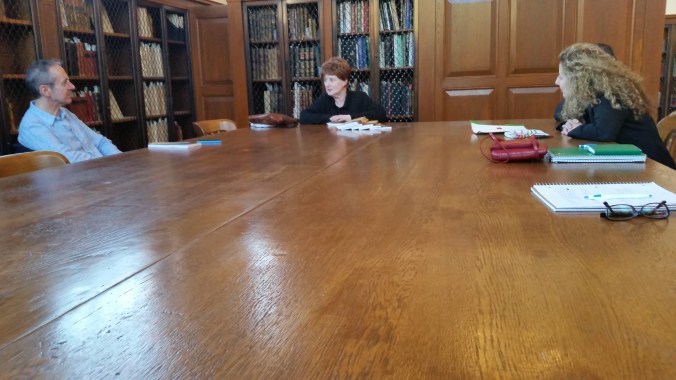
The beautiful, wise, awesome, funny Prof. Valis presenting her novella at UNC

My dear Kierkegaard explains how a person’s life goes through three stages. Simply stated: the young aesthetic where everything revolves around the ego, the more mature ethical stage where we concern ourselves with what is right and wrong and hopefully and eventually the religious stage where with some wisdom gained from pain and loss, we realize that it all boils down to love and giving and forgiving. These three stages of maturity are evident in academia. You find the young guns that know all the big words and trendy phrasing to write brilliant articles and books that say very little, but show off their brilliance. The ethical writers where everything is correct but boring, and a handful of scholars that “get it” and go beyond the big words or the correct arguments to delve into the spiritual.

Of course if you are in the aesthetic phase yourself, then you cannot see beyond the ego and the writing that caters to that. You think that the young, hip professor is the bee’s knees. It takes time, but more importantly spiritual growth that will only come from hardship to get to the religious phase.

During my time in the upper echelons of academia, I was able to experience this division in the quality of scholarship. Seeing these ego driven scholars, it is easy to understand the anti-intellectualism in vogue in certain social circles.

Flip the coin, however, and you find some of the nicest, most brilliant, most humble people around. I was blessed to have had some of those enlightened folks in my department and in my doctoral committee. I also got to meet some fantastic professors that came to present their work at Carolina.

David William Foster is one such fellow. Never mind that he is the Regents Professor of Spanish and Women and Gender Studies at Arizona State and President of the Latin American Jewish Studies Association, blah, blah, blah. He is a deep, brilliant, understanding person. I was honored to show David around UNC’s beautiful campus and then we went to lunch with two other colleagues. I did not want that lunch to end! It was funny, insightful, thought-provoking, just a pleasure.

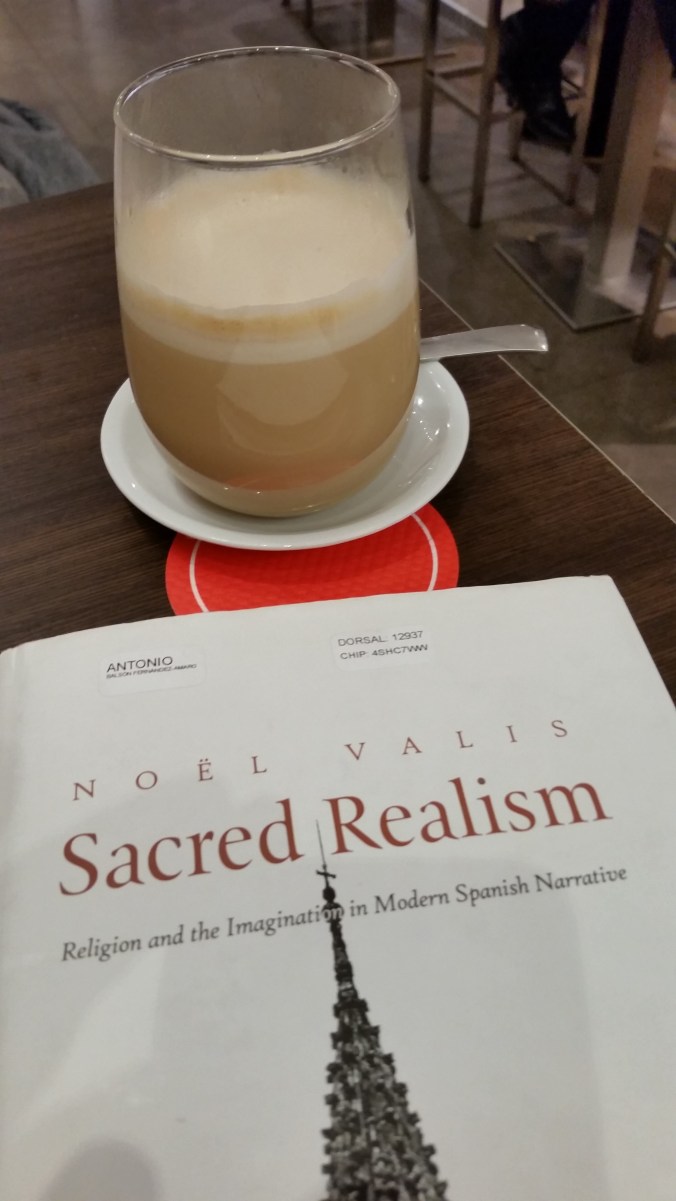
Another such person is Noël Valis. Yes she works at Yale and has published a shelf full of books and articles, but more importantly, she “gets it” she understands humanity in all its difficult intricacies, our weakness, our idiocy. I was working on my dissertation most of the time Prof. Valis was at UNC, but I eventually managed to go to her presentation of her own book of fiction: The Labor of Longing. After that intimate and enlightening (sorry to use the same word twice) chat I had the privilege of showing her around campus. For a glorious North Carolina autumn Friday afternoon we walked and talked and I did not want that walk to end, I kept adding bits to our tour, until I had to let go of her.

I could go on and on about marvelous professors that enrich academia and the world. I have already talked about the ones on my Doctoral Committee on other posts. On the other hand I could also talk about ego driven, academic climbers, more interested in publishing their work than on what is really in that work. Unfortunately not all the latter will eventually become the former.

20151218_121858

Enjoying one of Noël’s books with a cafe con leche.


On the importance of mentoring

The moment we learn a skill or acquire any knowledge or wisdom it is our responsibility to share it with those younger than us. Not doing so would be a selfish waste of that skill, knowledge or wisdom. I came about mentoring by the same circuitous and unknown to me way as most things happen in my life.

My college years were incredibly constructive: I wrote a column for the school newspaper, I had the classical music program at the radio station, I was president of the International Club, I was International Student representative to the Student Government, and my senior year I was appointed Student Government representative to the Board of Trustees. I sat next to a sweet old man, who by means of his mystical powers, realized I badly needed some guidance in my life. Thus, unbeknown to me I had my first mentor. Jere Dykema was a quiet, sweet and brilliant lawyer and investment manager in Boston. The fact that he was a trustee at Bentley means he was also well connected and probably rich. After graduation I did an internship at the Societe de Banques Suisses in Geneva, and in September of 1987 I moved to New York hoping to get a job in Wall Street at the same time as the financial markets took one of their biggest hits in history, Black Monday. Somehow Jere Dykema stayed in touch with me throughout – this was before personal computers and the interweb. After eight fruitless, should I say, jobless months in NY, Jere put me in touch with an acquaintance from his squash club in Boston. That acquaintance was Eyk Van Otterloo, and the rest, as they say, is history: he made the mistake of offering me a job, and I moved back to my beloved Boston, where I would regularly meet Jere Dykema for lunch. That is when I realized the importance of mentoring.

After a few years I moved back to Madrid to work for a stockbroker. We soon received a young college graduate from Atlanta on a one year internship. Sure we became good friends to this day, but more importantly I could help him get his professional “sea legs”. From that point on there was always someone I could help out. When I started my company in 1994, one of my biggest responsibilities, but also pleasures was training, coaching and mentoring my team, I loved it. Becoming a teacher in the US also meant automatically becoming a mentor. Advising students is a great way of putting my 20 plus years of business experience and my 50 (soon plus) years of life experience to good use.

In the photofinishing industry I was again lucky to find wonderful advisors. Although Renaud lived in Paris, he still helped and advised me, and made sure I was ok. I loved working with him and knowing that he always had my best interest in mind.

Back in the States, strangely enough, an old university professor became my mentor. Twenty years after teaching me, and having stayed in contact all these years, Prof. Nurick and his wife Diane became friends, advisors, mentors. I still remember conversations and advice they gave me. Being a Tar Heel himself, Aaron Nurick wrote a letter of recommendation for me to UNC, I don’t know what sort of lies he wrote, but it worked, they accepted me!

At UNC, other than with my students, I had a couple of great mentoring opportunities. We had the chance of guiding the graduate students that came into the department after us. My first year I had the best possible mentor. Grant Gearhart took me out on nice long bicycle rides where he patiently explained the ropes of graduate school to me. As expected we became close friends. Starting my second year it was my turn to help an incoming student. The Newman Church also had a mentoring program, so I also got involved with that. I was paired with Mauricio and Simdi, they were both great. We would meet for a meal, mostly sushi at Akai Hana, my favorite place in Chapel Hill (actually Carrboro). Mauri graduated and Simdi and I continued our tradition of meeting for great meals and chats.

Part of the beauty of mentoring is that there are as many different styles of mentoring, as there are mentors. Some mentors are so subtle you do not realize you have been mentored until after the fact. This was the case with Dean Minetti who was such a presence during my college years, but I did not understand how he had helped me out until much later. Other cases might be more obvious, which was the case with my father.

As I am about to post this, I am happy to report that my new school, Seacrest Country Day School has a faculty mentoring program, and I am thrilled to have the awesome Patrick Duffy as my mentor.

I hope my help and guidance advice have been of some use to those I have shared them with over the years. I can’t wait to continue helping those younger than I.

Rocinante’s 10th birthday

Despite being Rocinante’s 10th birthday, it has not been her best year. We can blame my PhD for that. For the last four years I basically only had time to ride to Trader Joe’s for some groceries, or for a quick ride (about half an hour each way) to lunch in beautiful Hillsborough or Saxapahaw, although mostly we would just ride to Five Guys just outside Chapel Hill. The only trip we made was to explore the North Carolina seashore, at the end of my first year at UNC in the spring of 2013. After that, between my dad getting sick and the pressure of my studies, there were no more long rides.

Although we would have loved to ride down to our new home in Naples, Florida, there was no money for the logistics, nor the time, if I was to make it to my nephew’s first communion in Madrid. Rocinante just rode inside a truck with the rest of my few belongings.

But we have great plans for our new life in Florida. Starting with a leisurely exploration of the Keys, a trip I have wanted to take for years, ending in Hemingway’s home in Key West. Then there is the West Coast and the East Coast, even “the panhandle” to explore. All very exciting.

The winter of 2006 was a tough one for me: I was still dealing with having closed my company in Madrid, with moving to the US, with not making friends. I was struggling with my first year teaching at a public school, and I was looking forward to Tracy getting well after her long sickness. I have been riding since I was 14, so getting a motorbike seemed like a worthwhile hobby to get me out of that slump

. I did a lot of research, made a few visits to Boston Harley Davidson, and had a massive tiff with Tracy. Ten years later I can safely say Rocinante saved my life.

So hopefully Rocinante will forgive me for my neglect over the last four years.

Don Quijote, 400 anniversary of Cervantes’ death, and conference panel time management

April 23rd marked the 400 anniversary of Cervantes’ death. UNC had two great events to celebrate, and as a Cervantes and Quixote fan I am very happy and proud to have participated in both.

The 22nd Annual Carolina Conference for Romance Studies hosted the “I Am Quixote Festival” panel… and I was asked to be the chair! Needless to say, I was thrilled to be asked and I jumped at the opportunity.

Given the importance of this 400 anniversary the conference room was packed, and the panel was filmed. The panelists were Alexandra Veronica Combs from UNC-Wilmington who presented on “The Heroines of the Quixote who Challenged Narrative Structures”, our own Colleen McAlister, who presented on “Violence and Fame in the Quijote: Corporeal Manifestations of the Search for Identity”, and finally, University of Texas at San Antonio professor Santiago Daydí-Tolson, presenting on “The Contrasting Diets of Don Quixote and Sancho”. They were all awesome and great sports to boot. I must confess I was as proud as a schoolboy when my Dissertation Director, Irene, came to the event. In case things got out of hand, I picked up a copy of the Riquer edition of the Quijote.

One of the main responsibilities of a panel chair is keeping the panelists from exceeding the time limits. This is always a delicate matter that can – if the panelist ignores the time limits – result in awkward situations. The problem is that it is also difficult for the chair to elegantly interrupt the panelist to let them know that they are running long. Of course part of the problem with this is the culture of these events where the panelists just sit there and read their papers, it would be much more interesting and fun if they just talked about their research! But that is not something I am going to change regardless of how wildly popular my blog is. I thought long and hard about how I was going to deal with my panelists if they ran long. The solution came from football (soccer if you are American). I bought a yellow and a red piece of paper and cut them down to card size. The first warning when the panelist was approaching the time limit I would slide the yellow card under their noses, sorry, eyes. If they still kept going, We would pull the red card, just like in football!! Fortunately, or unfortunately my panelists stayed well within their allotted time and I didn’t have to use my revolutionary new technique.

The second event was a marathon reading of Don Quixote. For this event my whole class signed up to read (ok, I bribed them with a free class period – but it was well worth it – and they all read in Spanish, in front of an audience). You can see them all read on the attached video, my bit is at 5:08:50. For this event I sourced a real suit of armor from a great theater costume shop in Raleigh and wore bits and pieces as Don Quixote, it was a great way to promote the event and it was a lot fun. As luck would have it I read the hilarious bit where Sancho is tossed in a blanket at an inn while his master looks on from outside the inn’s wall. I was – as I always am – reminded of how funny, brilliant, clever and well written this book is, and how fresh it remains at 400 years old.

Now, if you have not done so already, go read Don Quixote, the first modern novel, it makes a great summer read, extra points if you read it in Spanish.

Don Quixote Marathon reading at UNC

The Ackland Art Museum

20160110_130721

Francis Bacon, Study for Portrait VI (1953)

In my four years in Chapel Hill, I have mentioned it in passing and I have written about my girlfriend Melanie de Forbin-Gardanne by Jean-Louis Le Barbier but I have not dedicated a blog entry to one of my favorite spots. The Ackland Art Museum. That needs to change.

20160403_132344

My Sunday morning ritual

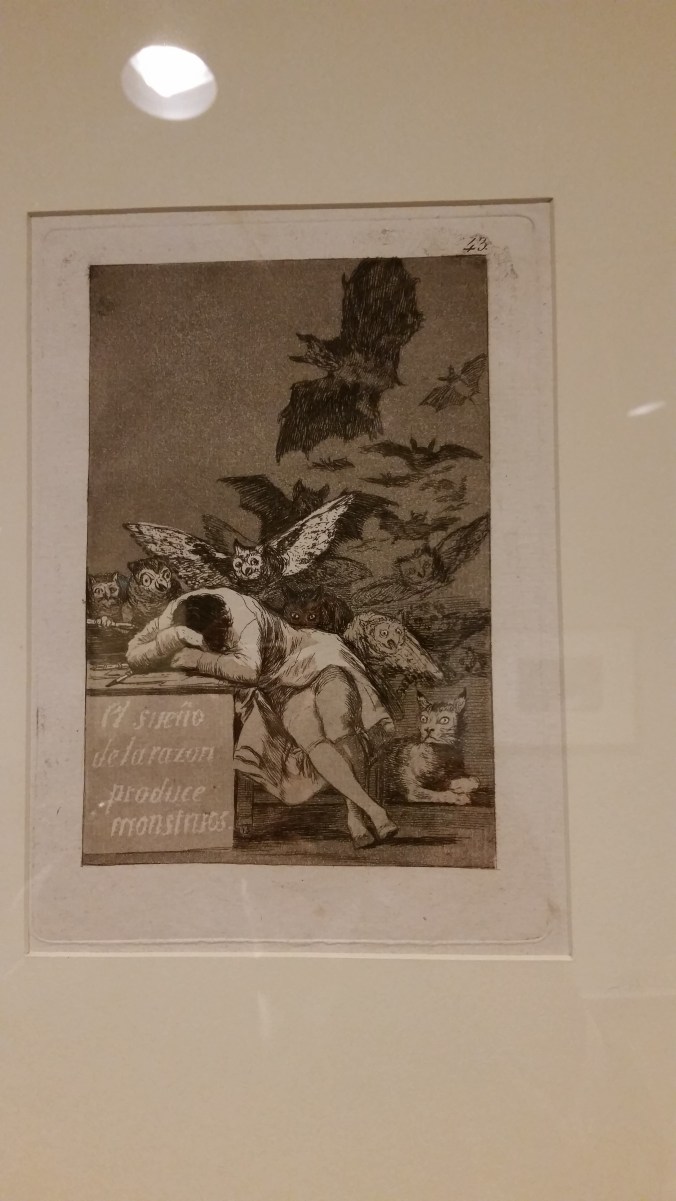
I discovered the Ackland in 2012 when I went to visit UNC during my Spring break from BB&N. I remember walking upstairs and coming face to face with some Goya prints from the Caprichos series. My mind was blown. Those prints let me know that Chapel Hill might look like a southern college town, but that it has some cultural weight. It was a deciding factor in my going to UNC.

20151025_132507

El sueño de la razón produce monstruos. Goya

Once school started, I discovered that walking home after Sunday mass I passed the museum. My Sunday morning routine was set: church, coffee and reading across the street at the beautiful Carolina Inn, and then walk to the museum, walk around and sit and read with Melanie. I know I am going to miss my Sundays in Chapel Hill.

20151021_083228

My girlfriend for the last four years, I’m gonna miss you Melanie!

This year was a bit special, the museum had an exchange loan with the Minneapolis Institute of Art, and we had Francis Bacon’s Study for Portrait VI, based on Velazquez’s Pope Innocent X. It was a pleasure to enjoy it all year long. The painting reminded me of Pierre Boulez sur incises that the Ensemble Intercontemporain performed at Memorial Hall. The piece is one, total and complete, but you have to use your imagination to “fill in the blanks”. The blurriness of the Bacon painting is also very tactile, like it was smudged. Another thought on the painting is that it is the real portrait of Pope Innocent X, it is what Velazquez would have painted if he could really represent the guy he was painting: a shifty, double faced, shrewd politician, a warmonger pope with a mistress – that might be why Bacon paints his own bedframe in the background of the painting.

For four years I have taken all my classes to the museum. We see the Spanish and Hispanic art (Picasso, Carducho, the Goyas, one of Korda’s original Che prints, etc.), I also took my French class when I taught French, and there is a wealth of French artists in the Ackland. When I was my Dissertation director’s Graduate Research Assistant for her 18th C. literature class I organized a class at the museum, and they set up some of those Goya prints in a special classroom they have. It was a great experience.

20151025_133112

Picasso print

After four years, I got to know the staff, the security personnel, the student employees, they could not be a nicer group of people! Professional, attentive, kind, funny, just great. I have always been a fan of the smaller, more intimate museums like the Sorolla or the Lazaro Galdiano in Madrid, the Isabella Stewart Gardner in Boston or the Frick in New York, so now the Ackland joins that list!

On the importance of culture, art, and beauty.

If we do not take time to appreciate beauty, how are we spending our time? This year has been another remarkable year for art, culture and beauty in Chapel Hill. It is a town with an exquisite taste for that which is beautiful. I have been lucky to enjoy that, even when in the stress of finishing my dissertation I had to miss some great performances.

The season started for me with Juliette Binoche, of whom I have been a big fan since the 80s, playing Sophokles’ Antigone in the T.S. Eliot translation, what a presence! I love strong women (now you know my vote for November 8).

UNC artist-in-residence, violinist Gil Shaham played Bach’s six violin solos. I think I still have goosebumps.

Two days later Shaham played Verdi and Tchaikovsky with the UNC Symphony.

As I become older, I have become more and more selective in my taste, but being a lover of the Portuguese Fado, I went to see Mariza, It was very nice, although I miss the tavernas in Alfama.

Another highlight of the year was listening to Riccardo Muti, directing the Chicago Symphony’s Beethoven’s Fifth and Tchaikovsky’s Fourth. Of course as an encore he regaled us with some Verdi!

In November I saw The Ensemble Intercontemporain play some modern pieces. Pierre Boulez’s sur Incises for three pianos, three harps and three percussion blew my mind. Rock and Rollers talk about Phil Spector’s “Wall of sound”, I have also heard it mentioned about Brian Eno and U2, but this piece is more like a tactile wall of sound, like a curtain of sound. Watch for yourself and tell me what you think in the comments section!

Before the Christmas break, I saw the great Carolina Ballet’s Nutcracker. Don’t mess with tradition.

Gil Shaham performed again in February, playing Prokofiev and Beethoven and I got to go with my composer friend, James.

After defending and delivering my dissertation I managed to catch a few more great events. The evening my dissertation was accepted by the Graduate School, I rode old Rocinante to a nice opera recital in Durham, Talya Lieberman sang a fantastic mix of Handel, Ravel, and Kurt Weill. Brava!

Back at UNC’s Memorial Hall I saw Les Arts Florissants perform a repertoire of Baroque Serious Airs and Drinking Songs. What a brilliant way to say farewell to four great years of jaw dropping concerts at Carolina Performing Arts.

Again with my dear friend James, we saw the North Carolina Symphony perform Handel, Haydn and Stravinsky’s modernist masterpiece The Firebird (1919).

On the theater front I saw not one, but two, Chekhov plays: Three Sisters and The Cherry Orchard, which the last time I saw performed was by my students at the Walnut Hill School for the Arts! I also snuck in one musical: Sweeney Todd, lovely Gore!!!

Of course I always support students’ productions and concerts which included two operas, the UNC Baroque Ensemble, the UNC Symphony Orchestra, and the University Chamber Players.

All in all, an extremely rewarding season, the likes of which I do not foresee enjoying in the near future.

The Job Search Part II, looking for jobs in secondary schools.

Since I had taught high school for seven years before embarking on my PhD., I knew I loved working with that age group and in my heart of hearts I understood I was to go back to teaching them.

Back in 2011, in case I didn’t get accepted into a doctoral program, I contacted Southern Teachers Agency to help me look for teaching jobs in the South. I loved working with them, although I did get into UNC. So this time around I contacted them again, and I could not be happier with how they worked with me to find the perfect job. In fact, Southern Teachers was the only venue I used to seriously look for a job teaching secondary school Spanish.

Things took off right from the time I signed up with them. I did a very promising Skype interview in November with a boy’s boarding school in the mountains of North Carolina. During Christmas break, an all girls school in Chattanooga Tennessee booked me to go interview with them as soon as I got back stateside, which I did. They put me up in a beautiful hotel in downtown Chattanooga, and the morning of the interview I was picked up by the head of facilities,  which I found a very telling gesture. Unfortunately, things did not pan out that well later, as I was pretty much abandoned halfway through lunch to walk myself out of the school, disappointing. In January, Southern Teachers held a job fair in Washington DC, which coincided with me having to do some paperwork at the Spanish Consulate (that story is for a different blog entry). During this fair I met and spoke with many schools all over the South, but my most rewarding conversation was with a school in Florida. Our pedagogical ideologies clicked right in place, I was very impressed that there was a school that was not obsessed with AP exams, “we tolerate them” was their precise wording, preferred not working with textbooks, and so on. My cup of tea precisely.

As winter progressed I had many phone and Skype interviews, I also had to take days off to go interview at schools. This, besides requiring a lot of time, was unneeded in many cases, like when I had to teach a sample class at a school in Charlotte, North Carolina only to not be hired because “I did not use technology”. Of course this was what they call a “tablet school” where every student has a tablet and thus they are slaves, victims, to the technology. It did not help that they had given me a really bad unit to teach, with very little “meat” and a bunch of vocab – which I am against, vocab is hard to memorize and easy to forget. I was a bit disappointed at first that they rejected me, but when I realized that the best teachers in history: Socrates, Plato, and Jesus only had a stick in the sand as technology, I realized it was not me who was in the wrong. The plus side of these school visits was that I got to visit many places I did not know: Chattanooga Tennessee, Charlotte (twice), Asheville NC, and eventually Naples Florida, for that school I had been so impressed with at the job fair.

During my dissertation defense, after many interviews, and with a few offers on the table, Seacrest Country Day School in Naples Florida left me a message with an offer. Against all prognostications, that was where, surprisingly, my heart had been since that original chat in January.

The Job Search, Part I. University gigs, or what do Galileo Galilei, Einstein and Groucho Marx have in common?

Finding a job has been a fairly lengthy and tedious process, so I will break it up into two parts: Applying for university teaching positions, and Part II, looking for secondary school jobs.

Applying for that endangered species, the elusive, under paid, tenure track, university teaching job is quite a silly process, one basically has to start in the fall of your last year as a student. Although this is not entirely true, as we shall see… I was all geared up to join the ranks of the job seekers in August when the first question popped up: How many academic articles have you published? And where? Well, I did try to publish one a couple of years ago, in the fairly respected Boletín de la Biblioteca de Menéndez Pelayo. It was rejected, and I decided to move on and focus on my dissertation, which I deemed far more important than publishing anything. As usual, I was wrong. Tenure track university positions are so scarce nowadays that it is totally a buyers’ market, they get to set the rules. Also basically all universities are strapped for cash which is, as we shall see another crucial factor. So what one has published and where becomes a key deciding factor, who cares how good you might be as a teacher.

You see, years ago, I think it was my old Bentley College Dean and dear friend and mentor Bob Minetti explained to me how you have the big research focused universities and the “student centered” or “teaching centered” universities. This made perfect sense to me and it is what I have assumed as true ever since. Being passionate about teaching I figured these would be the schools I would apply to, that might value more my worth as a teacher than as a publishing machine. Now, with the cash crunch and oversupply of applicants, universities basically want candidates that have already published top articles in top journals, this is what will bring prestige, and thus money to their institutions. So do not believe the “student centered” or “teaching centered” spiel. That might have been years ago, they still preach that concept, but believe me, it looks like they could care less.

Besides the article business they want to see a Statement of Teaching Philosophy, a Research Statement, mock syllabi, etc. This is just a smoke screen, a distraction from what they really want. I am confident that if you have an earth shattering Teaching Philosophy Statement, and the best crafted (mock) syllabus, unless you have published at least one article in a respected, peer reviewed journal, you are nothing. They do not care about your teaching, if they do, it is not their priority. Which brings us to the fallacy of the teacher/scholar. Universities like to boast of their teacher/scholars. It is a very rare occurrence in nature to find a leading scholar who likes to spend hours, days in libraries, reading, writing – a rather lonesome job – I can guarantee you, who also loves to be in the classroom teaching and sharing what they are learning in their research, this requires a very different skill set and personality from the research oriented person. One is really either a teacher or a scholar, with maybe one in a hundred having both characteristics. My graduate school experience both at Simmons College (a small liberal arts school) and at UNC (a top research university) prove this point. So, to summarize, if you are looking to work in higher education, you have to ask yourself: am I a researcher or a teacher? Which is basically the ancient Greek saying from the Oracle at Delphi: “Know thyself”.

Going back to the academic journal issue. Basically the academic journal is nothing but the ID card for a club. One has always needed an ID to get into a club. Now, this is my theory: originally the universities taught in Latin. This was what set the educated from the masses. If you wanted in, you had to master Latin, sure, this was a lingua franca, but it was also a proof of membership, of how bright one was. Latin started losing its grip as early as the 13th C.[1] Eventually universities had to switch to the vernacular – and they are still smarting about that. So now you have to gain access by writing a long article, full of big words that you might not necessarily need, quoting second rate theorists like Lacan or Bakhtin. Remember that this is all my conspiracy theory, but then, why did Galileo Galilei publish his Dialogue for the general public and not for the cognoscenti? Ditto Albert Einstein who chose to publish his last thoughts on General Relativity in a “small journal after spurning the peer-reviewed process at a better-known journal, the Physical Review. To an editor at the Review: ‘I see no reason to address the erroneous comments of your anonymous expert’”.[2] In no way am I comparing myself to Galileo, Einstein, or Groucho Marx when he said: “I do not want to belong to any club that will accept people like me as a member”.[3]

Sorry about my rant. Now, back to my job search. Teaching two classes, writing my dissertation, preparing my job search materials, I wrote another article. At least I could say in my CV: “article submitted to…” (it eventually got rejected by an “anonymous expert” as Einstein would say).

Basically all university Spanish teaching jobs go through the Modern Language Association (MLA) job database. This year there were well over 200 different Spanish teaching jobs in the US. Most of those were for visiting professors, meaning you get a one year contract, non tenure track jobs, meaning you are “hired help” and treated as such, or for the “trendy” subjects, the ‘in vogue” topics. Of all those, there was only one posting for an 18th and 19th C Spanish Literature specialist. It was at Wake Forest, a perfectly good university. They sent me a nice email in December saying they were going to call me for an interview and another very nice email in April telling me they had chosen a candidate. I also applied to a more “generalist” position at Gettysburg College  (yes, that Gettysburg) only to receive a three line email that they had hired someone. All in all, I guess my heart was not into teaching at a university, and it showed. But I still had to “tick the box”.

This process led me to learn a few fascinating bits: I am a passionate teacher, I want to teach, to share, I love learning – from my students – not from some pompous punk that thinks they are the last Pepsi bottle in the desert because they got an article published. Universities are hiring very bright young things that might be good researchers and writers, but might not have a clue how to engage a room full of curious, sceptic students. Second: I do not want to be a member of that club, I would rather teach at a secondary school as I did in Boston before getting my PhD.

So I asked myself: At the end of a day teaching, would I rather go read an academic journal full of big words quoting Lacan and Bakhtin, or would I rather go coach soccer, tennis or fencing? The answer for me was clear, and that leads me to part II of this tirade.

[1] Paul F. Grendler. The Universities of the Italian Renaissance. Baltimore: JHU Press, 2002.

[2] Popular Science, November 2015

[3] Telegram to the Friar’s Club of Beverly Hills to which he belonged, as recounted in Groucho and Me, Da Capo, 1959, p. 321.
IMG_0866

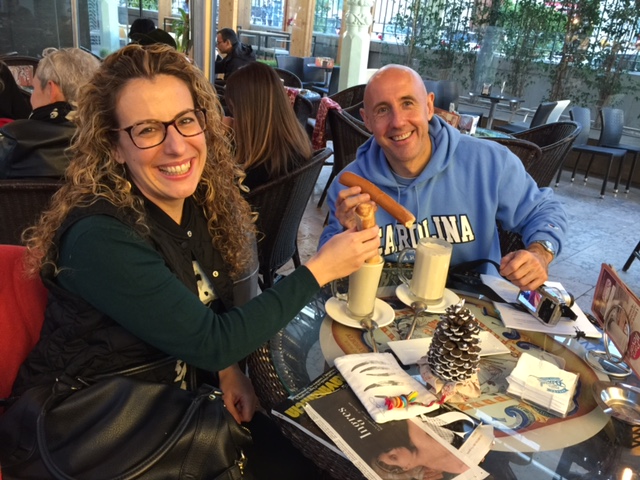
Discussing job strategies with my Dissertation Director, the one and only Irene Gómez Castellano in Valencia with horchata and  fartons.