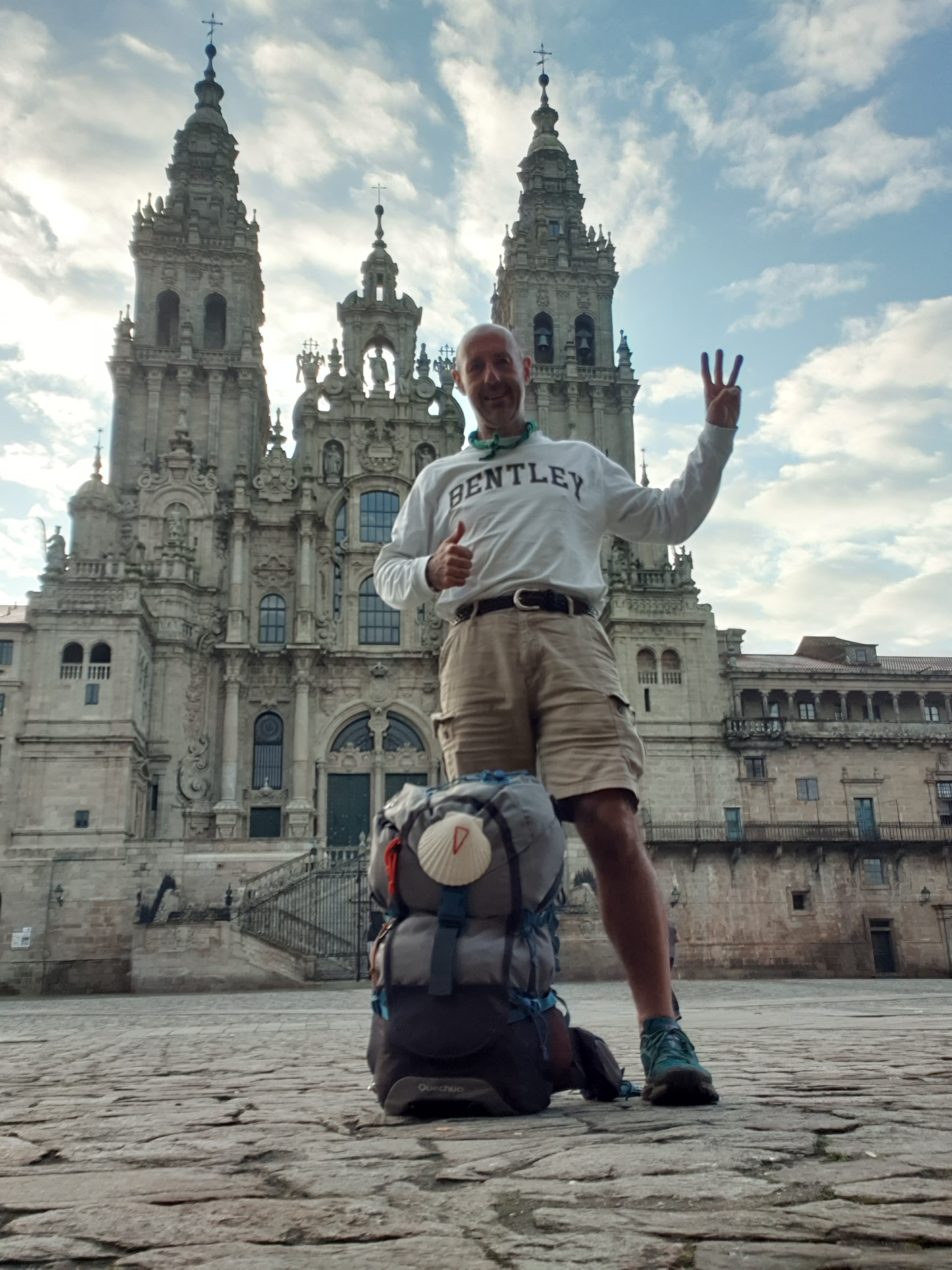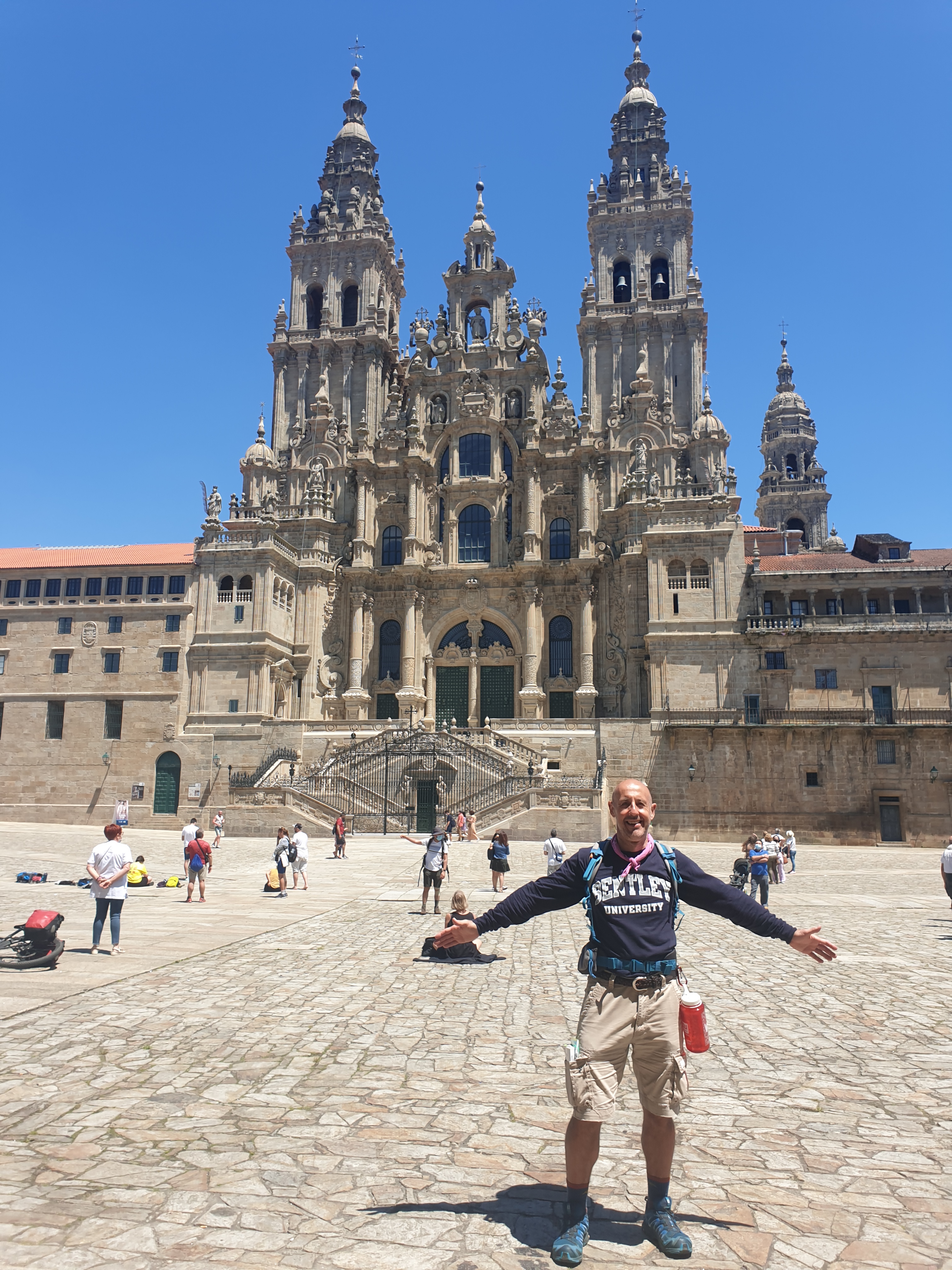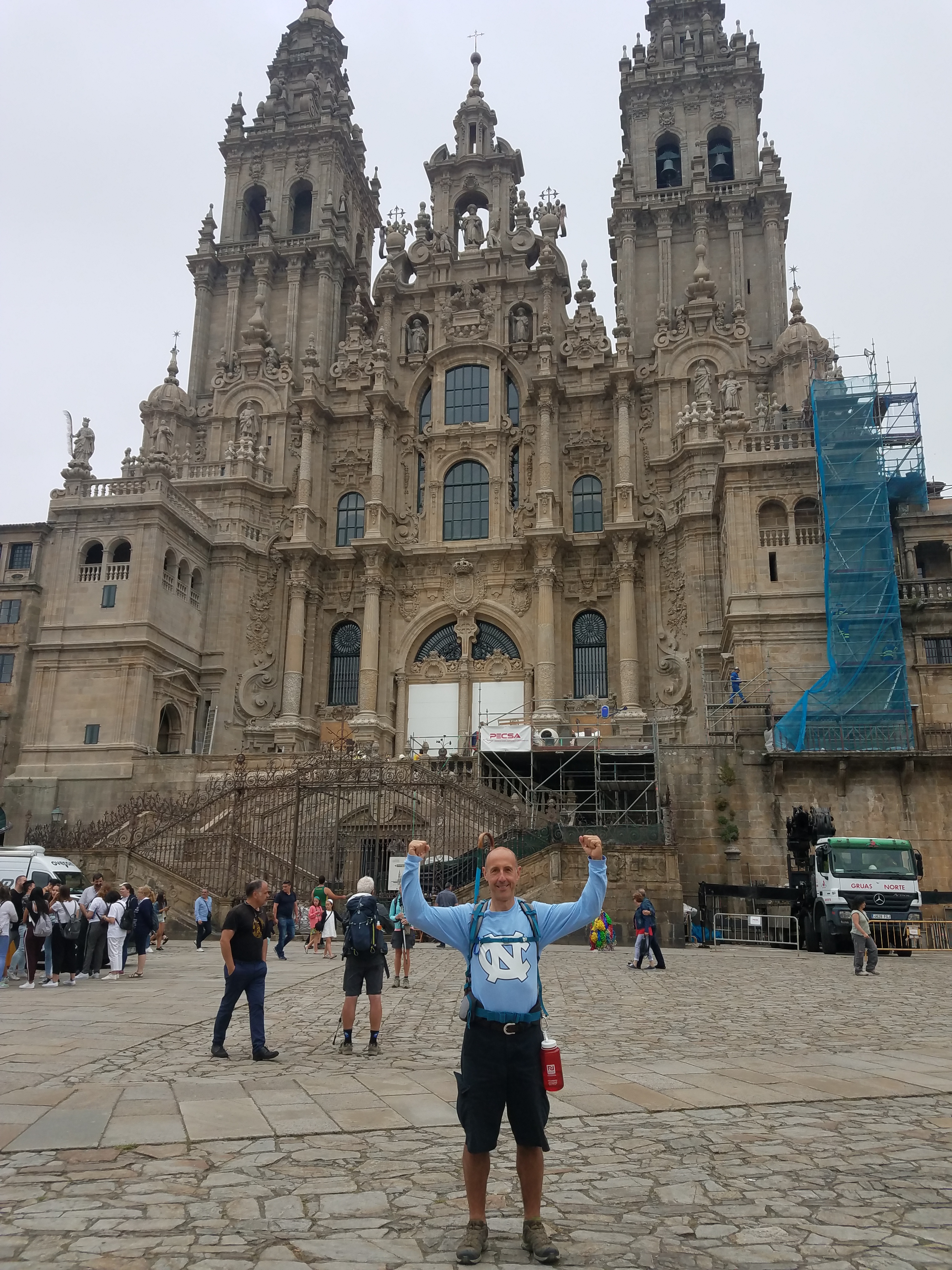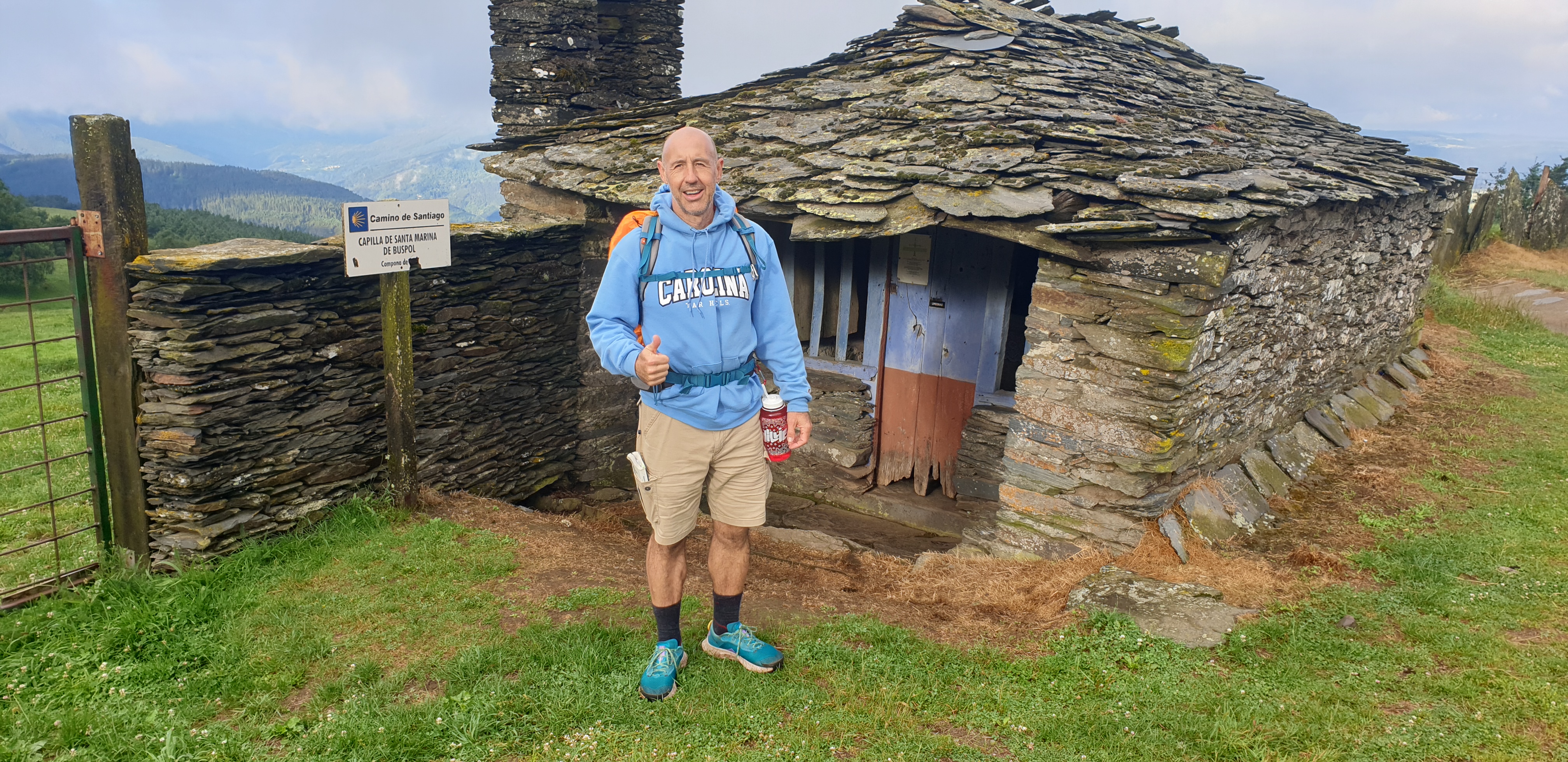
The evolution of my Camino packing

Pilgrims have been walking to Santiago from all over Europe since about the year 800, before Hoka running shoes, before high tech fibers, before ergonomic backpacks, before electronic watches that measure your heart rate, every step you take and your lymphocytes, before, before, before. So chill.

On top of that, most people walk really short Caminos, so your choices are not that critical; you are going to walk for 5 days, eating much better food at half the price of whatever you are eating at home, sleeping on decent beds, showering with decent water pressure, with a fully stocked pharmacy in almost every village you walk through should you need any medicine, and enjoying free, high speed Wi-Fi internet connections so you can post on Instagram. You will not be roughing it (unless you choose to).

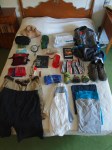
As I prepare for my fifth Camino, here are some thoughts on my packing and the evolution of my packing philosophy.

One of your realizations on the Camino might be how happy you are with so little, only with what you are carrying on your back. So packing is or should be an exercise in minimalism. Here are some thoughts:

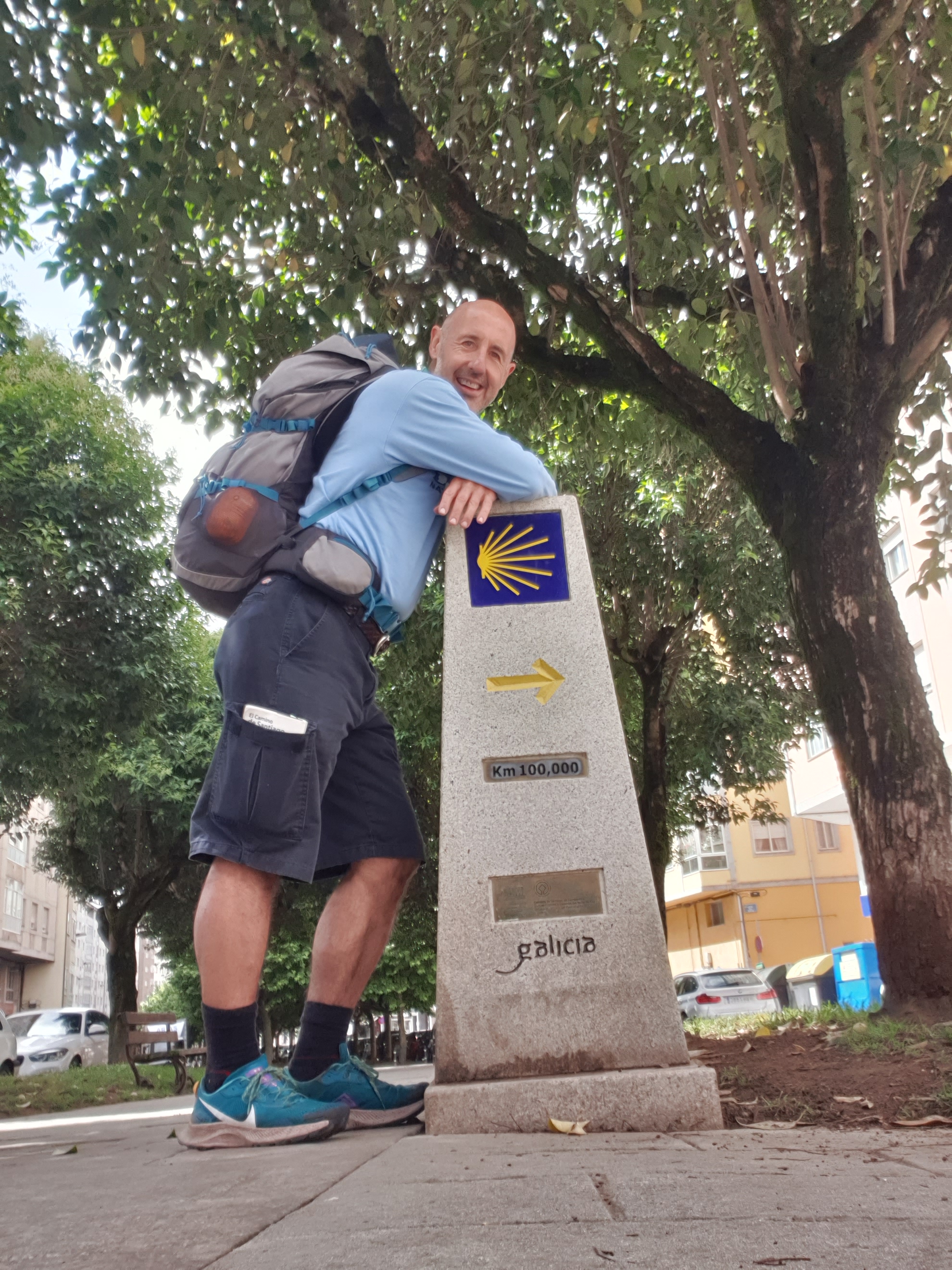
There are laundry facilities in all albergues, some might be modern washer driers, some might only have manual washing options. If you are not willing to hand wash your own socks, underwear, and t-shirt –ask yourself if you want to be on the Camino. So you do not need to pack a lot of clothes. I pack 3 pairs of wool, no stitching socks, 3 underwear, 3 (long sleeve) cotton T shirs -yes, I am a snob and hate the feel of modern fibers. 2 pairs of cargo shorts (the side pocket is perfect for guidebook, maps, etc.) and a sweatshirt. My first Camino, optimist that I am, I did not pack a sweatshirt, and it was freezing in June in Burgos, so I had to buy one!

Did I tell you I am a snob? My sleeping bag is my favorite bedsheet folded in half and sewn together like a sleeping bag. It is much heavier than a modern sleeping bag, but it is far comfier, with matching pillowcase, of course.

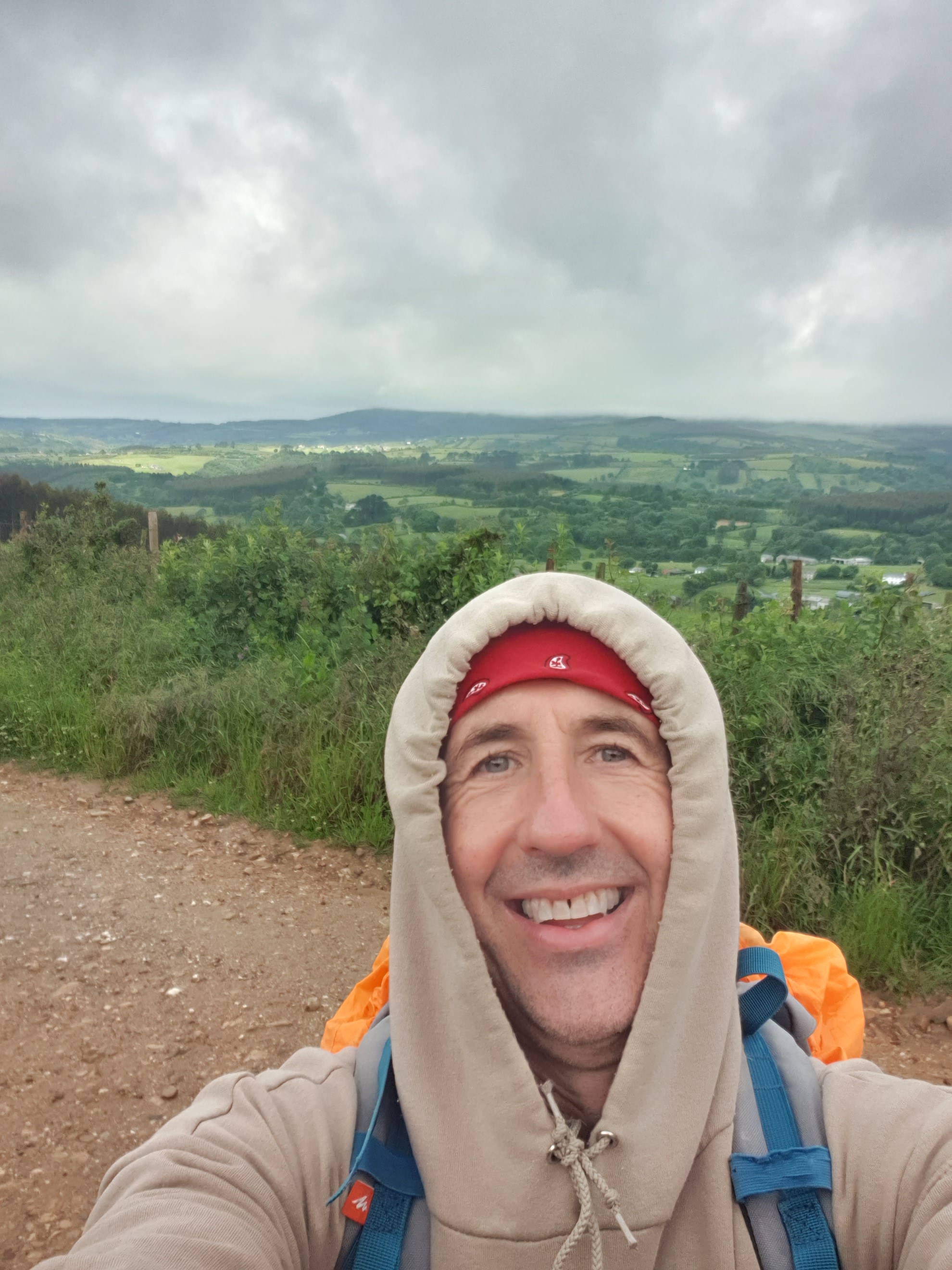
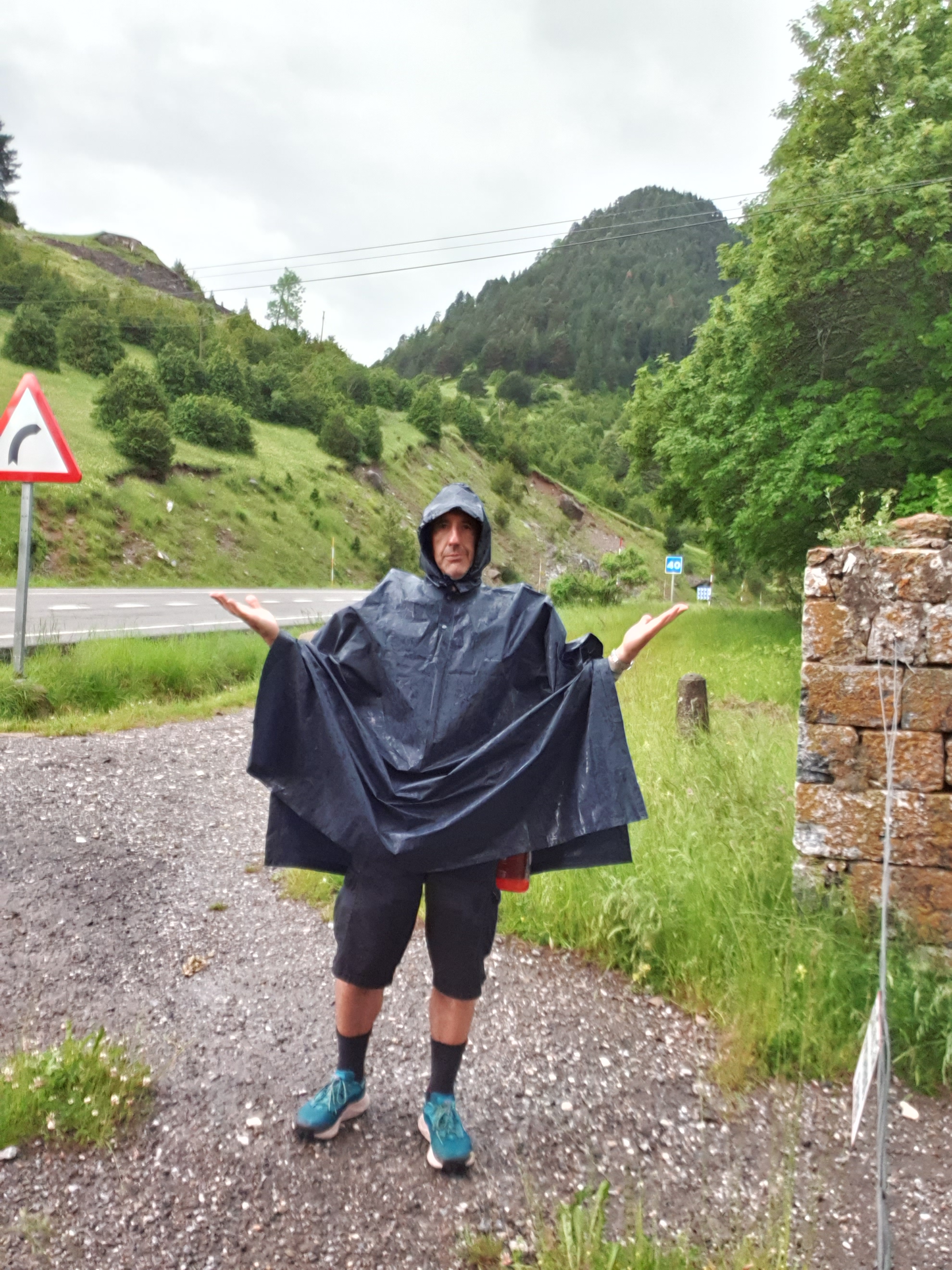
If it rains you are going to get wet. Yes, you can buy a $200 jacket that will keep you dry, good for you. For a few bucks you can have a poncho that will also cover your pack. (although you should also have a rain cover for your pack). Be ready to activate your rain protocol quickly as summer showers might pop up unannounced. (You do not want your poncho at the bottom of your pack.

Bag of mixed nuts (trail mix) in a side pocket for a snack if the walk between villages is too far.

Bandanas (x 3) great for picking up sweat, as an impromptu hat, etc.

Sun hat, people have died on the Camino from sun strokes. On the climb up from Castrojeriz you read the sad story of a fellow who basically got skin cancer -on that climb.

Swiss Army Knife, you are only going to use it to maybe slice some bread to make a bocadillo (Spanish sandwich) or to open a bottle of wine, but it gives you great peace of mind knowing that you have it.

Bathing suit! If you find a spot for an after-hike dip, or a municipal pool, you will need it.

Lightweight towel.

Flip flops. My first Camino I carried sandals for the après-Camino, but then I realized that most of the population of Southeast Asia only wear flip flops. So I ditched the sandals, I now wear my cheap flip flops all the time.

Silk long johns. Some evenings it does get chilly, long johns to the rescue. They weigh nothing and take up zero space.

A few feet of thin rope. No rope space for your laundry? Bring your own line…

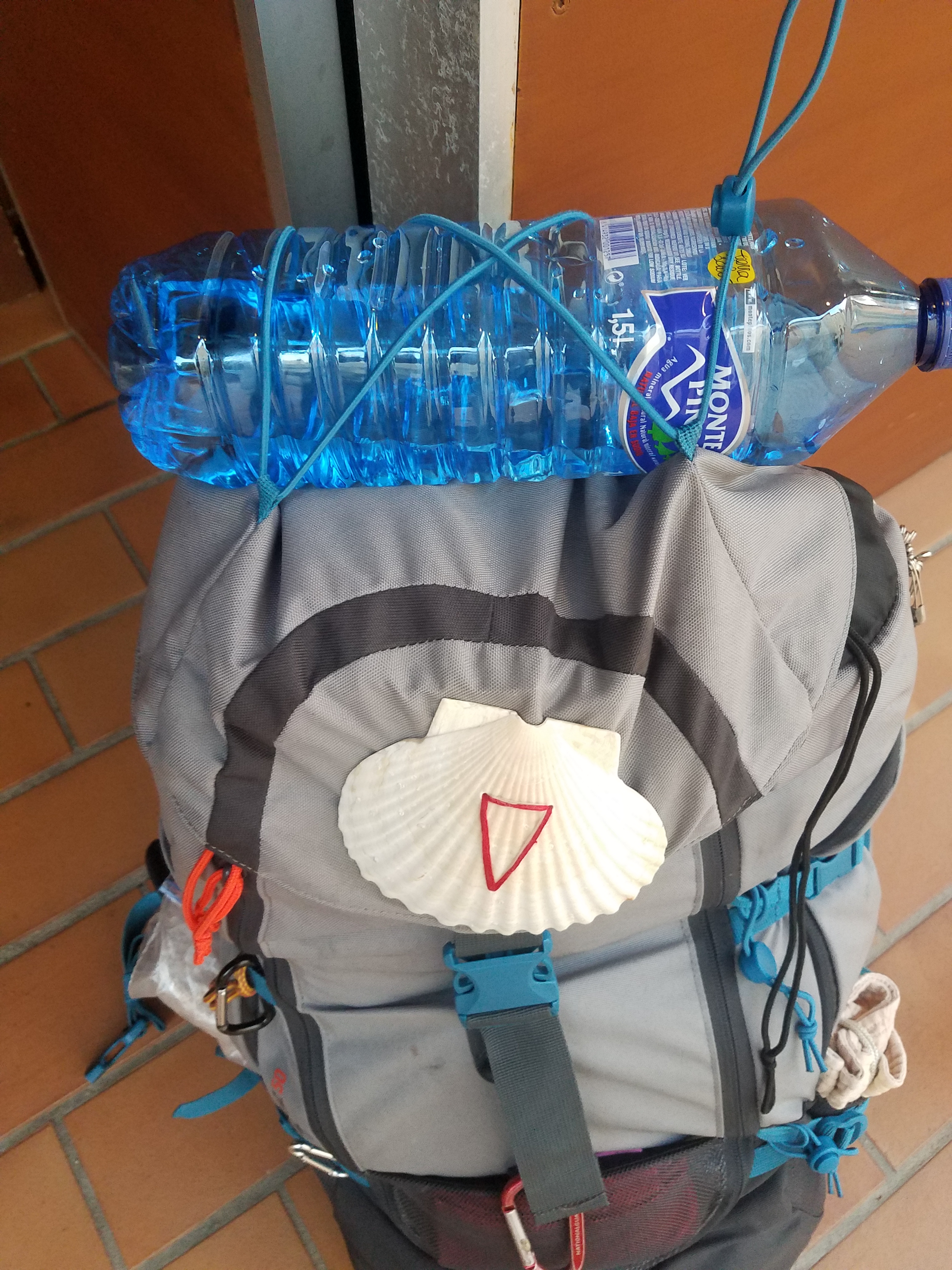
Water bottle. A lot of people use bladders, on a sweltering day you will quickly run out of water and those are difficult to fill in a village fountain… you have been warned.

Savon de Marseille: use it for your body, shampoo…or clothes, 3 in 1. If you get it in Spain, it is called jabón Lagarto, every supermarket has it.

Small first aid kit, you might need a few things to take care of blisters, etc. More for peace of mind on the trail.

Small book and writing/drawing notebook.

Sunglasses.

Rule of thumb is your pack should never exceed 10% of your body weight and should never exceed 10 kg (22lbs). My pack is a 50 liter, but I have plenty of space. Also remember to pack the heavy stuff in the bottom of your pack so it will sit in your lumbar area.

Now, having said all this, forget it! Each person is different with unique needs and expectations, experience, etc. So, make your own Camino, and your own pack. Buen Camino!!

Which Camino: Francés, Norte, Primitivo or Aragonés?

Having just finished my 4th Camino, the Aragonés, here is a bit of a comparison between the Francés, Norte, Primitivo and Aragonés to build on my previous analysis of the Francés and Norte (click here for that post):

I loved the Aragonés! It is wild and beautiful, we were very few pilgrims on the trail -about a dozen or so, most days I did not bump into any pilgrims! There are very few albergues and they are stage distance apart (with few exceptions), so we were the same pilgrims every evening at the end of the stage.

At around 7 days before it joins the Francés at Puente la Reina, it is a bit short. That is the worst thing about the Aragonés.

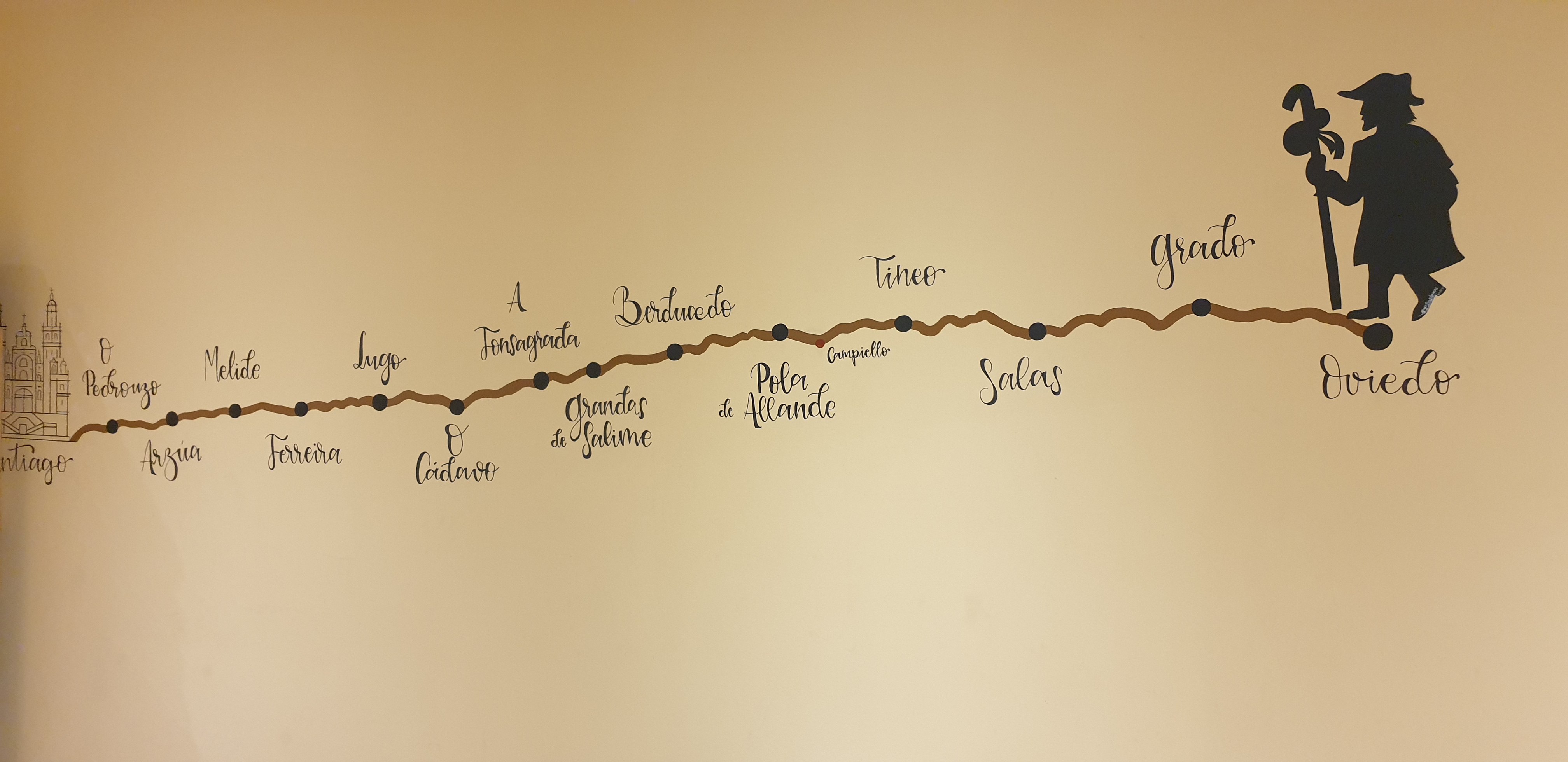
My all time favorite so far is the Primitivo due to the rugged beauty and the three days right in the middle which are quite hilly and “uncivilized.” It lacks the “spiritual” component of the Francés but makes up for it in natural beauty. At around a dozen days from Oviedo to Santiago it is a perfect “full” Camino.

The Norte is canonically the most beautiful: beautiful beach, beautiful forest, San Sebastian, beautiful beach, beautiful forest, Bilbao, beautiful beach, beautiful forest, Santander, Gijón… you get the idea. Plus, the food. While popular, this route still has far fewer pilgrims than the Francés.

The Francés is like Classic Coke: the most popular, the best known, the oldest (not really, just in modern terms, it was the first one to be rehabilitated in the 80s), and it is the most spiritual: most churches are open -unlike other Caminos, the change of orography makes this Camino “feel” longer. And the cities, with their Gothic cathedrals are impressive: Pamplona, Burgos, and León.

So, my ranking for now is: 1, Primitivo, 2, Aragonés, 3, Norte, and 4, Francés. Of course, you could start your Camino with the Aragonés and then hook up with the Francés, but you would miss crossing the Pyrenees, and the Navarra hills to Pamplona. On the other hand, by then the early crowds will be a bit more spread out…

Yes silly, of course I am thinking of next year’s Camino, but you will have to stay tuned to this blog for more!

Camino de Santiago #3, the Camino Primitivo

The Camino Primitivo is not only the original Camino, but also the most intense. Yes, it is half the distance of the other “main” Caminos, The Francés and the Norte, but what it lacks in length, it makes up plenty in beauty, ruggedness, physicality, and authenticity.

As you know I had been planning this Camino since I finished the North route last year. It did not disappoint. Here is the story:

Around the year 800, a hermit in Galicia called Paio (or Pelagius) was guided by lights and angels to St. James’ tomb. After telling his local bishop, king Alfonso II “El casto” went to check out what the fuss was about, thereby creating the first pilgrimage. As the Reconquista developed, new routes were established leading to the North and eventually the Francés route, which is today the most popular.

So, I took a train to Oviedo, the ancient capital of Spain during the Moorish occupation. It is a high-speed train only halfway, as the mountains that separate the plateau from the shore has not been breached by the high-speed line yet, making it is a five-hour journey. I arrived in Oviedo just in time to run to the albergue -an old seminary- before it closed!

I shared room with Vicente, a retiree from Valencia whom I would continue to bump into well into the Camino.

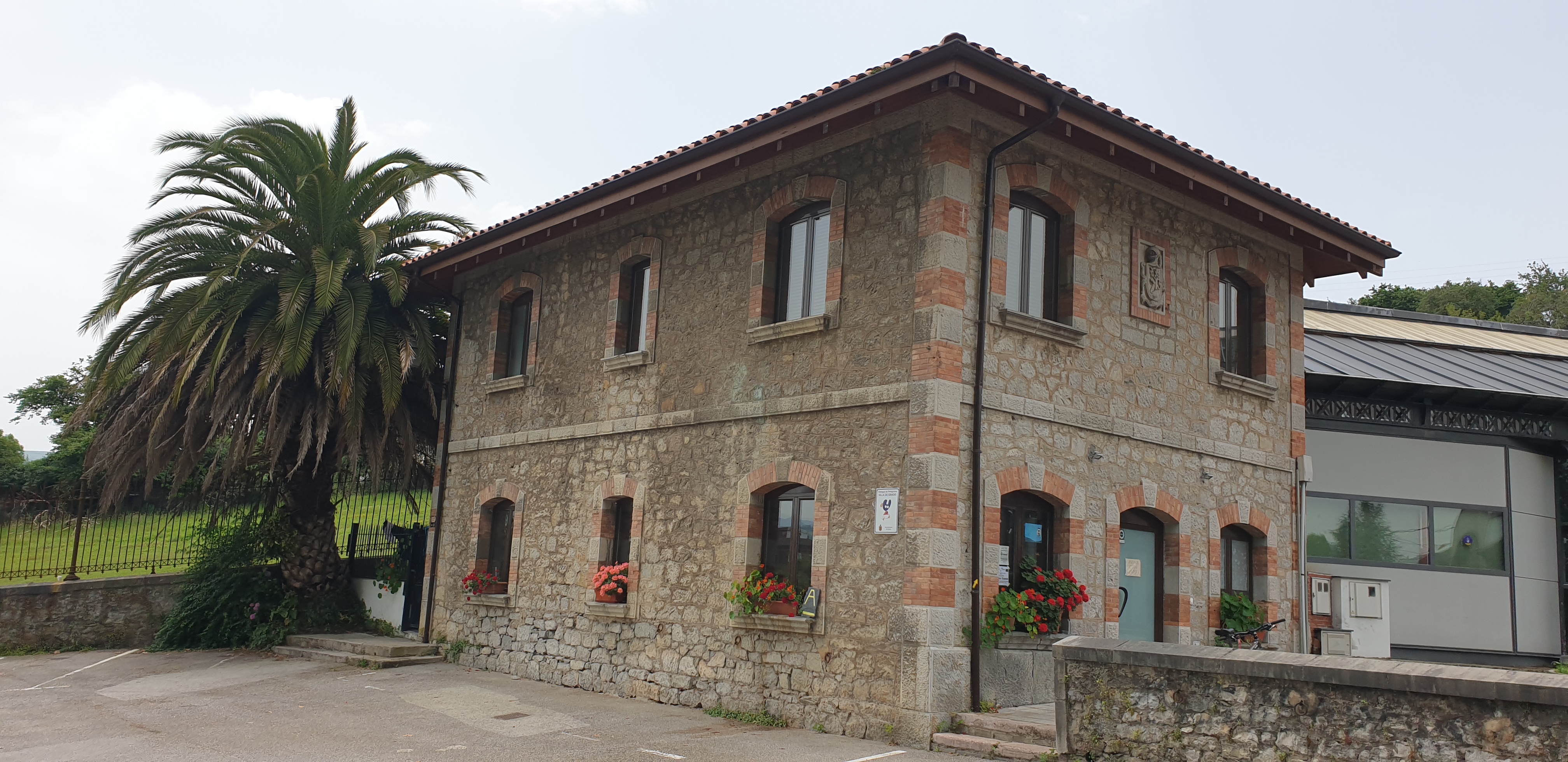
Downtown Oviedo is lovely, clean, and full of sculptures! It is so cool! The walk out of town was pleasant enough, and soon you are in the middle of the countryside in total pilgrim mode. The first day is an easy 24Km to Grado, where I had been years ago with my Land Rover. A dip in the frigid river quickly got rid of the day’s hiking inflammation. The albergue is an old horse brokerage house, and there is a cute town square with restaurants and a working church where the priest is happy to give me a pilgrim’s blessing.

The second day brings the first important climbs of the pilgrimage. With hot temperatures and sun, the last climb took a toll, but fortunately I would not have to tackle it first thing next morning.

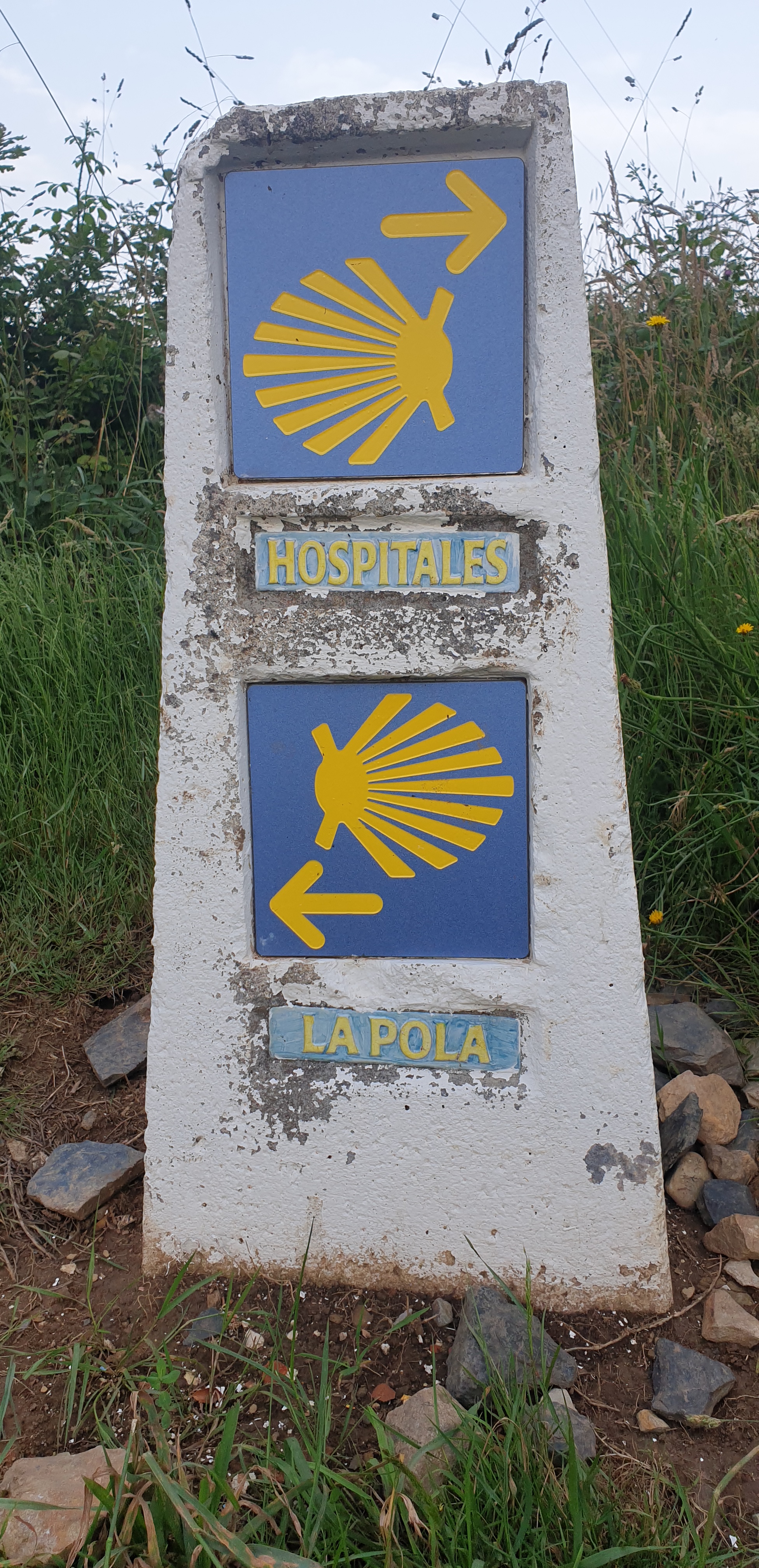
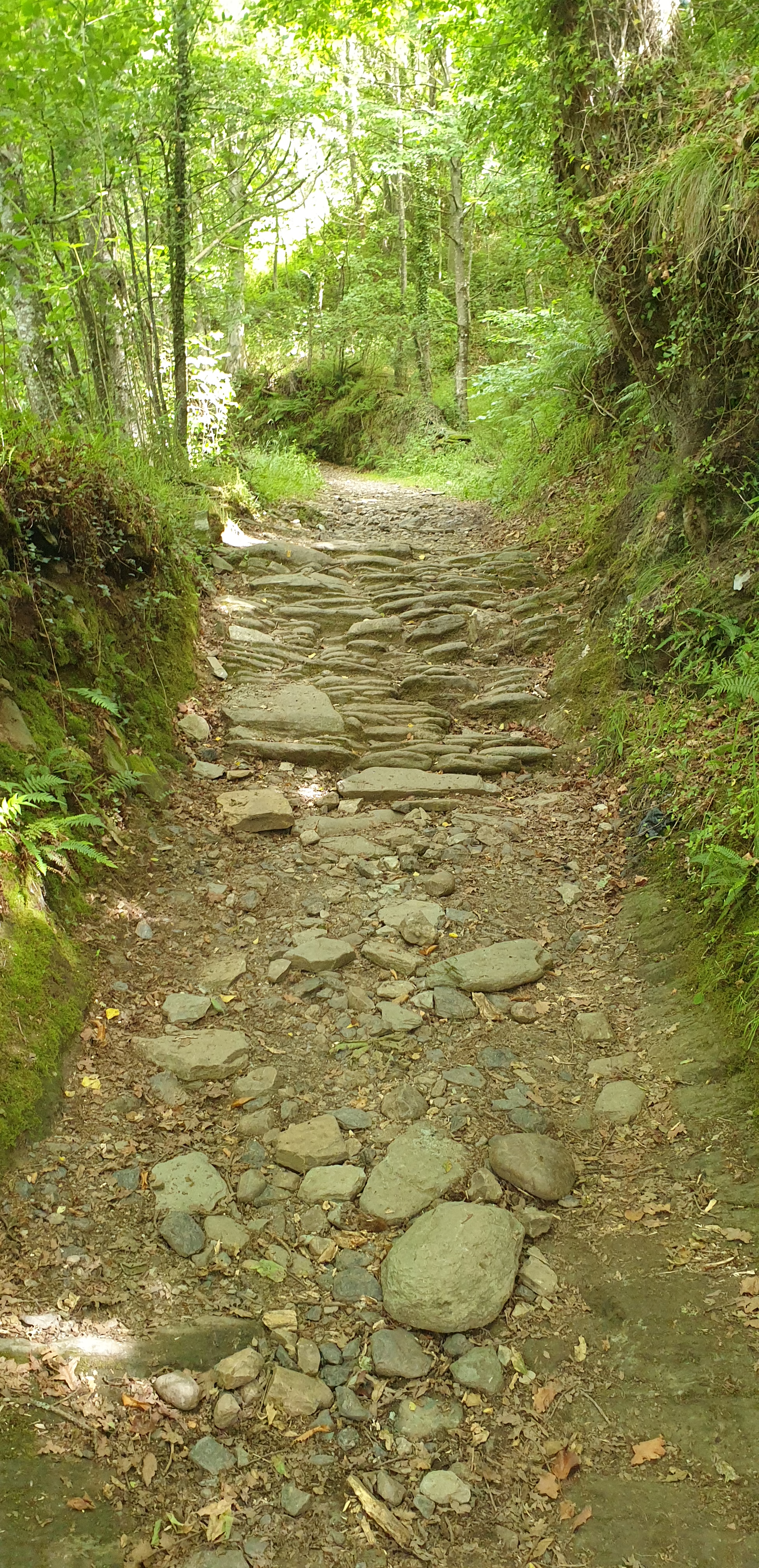
The next five days are a thing of beauty. I chose the Hospitales variant which takes you up over the tree line for a day of ridging 1000 mts over sea level. Amazing, you do not even miss the cafés! The following three or four days are just as impressive: natural, rugged, and fairly uncivilized. although without the altitude,

About halfway through you cross the grassy paths of Asturias to the dense forests of Galicia. After the city of Lugo with its amazing Roman walls, you have a day of a lot of asphalt, although the views are lovely, your feet pay the price. Then you have a final day of hillside living, before merging into the popular Camino Francés with all the “tourists” doing just the last 100 km (62 miles) to say they have done the Camino. So, the last three days are crowded and rainy on top of that.

But nothing compares to arriving at the plaza del Obradoiro and standing in front of the Cathedral. For me it was 310 km (200 miles) in 11 days.

The Cathedral has been totally renovated and I could finally go down to the crypt to see the tomb of St. James third time is the charm –it had been closed for restoration all my previous times. Lunch was at the amazing Santiago market, where I had the best hake I have ever tasted. With no train spots available that day, a flight to Madrid that afternoon ended my adventure.

How does it compare to the other Caminos? Well, the obvious facts are that while shorter, it is indeed more intense, beautiful, natural, and rugged. I loved every step of it, even the hard climbs and descents.

Which shoes to wear on the Camino

Shoes are arguably the most crucial element in your Camino kit. You are going to walk many hours a day for many days. The number one issue with pilgrims is blisters. You have been warned.

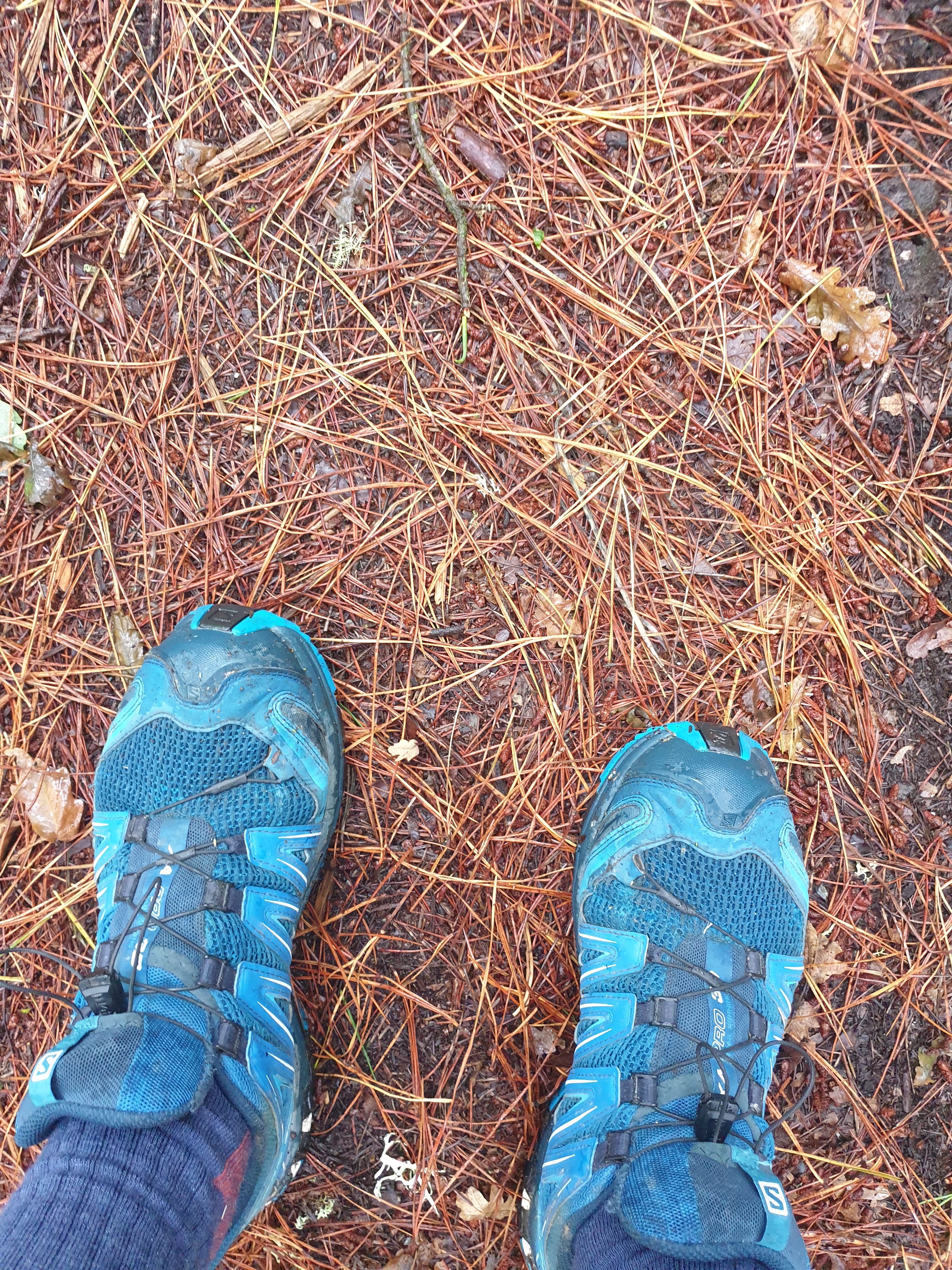
I am really excited to walk my third Camino this Summer, and I needed new shoes. For my first Camino I used Salomon XA Pros, and they were formidable I did the whole Camino with nary a blister (I might have gotten a couple of “hot spots” -pre-blisters- but never developed full blisters).

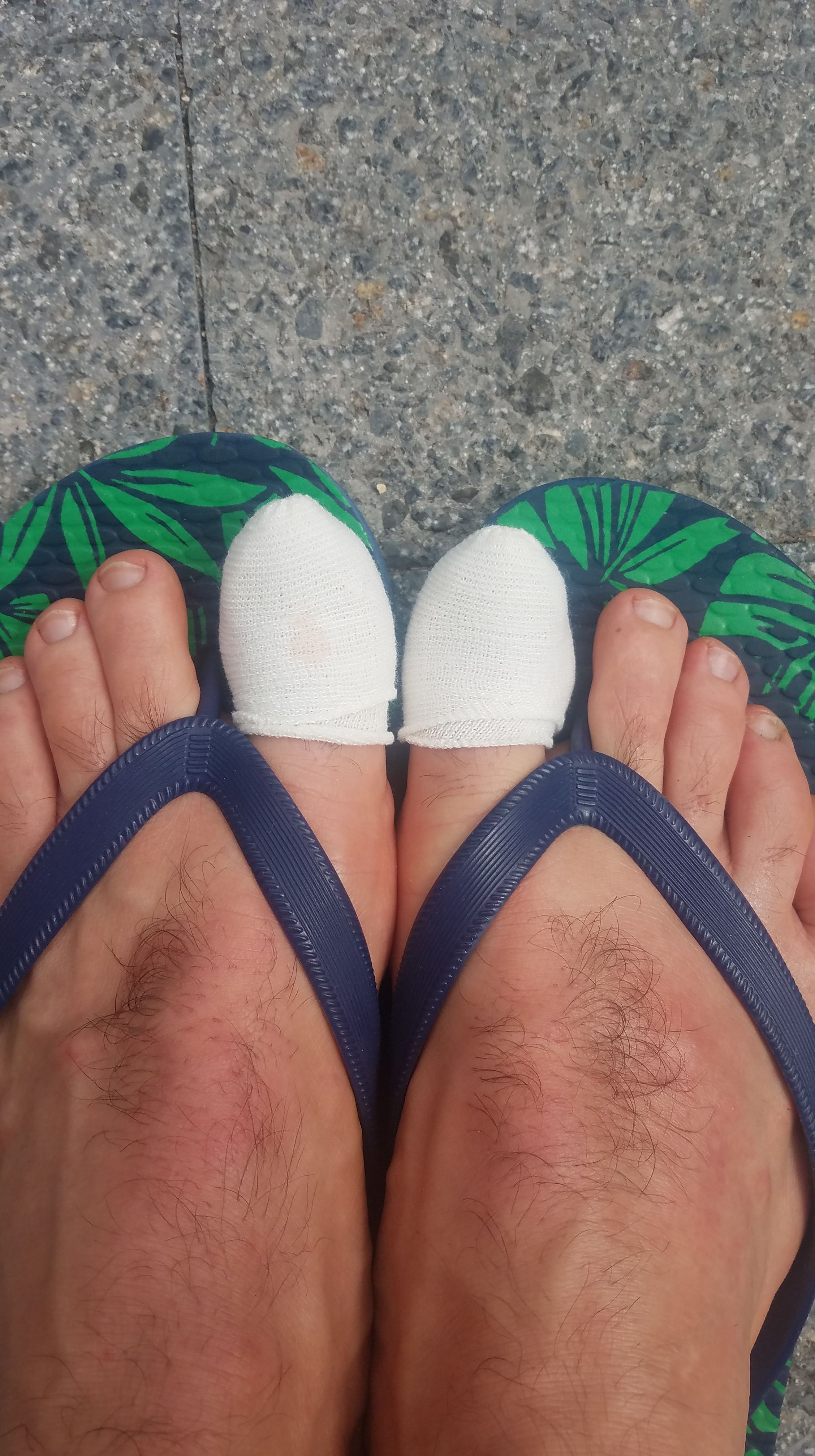
For my second Camino I chose the same shoe, only newer model in bright blue. Unfortunately, these did not perform as well as the first pair, and I ended up losing both my big toenails, twice (yes my toenails were cut very short, but wet feet in a steep downhill are going to slide). If you have never lost your toenails, it is not painful, but it is a bit of a nuisance, and they take almost a full year to grow back out.

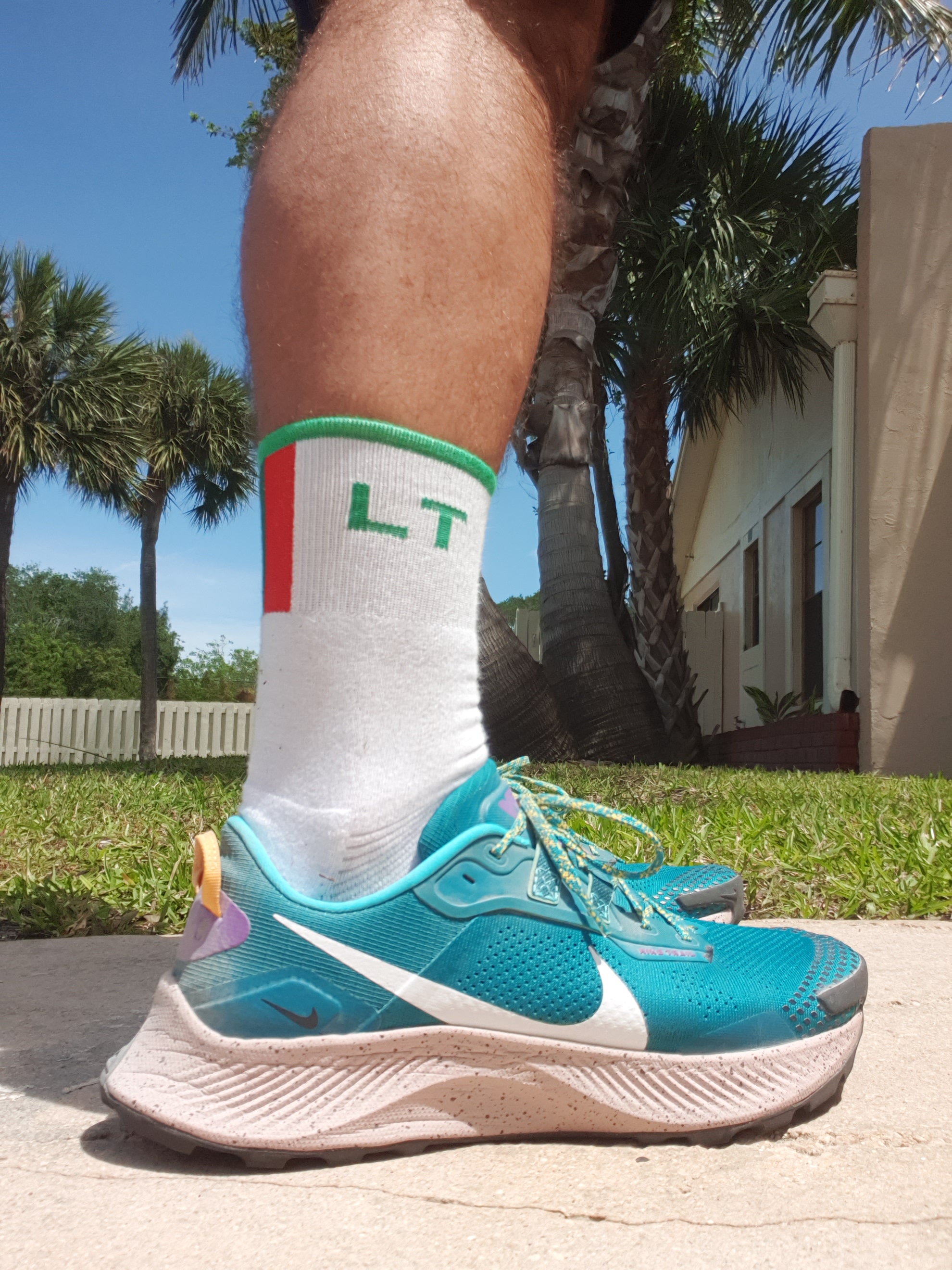
This year I did my homework. I did a comparative spreadsheet checking out a few internet websites. (attached) –it is in no way comprehensive, or professional– it is just a few references from a few random running shoe websites. Once I had my ranking, the move was to find the best price, that is where the Palm Beach Outlets come into the picture. New Balance, Nike, and Asics all have shops there, and the Nike Pegasus Trail 3 came in as the best ranked at the best price. I “broke in” the Nikes during Easter break and loved them! I will give you a full report after my Camino…

Here are a few pointers on Camino shoe buying:

  • Unless you are doing the Camino in the Winter, you do NOT need boots. Most pilgrims walk in the warmer months, and you do not want your feet baking inside of boots.
  • I once met a very bright German pilgrim; PhD in math, an internet startup in Berlin in their fourth round of capitalization… but his feet looked like steak tartare from wearing Alpine hiking boots!!
  • On the other hand, you do not want to wear sneakers/running shoes/tennis. They are not designed to pound the ground for miles with a backpack on, and you will also soon develop blisters.
  • The ideal shoes are trail running/hiking shoes. They are designed for this kind of thing.
  • When you are at the shop, with the laces undone, inch your foot all the way forward, you should be able to put a finger between your heel and the shoe. This means that your shoe should be half a size to a full size bigger than your “normal” shoes. Your feet will expand when walking for hours every day.
  • Gore-Tex or no Gore-Tex? When it rains, your feet will eventually get wet, Gore-Tex or not. So, I opt for NO Gore-Tex, this way when it is not raining my feet will breathe, and when it rains, they will get wet either way. Remember if you are in the Gore-Tex club you are going to have to stop and take your shoes and socks off every so often to let them breathe a bit. A rhythm busting nuisance when you are walking.
  • Soles: the terrain you are going to walk on is going to differ vastly from long stretches on tarmac (yuck) to grassy fields, but most of your walking is on dirt tracks, so you do not need a super aggressive pattern (unless again, you are going to walk in the mud of winter)
  • Once you have your shoes, make sure you break them in. Try to walk at least a few miles with your new shoes in order to avoid any unwelcome surprises.
  • Your feet do most of the work on the Camino so make sure you take care of them! Remember to have your toenails cut very short.

A whole blog post could (and might) go into socks. For the time being remember wool and no stitching…

Camino Francés vs Camino del Norte, which is better? My opinion

As soon as people find out I have done the full Camino Francés AND the Camino del Norte they always ask the obvious question: which is better? Well, here are my thoughts.

Like everything else in life, it is all about your personal tastes, the purpose of your Camino, etc.

The French way has more varied terrain, switching every few days. You get the Pyrenees on day one, then the rolling hills of Navarra, blending into the vineyards of La Rioja, eventually you get to the agricultural hills of Burgos, before hitting the plains of the plateau of Palencia and Leon before arriving at the hills of El Bierzo and the ancient Celtic hills of Galicia. The North or Coastal route on the other hand is amazing beach after amazing beach, and amazing forest after amazing forest, oh, and the only flat bits are the beaches, the rest of the time you are going up or down, which makes this route much tougher physically, but extremely rewarding as you are never more than a day or two away from the sea.

Also since this was the predominant trail in the late Middle Ages, the French way has a lot of history and a powerful spiritual charge, every chapel, every church, and cathedral just has this literally awesome, moving presence. By contrast, the Northern trail was abandoned in favor of the Francés as the Moors were driven out of the peninsula so, in fact, you are walking a much newer trail without so much of the spiritual aspect.

Food is probably better on the North route, as you partake from the bounty of the lush, green countryside and the ocean. This does not mean that the French way is bad, it just does not pass-through San Sebastian, arguably the best food per square foot in the world!!

North Coast of Spain is very green. Why? Because it rains a lot! So, if you commit to the North way, make sure you are prepared mentally and physically to deal with rain, sometimes for days… The French way on the other hand tends to be much drier.

Finally, depending on when you are doing it, the French way can become a bit crowded, while the North route has consistently less traffic.

If you are more into exploring cities and towns, both ways offer great stops, San Sebastian, Bilbao and Santander on the North, Pamplona, Logroño, Burgos or León on the French way.

So, in the end it boils down to what you want from your Camino. If you are looking for tradition and spirituality, go with the French way, if you prefer breathtaking views and more of a physical challenge, go North.

Have you done both Caminos? Leave your thoughts in the comments!!

Camino de Santiago #3 Camino del Norte

People start the Camino de Santiago for all sorts of reasons: adventure, self-improvement, fitness, spending time with their partners or friends, personal growth, finding oneself, etc. Upon finishing my third Camino, I have found that my main reason is a spiritual one – which by the way was the original purpose of the pilgrimage.

This year I did the Camino del Norte which  “officially” starts on the Spanish border with France at Irún. I crossed the Bidasoa river that separates the two countries, had a coffee in France, got my first stamp on my Credencial (the pilgrim’s “passport” that gets stamped along the way) and so got my official start in France, how is that for one-upmanship? or just for snobbery! This Camino then goes all along the North shore of Spain until turning in at Ribadeo to finish at Santiago.

Technically this is the second oldest Camino. When European Christians first started going to visit the tomb of the Apostol James in Santiago they either took a boat to one of the nearby ports in Galicia or to Oviedo and then cut inland to Santiago – that is the Camino Primitivo. Then came the coastal route, and when the Moors had been pushed South enough, pilgrims started going along the interior of the country on much easier terrain than the constant hills of the coast, this would become the Camino Francés, the most popular and most long-lasting Camino.

Now, before I continue let me point out that specially the Camino del Norte is a bit of a scam. You see, the Camino really was abandoned in the XX Century. In 1978 there were only three recorded pilgrims arriving in Santiago. Then in the ’90s it came back into fashion with younger people going on this route of self discovery. With increased popularity regional governments needed to re-mark and really re-establish the Camino. For the northern route this was difficult since the medieval paths that would unite villages along the valleys were now taken over by roads, so especially the Basque and Cantabria governments reinvented the Camino as a hiking route over hills and mountains where medieval pilgrims would never have set foot as they would have been eaten by wolves, bears and/or assaulted by bandits!

My Camino was glorious. The first day it crests a long mountain with amazing views of the sea and of the valley inland, finishing in San Sebastian, one of Spain’s prettiest towns and with the best food in the world. The second day it rained, and on a difficult descent, with wet socks I hurt both of my big toenails. This would be a bit of an issue for the rest of the Camino, but you do need some suffering in order to fully enjoy the Camino!

The Camino del Norte is known for it’s beauty. You walk between gorgeous beaches to verdant valleys day in and day out, through postcard perfect villages and some of the prettiest cities in Spain: San Sebastian, Bilbao, Santander, Gijón… The down side, if it can be called that, is that there is little variety as compared to the Camino Francés which changes topography constantly from the wooded hills of Navarra to the dry tableau of Palencia. The Camino del Norte also lacks the spiritual “weight” of the Francés with it’s open churches, pilgrim’s masses, etc.

I can’t wait to finish the few days left of this Camino and get started on the Primitivo…

Camino de Santiago #3 The North Route

Repeat pilgrims of the Camino number their Caminos by sorties, not by completed Caminos. That means that I have done two Caminos although I have only completed one, since I did it in two parts. So for veteran pilgrims, I am no preparing to embark on my third Camino!

Also I must apologize for my recent silence, I have been immersed in a project you will soon learn about. But now back to the Camino…

Being a freelancer nowadays means that I can take the whole month of June for my walkabout. After much consideration: De la plata (from Seville), Portugués (yeap, from Lisbon), Aragonés (from the Pyrenees), I settled on the Norte: all along the breathtaking North Shore of Spain, starting in Hendaye in France.

Over the last three years people have asked me why I do the Camino. The answer is multi faceted, but the main one is being far from the madding crowd (thanks Mr. Hardy), alone, in silence, in a state of almost constant meditation, meeting people from all over the world and sharing the walk and meals (and yes, the bathrooms and bunk beds) with them, getting to know this wonderful country more and more intimately, taking part in something much bigger and far older! than oneself. Finally it is the physical bit, the sport, the personal challenge of walking every day for days. As I have said before in this blog, the Camino is what the world should be like. So much so, I think I might be addicted to the Camino!! I will keep you posted on my adventures.

Source: Club Renfe magazine

Source: Club Renfe magazine

The Camino Part II

Since I ended my Camino last year I was itching to get back to my pilgrimage. It did not disappoint. Exactly a year to the day, I boarded a bus to Astorga, the city where I finished last year. Four hours later, I arrived. I did not want to spend the night in a place that only had sad memories and heartbreak for me. So I walked to Murias, the first village out. It was a gorgeous evening walk on one of the longest days of the year. I passed by the obligatory tiny chapel and yellow arrows. The small Albergue was a repurposed, old, one classroom schoolhouse. Just about everyone inside was already dozing. But I walked to the local restaurant for a quiet dinner with a glass of wine. Then crawled into bed after a quick shower.

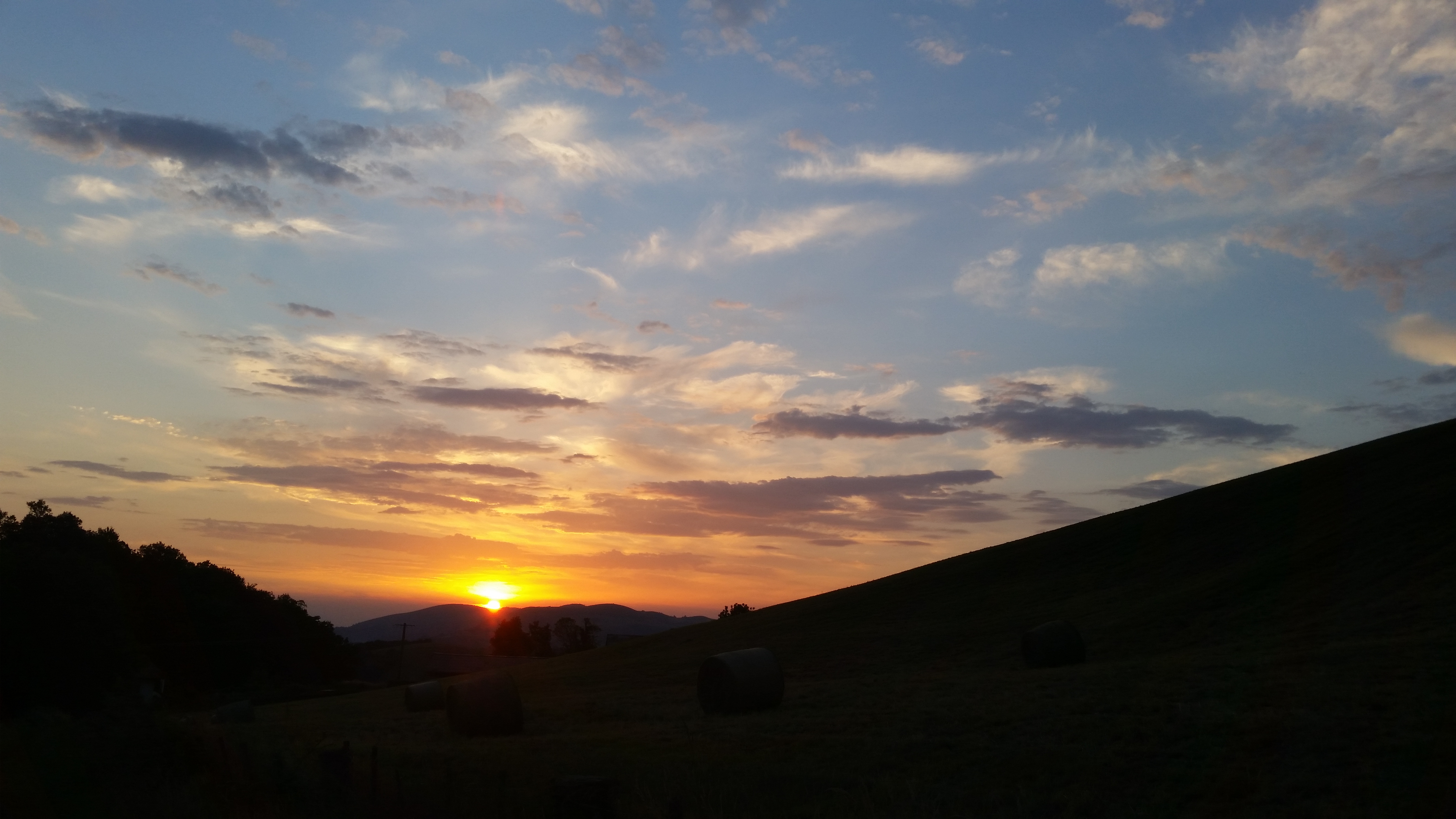
My Camino proper started, like last year, on my Dad’s birthday. It is a tiny, silly way for me to honor him and to celebrate with him, walking with his old walking stick. Right out of Murias there is a small detour to one of the prettiest villages in Spain: Castrillo de los Polvazares. An ancient, untouched stone village. Stone homes, stone streets, stone church, stone everything. I made the detour because I remember driving there with my father in his massive Mercedes and being so awestruck by the beauty of the village. My morning walk is always my favorite. The dew on my legs, the silence, loneliness, the cool.

The path was a slow but steady climb to the second highest peak of the route, past Rabanal del Camino, where I stopped to chat with a Benedictine Monk in his monastery, and Foncebadon, to Cruz de Fierro, the site of an ancient Roman temple. It is a tiny iron cross on a massive wooden post. Pilgrims are supposed to drop off a stone picked up at the base, but with the accumulation of stones, they are now suggesting leaving flowers. I had a pebble I had been carrying since Navarra.

After cresting for five odd km. the descent is very technical, putting a lot of pressure on feet, shins, and knees. I was out of the Maragateria area and into El Bierzo, a previously forgotten region of Spain that is now on the map since their wines became noticed some years ago. I eventually stopped at Acebo a lovely village of stone homes with slate roofs.

There are three basic types of albergues a pilgrim can stay in. The municipal or public ones, the parochial or church affiliated ones and private ones. I normally chose my albergues in this order. In Acebo the options were parochial or private, I stayed at the parochial, run by a wonderful American couple that had left the US because of President Trump (they can hardly be blamed).

My walk the next morning led me by a wonderful 18th C. altar in one of the tiny chapels along the way. I always stop and chat with the attendant, while I get my official stamp to prove my visit, which I will need in Santiago. Breakfast was at the gorgeous village of Molinaseca. And the walk continues past fields and vineyards to Cacabelos. The Albergue at Cacabelos is paradise for me. It is set up along the inside wall of an 18th C. neoclassical church, right up my alley! The next day I end up at Herrerias, the base of the third highest climb of the route. There is only a couple of private albergues and the one I choose is super cute. The bedroom only has 8 beds so it is very quiet. There is a neo-Hippy project next door called Project Brigid where they do music workshops, and they lend you their kitchen. I signed up for their yoga class in a small clearing, surrounded by high trees, next to a lovely stream. It was by far the best yoga session of my life.

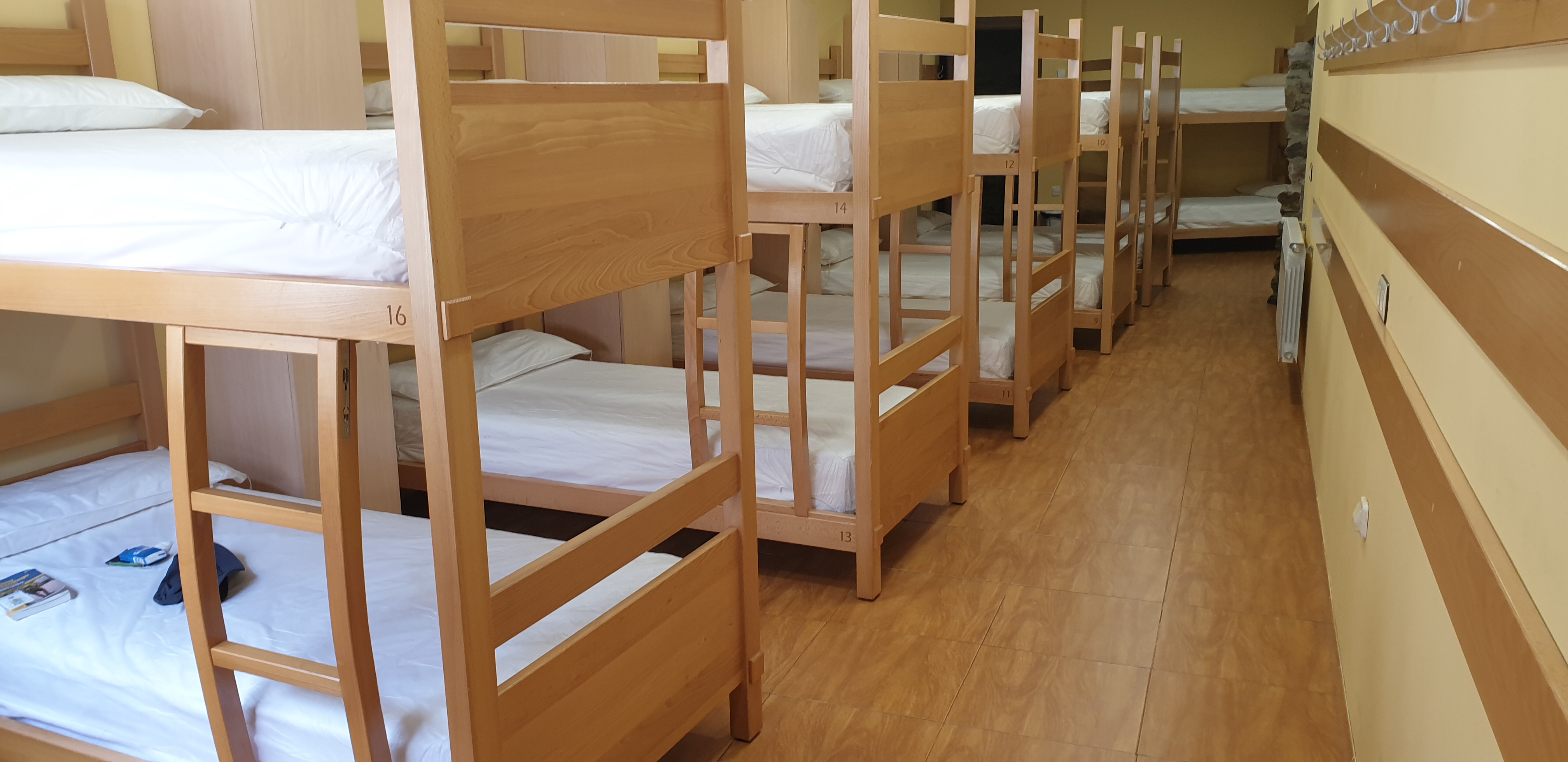
The climb to Cebreiro is the third highest in the Camino, but in the early morning, it is a breeze. A stop at the great bar El Arbol in La Faba provides great fuel to keep climbing. The view of the hills of Galicia from the top is awesome and the town of Cebreiro is really cute, with a fantastic, intimate church where I spend some time. I keep walking downhill to Triacastelas. The albergue is in rooms of four. I room with a Mexican girl, a South African fellow and Go from Japan, who will become my new friend.

I walk to the Benedictine Monastery at Samos in one gorgeous chestnut tree forest crisscrossing  gurgling streams. At Sarria I enjoy a wonderful empanada, the local pie, stuffed with tuna. The Camino now is a bit more crowded with busses full of “pilgrims” who only walk the last 100 km. in order to earn the coveted Compostela, the traditional forgiveness of sins for doing the Camino. These mostly Spanish folks can afford to do the walk with only a day pack – or just some water – as their bus will carry their kit from village to village. I must confess it does distract from the purity of the Camino, but they must be equally accepted as they are also pilgrims, even if all they are wearing is a bikini and a water bottle, as I saw one girl doing.

Galicia is a magical region of Spain, it’s ancient hills covered with chestnut and eucalyptus forests, streams and tiny agricultural plots. The food is delicious and the people are wonderful. My last two days’ walk is in the company of awesome Aussie Bec and our Japanese friend Go. After a good night’s sleep at a gorgeous little hotel, the walk into Santiago is an easy 9 km, just in time for the Pilgrim’s mass with the fabled Botafumeiro incense burner that somehow uncorks all my emotions as it swings across the naves of the cathedral. I only have time to get my Compostela before jumping on a train home, I’ve got a busy summer ahead!

The Camino is what the world should be like

Three months have passed since I finished my Camino for the year. I have had time to think and process my pilgrimage. In the meantime, a student from UNC interviewed me about my experience on The Camino, which helped me to vocalize my feelings about the experience.

My conclusion is that The Camino is what the world should be like. Pilgrims are generous,  considerate, and kind, we are all fairly equal, united in the task of walking to Santiago. Add to this the human and humane pace of walking, allowing you to talk to others, to enjoy the beautiful scenery, there are no unwanted interruptions, there is no need for technology. There are no hidden interests, we are all just walking and that is pretty much all there is to it. You can walk faster or slower, you can stop wherever you want. It really is a parallel world that is as much of a real world utopia as you can find.

I recently read this passage from Thomas Merton, a real modern-day mystic, and I immediately connected it to my Camino experience:

In Louisville, at the corner of Fourth and Walnut, in the center of the shopping district, I was suddenly overwhelmed with the realization that I loved all those people, that they were mine and I theirs, that we could not be alien to one another even though we were total strangers. It was like waking from a dream of separateness, of spurious self-isolation in a special world, the world of renunciation and supposed holiness. The whole illusion of a separate holy existence is a dream. . . . This sense of liberation from an illusory difference was such a relief and such a joy to me that I almost laughed out loud. . . . I have the immense joy of being [hu]man, a member of a race in which God . . . became incarnate. As if the sorrows and stupidities of the human condition could overwhelm me, now [that] I realize what we all are. And if only everybody could realize this! But it cannot be explained. There is no way of telling people that they are all walking around shining like the sun. . . . Then it was as if I suddenly saw the secret beauty of their hearts, the depths of their hearts where neither sin nor desire nor self-knowledge can reach, the core of their reality, the person that each one is in God’s eyes. If only they could all see themselves as they really are. If only we could see each other that way all the time. There would be no more war, no more hatred, no more cruelty, no more greed.

Unfortunately The Camino ends, and one returns to the world we have created. We return to noise and pollution, but even worse: to rude and aggressive people, to rushing, to everything we have constructed that separates us from peace, and beauty, and truth.


Gear for El Camino. What should I pack?

Many of my fans preparing for the Camino have asked me about my gear (ok, maybe just a couple of people). There are many Internet spots that explain what and how to pack, but here are my two cents, as Americans would say:

Walking 500 miles (give or take) in a month (give or take) carrying your backpack is an exercise in minimalism, physically, mentally and spiritually reducing clutter. By reducing stuff in your backpack, you also reduce it in your mental/spiritual backpack. I hope to soon be able to write about the emotional and mental process of the Camino. For now I will leave you with this quote from Richard Rohr, and write about the material gear that goes in your backpack.

The German Dominican mystic Meister Eckhart (c. 1260—c. 1328) preached, “God is not found in the soul by adding anything, but by a process of subtraction.” [2] But in the capitalistic West, we think very differently. We all keep trying to climb higher up the ladder of success in any form. We’ve turned the Gospel into a matter of addition instead of subtraction. All we can really do is get out-of-the-way. The spiritual life is often more about unlearning than learning, letting go of illusions more than studying the Bible or the catechism.

There are a few things to keep in mind when packing for the Camino: a. you are never more than a few hours away from civilization, with supermarkets, pharmacies, convenience stores, and anything else you might need. b. there are laundry facilities at all albergues, so you do not need to pack many clothes, and c. basically all you do on the Camino is walk, eat and sleep. Having said all that, this was my packing list:

Shoes are probably the first thing to think of. If you are walking in the summer you do not need hiking boots. I saw plenty of people struggling with heavy hiking boots in the hot 30+ C° weather, plenty of abandoned boots, and plenty of feet like steak tartare. Good, broken in hiking shoes are perfect. Some people wear running sneakers, they are probably fine, although maybe a bit too lightweight for you and your pack, in my opinion. I packed a pair of cheap Flip-Flops for showering and a pair of water sandals for the apres-walking evenings.

You basically only need the clothes you are wearing and the ones that are washing/drying. Of course this depends on the season, but in the summer that means T-shirt, underwear, shorts and socks. As I mentioned before, as I am a snob, I carried three changes.

Since your feet are doing basically all the work on the Camino, and account for 25% of the bones in your body, you really should pamper them with the best socks you can get. Ideally hiking specific socks in a wool blend without seams. The higher up the leg they are, the less dust and grit is going to get into your feet.

Although everybody recommends hi-tech, moisture wicking, breathing fibers, for your T-shirts, I chose old school 100% cotton long sleeve shirts. The cotton because I am a snob and don’t like the feel of synthetic fibers, and the long sleeves because I also hate sunscreen and long sleeves meant I could avoid creams (and packing them).

For a second I considered athletic underwear, but ended up going with my Brooks Brothers boxer shorts. Some things just like hanging the way they always do!

I carried two cargo shorts. The side pocket was extremely handy for my guidebook/map as I used it constantly.

It was never too cold for me until the approach to Burgos. That day I wore two long sleeve shirts all day long. That evening I surrendered to the cold and bought a hooded sweatshirt at the souvenir shop, the only shop open in Burgos that day, as they were celebrating their festivities!

For my bald head I alternated bandanas (which I would tie around my neck in the morning) in different configurations depending on the sun: a la Marco Pantani, Il Pirata, or a la Tupac Shakur, and a  “crunchy” boonie, or giggle hat that I could soak at fountains to keep me cool.

Unless you are going to camp or bivouac (which I saw plenty by the side of the Camino) you are going to sleep indoors, so a summer weight sleeping bag is fine. I chose to have one of my favorite cotton sheets folded in half (lengthwise, duh) and sown to create a sleeping bag. It might have been a bit heavier than the synthetic bags, but it was oh so comfy. Most albergues have blankets, so on cool nights I pulled a blanket over my sheet/bag. I did carry a pillowcase since the albergues all have pillows, in retrospect I could have used one of my three T-shirts.

Your minimal dopp kit with your bathroom supplies. I used Marseille soap – Jabón Lagarto – in Spain as I could use it for my laundry and my body, and my bald head, hahaha!

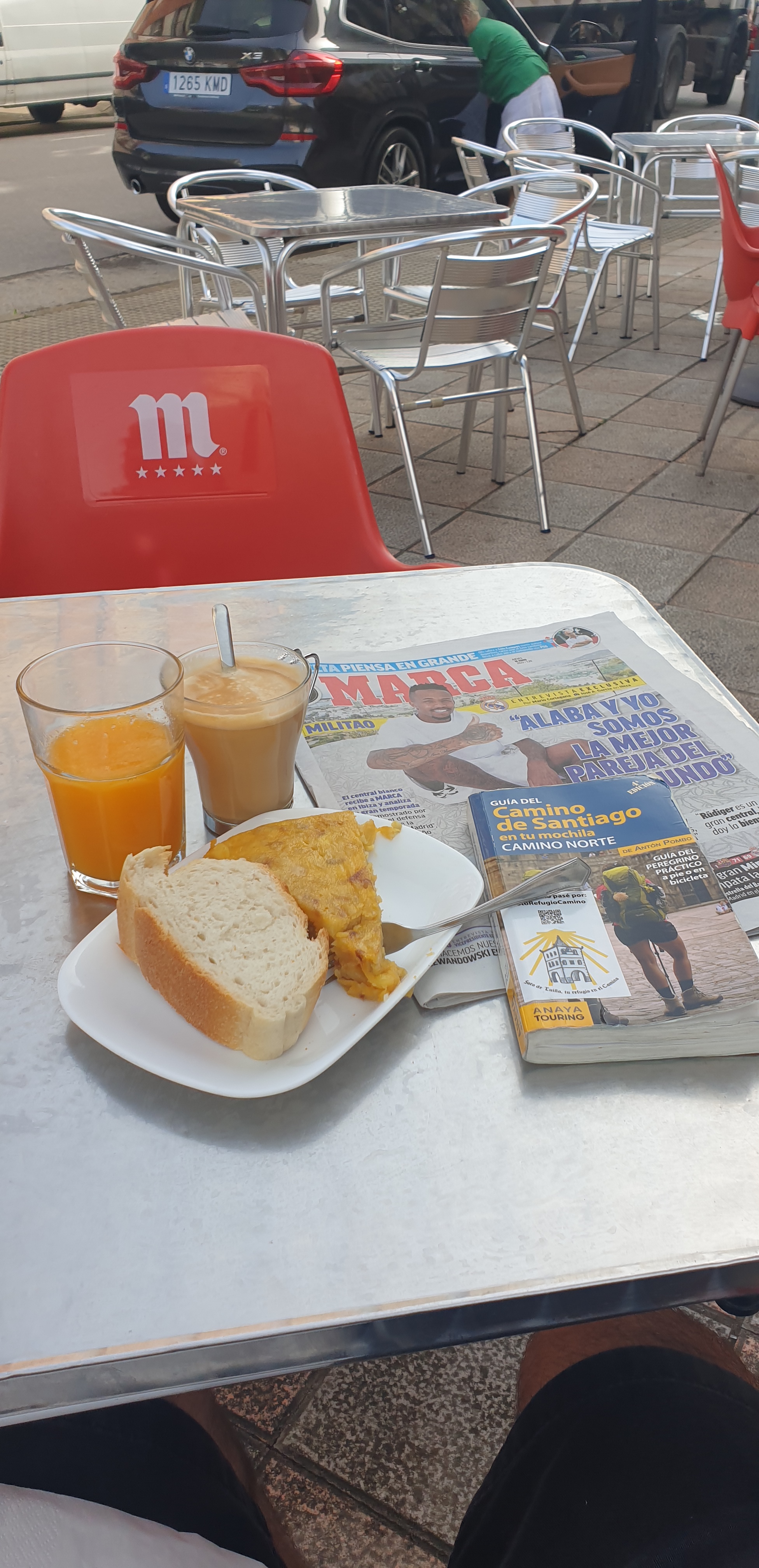
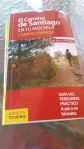
A lot of thought was given to what to read on the Camino, something meaningful but light. The library at the albergue in Roncesvalles, the first stop, is full of donated/abandoned Bibles… I ended up choosing The Book of Job and I do not regret it. I did finish it early and donated it to the Convent of Saint Claire where I was staying at Carrión de los Condes. I also packed a notebook and writing material to keep a diary and a daily Scripture reading for inspiration.  I carried two guidebooks: The Michelin Guide for quick reference on the go, and the Anaya “El Camino de Santiago en tu mochila” for more detailed reference.

Small flashlight – critical for reading and moving around the albergue after lights out. Mine has a wrist band which means I could hang it from the boards of the bunk above me, great for reading.

For towel I used a lightweight microfiber from Decathlon, it is not the most luxurious item, but it works. I must confess I was very jealous when James pulled out this exotic, gorgeous, printed Indian sheet. It is very refreshing to see flashes of glamour on the drab, technical, weight obsessed Camino equipment.

Water bottle, and make sure you have a comfortable, handy spot to carry it, I struggled carrying mine around in different locations until I settled on a hip strap. Although you are never too far from a fountain, there are a few long (over 10 km.) stretches without water. Also, you should always be drinking anyway, so even if you do not fill it up, always carry water. It is also handy to wash fruit, hands, etc. Some people carry water “bladders” but these seem tricky to fill up mid hike and are apparently expensive.

Basic first aid kit with whatever you think you might need – hopefully you will not use anything.

Bathing suit!

Trail mix, it is nice to have s snack without having to wait for the next bar.

Phone and charger.

Bug spray – I did not use it.

Sharpie, critical for marking stuff and writing on stones at mileposts.

Safety pins in case your clothes have not dried overnight and you need to “hang” them outside your pack.

Poncho that covers your backpack. Keep it handy in case of sudden storms.

Most albergues have laundry facilities for manual laundry. The bigger ones have washer/driers. Some of them will even treat you to detergent, so I packed a few of the liquid plastic pods in a zip-lock bag.

Pilgrims swear by the hiking sticks (that look like ski poles), I carried one of my dad’s old walking sticks that an old friend had given him. It was useful on technical climbs and descents and to poke at things.

Last, but not least a pocket knife is critical. You might only use it to make bocadillos, but it is always handy to have. I found an old Swiss Army knife that I had given my little sister years ago and that for some reason was in my dad’s desk drawer.

Buen Camino!