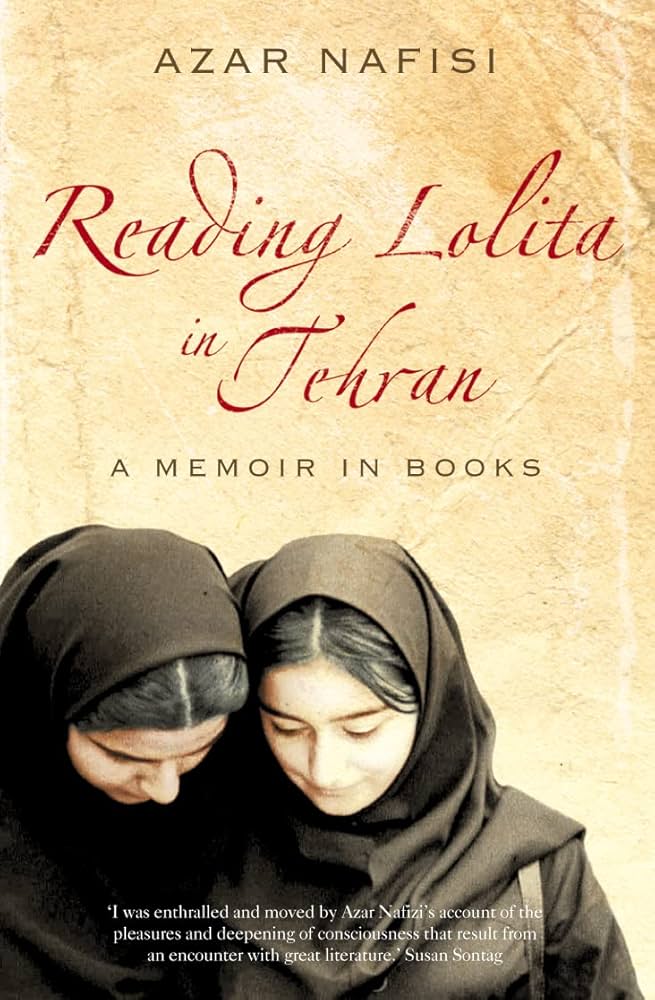
Reading Lolita in Tehran, four books in one.

Reading Lolita in Tehran

On a Sunday in January 1979, my dad and I were puttering around the garden, collecting, and chopping wood for the fireplace, listening to the radio. The news came on and explained that the Shah of Iran had fled the country into exile. I looked over at my dad, who had dropped the ax and was running up the stone stairs into the house. He took off to work at the bank -on a Sunday morning! My dad was a foreign exchange trader, and he knew the news of the Shah leaving Iran was going to cause a lot of market turmoil.

Growing up in London in the early 80s, there were many Iranian exiles. I remember going to school with a few of them. I also remember the SAS operation to liberate the Iranian embassy in 1980, a few blocks away from my best friend’s house. Even my mom’s English teacher was a beautiful, tall, elegant Iranian who brought me pistachio nuts and gave us a beautiful edition of the Rubaiyat of Omar Khayam.

After leaving London for college in Boston in 1983, I mostly forgot the Iranian revolution. A few weeks ago, I finally picked up a copy of Azar Nafisi’s Reading Lolita in Tehran, which had been waiting on my shelf for years, not knowing really what to expect. I loved every page. (Spoiler alerts)

The book is really four books woven into one magnificent narrative, like a-forgive the cheap simile-a fine Persian rug.

The main and overarching story is the author’s own story, her memoirs, from a child in Tehran, to studying in Europe and America, to teaching in Iran, and returning to the US. It is a fascinating life story.

The second thread of that biography is Nafisi´s job as a university professor of English literature, teaching: Lolita, The Great Gatsby, Pride and Prejudice, Emma, Daisy Miller, and Washington Square… in the classroom and eventually in her living room! which is where the name of the book comes from. But Nafisi does not stop at explaining that she taught (she still does); she gives her literary critiques of all the authors mentioned! It is a brilliant and amazing third layer, reading her interpretations of all these books. Yes, I felt jealous, as I have the same job as Nafisi, but I have nowhere near her capacity or talent.

The fourth story is the history of the Iranian revolution, the origins of the Islamic Republic, the persecutions, the disappearances, the crackdowns, etc. This story reminded me of Khaled Hosseini’s 2003 novel The Kite Runner, as he describes the crumbling of Afghanistan.

Yes, Reading Lolita in Tehran came out in 2003, but if you have not read it yet, I recommend it. You are welcome.

“Do not, under any circumstances, belittle a work of fiction by trying to turn it into a carbon copy of real life; what we search for in fiction is not so much reality but the epiphany of truth.”
― Azar Nafisi, Reading Lolita in Tehran: A Memoir in Books

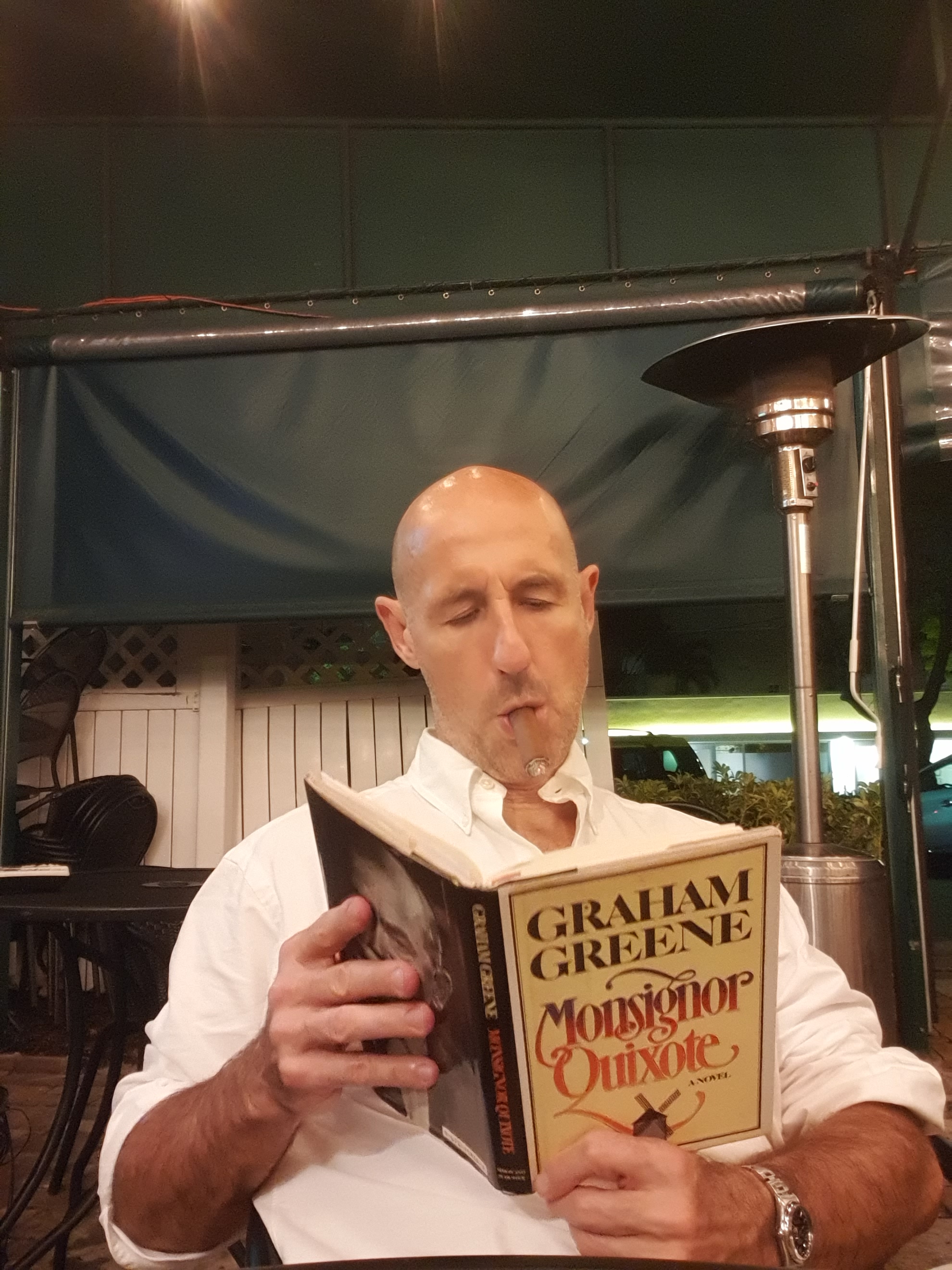
Don Quixote, Monsignor Quixote, Graham Greene, and madness vs. Existentialism

A good book and a good cigar

There are books that I re-read with certain regularity: The Old Man and the Sea, Voltaire’s Candide, the Rubaiyat of Omar Khayyam (you can read about that one here), Don Quixote only three times.

But I recently came across a book I had read as a teenager in the 80s and decided to revisit: Graham Greene’s Monsignor Quixote.

As you can see from the title -I will try not to spoil anything- in a fictional meta-reality, Monsignor Quixote deals with the adventures of a descendant of Don Quixote. There is a Rocinante and a Sancho. Greene converted to Catholicism at 22 in 1926 (you can read his bio here) and this novel deals precisely with -no spoilers- with religion, theology, and the Church in early ‘80s, post Franco Spanish society (It was published in 1982). The book is an easy, quick read, and, since I am always on the lookout for the far reaching effects of Don Quixote, I re-borrowed Monsignor Quixote (thanks Sue) and thoroughly enjoyed it.

My more faithful readers know that one of my research interests is the influence of Don Quixote on Existentialist philosophy. So my antennae are always poised to pick up on this theme. Monsignor Quixote does not disappoint! The references to the links between Don Quixote and Existentialism might have been written unknowingly by Greene, which I doubt, but they are there either way:

There is a heartfelt reference to Miguel de Unamuno who was a big fan of Don Quixote and a proto-Existentialist (read San Manuel Bueno, Mártir). This is an indication that Greene understands Cervantes.

There are explicit mentions of Monsignor Quixote acknowledging his existence, which is a big step in understanding who one is.

The novel deals with our doubts and beliefs, the Existential anguish that drove Kierkegaard (but not in those words), the father of Existentialism -which would make Cervantes the great-grandfather of Existentialism (read about that here).

Finally, as any alert reader would expect of a novel with the name Quixote in it, it talks of madness. Of course, folks -specially those who have not read the novel- often confuse Don Quixote’s drive and purpose with madness (which drives me mad). I will not elaborate but Don Quixote knows who he is, it is just that nobody understands what he is doing, so they call him mad. This leads me to my first and hopefully last political statement ever on this blog: Former President Trump was often called Quixotic, for whatever reason, and the people who labeled Trump like that have obviously never read, and/or never understood Cervantes’ novel!! A similar point is seen in the film Easy Rider when Jack Nicholson as George Hanson says:

Oh, yeah, they’re gonna talk to you, and talk to you, and talk to you about individual freedom. But they see a free individual, it’s gonna scare ’em.

I guess I could have written a more academic article about this book, and maybe I will, but for the time being, enjoy.

A good book and a good coffee

On poetry

Although I started this blog years ago with some poetry: Frost’s The Road Not Taken and Cavafy’s Ithaka, I have not written as much about poetry as I should have, given how much I enjoy it, and compared to other arts. Sure, I recently wrote about Omar Khayyam’s Rubaiyat, but that is still not enough for my liking. So here is an attempt to fix that.

My first conscious appreciation of poetry came in college with Pablo Neruda. To this day I am still moved by his words, and Tu Risa is still one of my favorite poems. Alfred Lord Tennyson’s Ulysses is also right up there as well as the two poets mentioned at the beginning. But the list of favorite poets is a long one: Lorca, Bequer, Espronceda, Benedetti, Mistral, Pessoa, Milton, Manrique, Dante, EE Cummings, Wordsworth and Coleridge, Blake, Elizabeth Bishop, and on and on. But one does not have to go to the big guns to find poetry that will amaze you. Naïf, amateur or student writers can take you places you would not think. Sometimes poetry hits you when you least expect it: I was surprised and blown away by 22-year-old Amanda Gorman at Biden’s Inauguration. Quadriplegic Ramón Sampedro, euthanasia’s cause célèbre in 90s Spain also wrote some sweet lines. Check out this poem in the namesake movie:

For me, the beauty of poetry is the capacity it has to transport you in a few words, in a verse. Never mind words, Haikus only have seventeen syllables – three lines!! I love Haikus: although I knew and had read them before, I actually became a follower of Haiku poetry by reading, wait for it… Jack Kerouac’s book of Haikus! (although he does not always follow the 17-syllable rule), since then I have read and enjoyed Bashō, the master. I am in awe of poets since I cannot write my way out of a paper bag (thank you for reading this, it means a lot).

Years ago, at Walnut Hill School I got a glimpse, a backstage tour of the poetry world from the brilliant poet and teacher Daniel Bosch. I once invited him to my advanced Spanish class to talk about Neruda’s Veinte poemas de amor…, which we were studying at the time, and he blew our minds!! Daniel also wrote a hilarious poem when I got my citizenship: Song for a New American. To this day it is framed and on my wall!!

I write all this because I have just read …del amor hermoso by Chilean author and teacher Luis Correa-Díaz, and it is wonderful. His capacity to write about love, apparently in a playful manner, but not really. His poems are soaked in ecclesiastical vocabulary and structure which gives his writing an extra edge and throws you off the traditional expectation as a poetry reader. This is apparently three books in one, which again is a bit unsettling: where there originally three separate books? Is it all another manipulation of my expectations? Another old-fashioned trick, which still works is that he “found” the poems in a manila envelope, and the ones he did not find are “anonymous”. Never mind the trickery, the poems are lovely and they keep you reading and paying attention.

The Rubaiyat of Omar Khayyam

The Rubaiyat of Omar Khayyam

Although I have a few editions, the other day I picked up a nice, used copy of The Rubaiyat of Omar Khayyam. It is one of my favorite books/poems of all time. I think it all started in the early 80s when we were living in London. My mom hired an Iranian English teacher to teach her English. I rarely saw her. I would come home from school and she would be in class with my mom. But one holiday she came to visit us in my parents’ country house outside Madrid. As a gift she brought a kilo of pistachios -which to this day I love, and a beautiful edition of the Rubaiyat.

I immediately fell in love with that book, it had an illustrated cardboard cover and beautiful illustrations. Every page had the verses in the original (more on that later) Persian or Farsi, English, and French. Right after college I purchased my first copy, and I would read it occasionally. For the last few years, I read it almost every Summer! This is not so strange, as there are several books I read and have read multiple times: Voltaire’s Candide and Hemingway’s The Old Man and the Sea are examples.

At any rate, the book is not without controversy: About the original text, about authorship, about religious interpretations, and about the translations. I have no academic interest in the text, I just enjoy the poetry. I love the flow of the verses, the circularity of the themes, the imagery. It is ancient Persian but feels totally modern. It is an appeal to stop and smell the roses, something that we so often forget to do. Take for example:

I sent my Soul through the Invisible

Some letter of that After-life to spell:

And by and by my Soul return’d to me,

And asnwer’d “I Myself am Heav’n and Hell”

While I do not consider myself an Epicurean or a Hedonist in the modern interpretation of the words, I do enjoy small pleasures in life – which is much closer to the original thought of Epicurean philosophy, to enjoy modest pleasures from tranquility. Thus, I love a good cup of coffee or glass of wine, a well-prepared meal, a well rolled cigar, a piece of music or any art. That, I believe is the message of the Rubaiyat: to enjoy the moment that is life.

Let me know what you think of the Rubaiyat in the comments section.