The Holdovers, an ode to Stoicism.

One of the many blessings of Film Club, beyond the fellowship and deep discussions, is that every few months you watch a jewel of a film. This month’s theme was Boarding Schools, and the repertoire was: Louis Malle’s Au Revoir les Enfants (1987), Netflix’s version of Matilda (2022)(ok, not a boarding school, but it might as well be), Robin Williams’ classic Dead Poets Society (1989) and a film I had never heard of: The Holdovers (2023).

There are many factors that make The Holdovers a fantastic film -at least for me: it is filmed in two main locations I know and love well, New England boarding schools, and Boston, my beloved old Bostonia, Paul Giamatti, wonderful photography, and an insightful narrative.

As I mentioned the film starts in a New England boarding school (it was filmed in half a dozen of them, including a scene in Waltham, home of my alma mater Bentley College), so we have the whole school as the cast. Christmas break arrives and the cast is narrowed to five students who are stuck in school over break with a teacher (Giamatti) and the cook. The dad of one of these holdovers, the CEO of a helicopter manufacturer will eventually pick up his son and the rest of the boys -except one, Angus Tully (Dominic Sessa) to take them skiing. The brunt of the story is then the three holdovers: the student, history teacher Mr. Hunham, and the cook, Mary Lamb (Da’Vine Joy Randolph).

Yes, the film touches on the inequalities of the “legacy students” -children of wealthy alumni, family dynamics, class inequalities, etc. But those are accessory to the plot.

What could these three different people have in common? You might ask. Well, what we all have in common: our brokenness. And this is where the film shines. The big clue comes when Hunham, gives his two Christmas companions copies of Marcus Aurelius’ Meditations “For my money, it’s like the Bible, the Koran, and the Bhagavad Gita all rolled up into one.” At the end of the film, we will see a box full of the books, Hunham’s go to present, apparently.

Stoicism is less a philosophy and more of a way of life: understanding what is under our control, and if it is beyond our control, there is not much we can do about it but accept it. (I recently wrote about this here). Of course, it is difficult for us to become full, real stoics, it is a lifetime process. Our three protagonists -eventually only the two men in their “field trip” to Boston, struggle with their issues. Despite the obvious age difference, we see these two men are basically the same, a mirror image in their brokenness.

As any good film does, The Holdovers makes the viewer consider their lives and how to deal with their issues, and at the same time enjoy a wonderful cast, beautiful photography, great early seventies music and Paul Giamatti.

Enjoy the 70s style trailer:

70s style trailer is classic!

Desperate Literature (or interesting bookstores and libraries)

I fell in love with literature at the American School in London with a couple of great teachers: Soledad Sprackling for Spanish Literature and James McGovern for English. But I did not fall in love with books until college.

At Bentley University I discovered the Bowles Reading Room which had beautiful books. It was glassed in from the rest of the library and every day I went there to do my homework but would invariably end up looking at the wonderful books. I loved that room so much that at the end of my studies, I donated a book about Spain to the Collection. (I contacted the librarians who got me this rare photo of the Reading Room for this post, thanks!).

Bowles Reading Room 1992 (After I graduated) (PC: Bentley Archives)

Bowles Reading Room 1992 (After I graduated) (PC: Bentley Archives)

But I would have to wait until after college to have enough disposable income to buy books, which, living in Boston, was very easy. Some days on my lunch break I would sneak to Goodspeed’s to look for treasures. Such is my love for books and literature, that years later, I ended up getting a PhD in Spanish Literature! (see previous posts)

Speaking of UNC, one of the highlights are the libraries. Plural. The old library is the Wilson Library (which is featured prominently in Robin Williams’ great film Patch Adams). I spent hours studying in this library and a couple of times studying very old books in the Rare Book Collection. The big, modern library is the Davis Library with its 7 million books. There, I soon made best friends with the Spanish book librarians Teresa and Becky. I would walk to their office deep in the heart of the library and talk books, (and gossip). This library is as close to the Borges idea of a library as I have ever been: massive and repetitive, but with a soul.

During my studies at UNC, one summer I got a Fellowship to do research at the Biblioteca Nacional in Madrid. What an experience! To get to the rare book collection you have to pass not one, but two security checks, you cannot bring in any pens, books, phones, etc. Books there are treated with the care and reverence one would expect of -in my case- over two hundred year old books. I spent every morning that summer reading most of Francisco de Isla’s first editions, manuscripts, and other pieces attributed to him but not his. That experience is one of the highlights of my academic career. (Their coffee shop in the basement was also excellent – and subsidized! but that is for another post)

Biblioteca Nacional, Madrid

Biblioteca Nacional, Madrid

After UNC I moved to Southern Florida, which is a wasteland for books -must be the humidity. But, in 2016 I did read this great article in Vanity Fair, (to which I have subscribed and read every issue from cover to cover since around 2006) about this magical book store in Santorini called Atlantis Books.

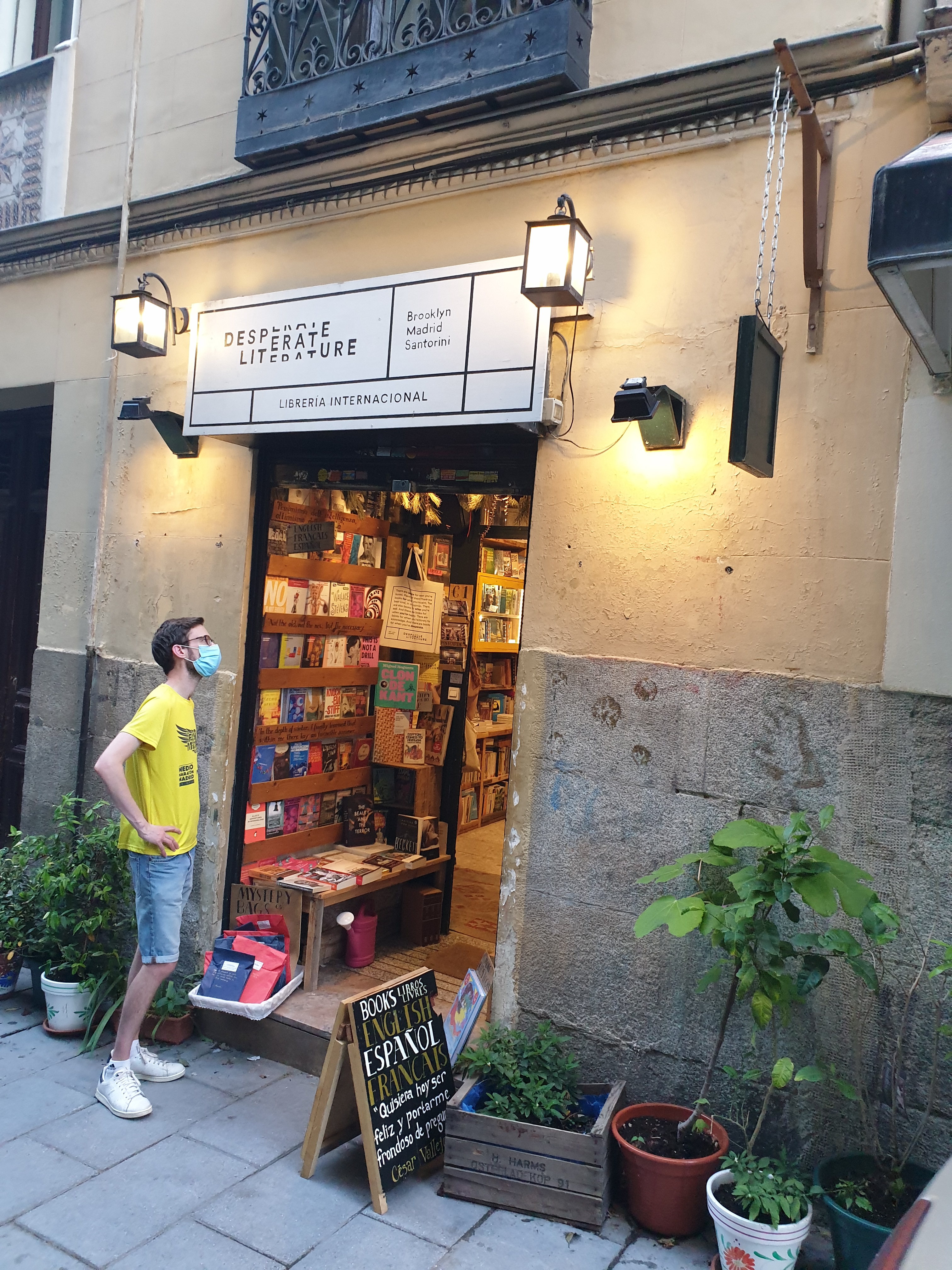
Fast forward to 2018 when my dear friend Matthew came to visit me in Madrid. He stayed at a hotel in the old part of town. One evening after I dropped him off, around the corner from the hotel, on narrow Campomanes street, I bumped into Desperate Literature. I was ecstatic! What a discovery, what a find! A tiny bookstore, but filled with books mostly in English, with a few in Spanish and French for good measure. It was a tiny paradise, an oasis of… books!

Books in time of Covid

Books in time of Covid

I soon found out that this bookshop is part of Atlantis Books which I had read about in that Vanity Fair article. It all fit in, a collection of magical bookstores.

During this Covid-19 pandemic I found out they were sending books to folks. I ordered one and I was able to make use of my workout time to ride my bicycle to pick it up.

In conclusion: support your local -hopefully quirky- bookstores, and read.