The Quixotic in David Lynch’s The Straight Story

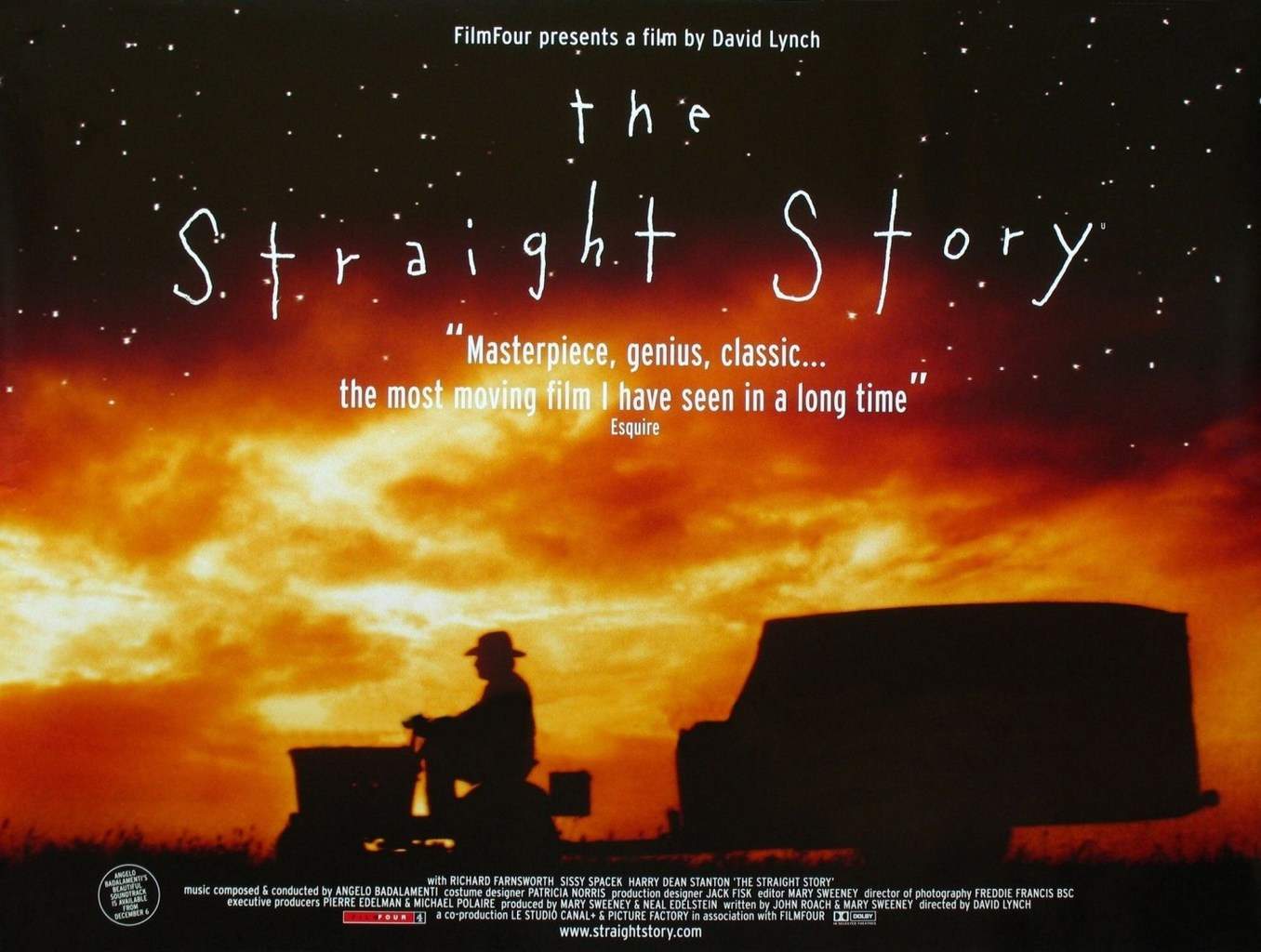
The Straight Story poster

When people think of David Lynch, they think of surreal, dream sequences and noir-style classics like Blue Velvet or Mulholland Drive. Because it is in essence a documentary, The Straight Story is the exception to the rule. It is based on the real story of a fellow, Alvin Straight—thus the name—who travels to visit his brother 300 miles away on a riding lawnmower!!

Due to Lynch’s recent passing, we just celebrated a David Lynch month in Film Club, and it was fantastic, a little homage, our tribute. We saw Elephant Man, Blue Velvet, The Straight Story, and Mulholland Drive.

One of the many things I learned during this month’s research is how much of a jokester Lynch was—what a character! But did he know how much of a Quixotic journey his film represents?

The few outward, visible clues that Straight Story is a Midwestern, late 20th-century Quixote story are that Straight is an older, skinny, rough-bearded fellow with an existential need to embark on this trip. Like Don Quixote, he has a false start to his adventure, returning home before starting his quest. He has a cohort of naysayers -hanging out at the local hardware store, the hardheadedness, a boring home life; although he has a loving daughter in Sissy Spacek, a phenomenal, but underrated actress.

The Straight Story poster

Along the way, he has many adventures: he encounters a group of cyclists, reminiscent of Quijote’s encounter with the herd of sheep, the lady who keeps running over deer, a few close encounters with 18-wheelers, giants? Etc.

But at the end of the day, this is a story of a man seeking his redemption, it is a physical representation of an inner journey, it is an existential, transcendental quest. It is important to know that while most road films represent an escape, in this case, like in Quijote, the journey is a necessary trip of personal realization.

The film is beautifully shot with great photography of the vast Midwest, not unlike the plains and hills of La Mancha. Straight camps out most nights, and like Quijote depends on the charity of strangers to progress on his trip.

One could argue that most road trip films are in some way Quixotic, but I argue that Lynch’s Straight Story is particularly so.

Don Quixote, Monsignor Quixote, Graham Greene, and madness vs. Existentialism

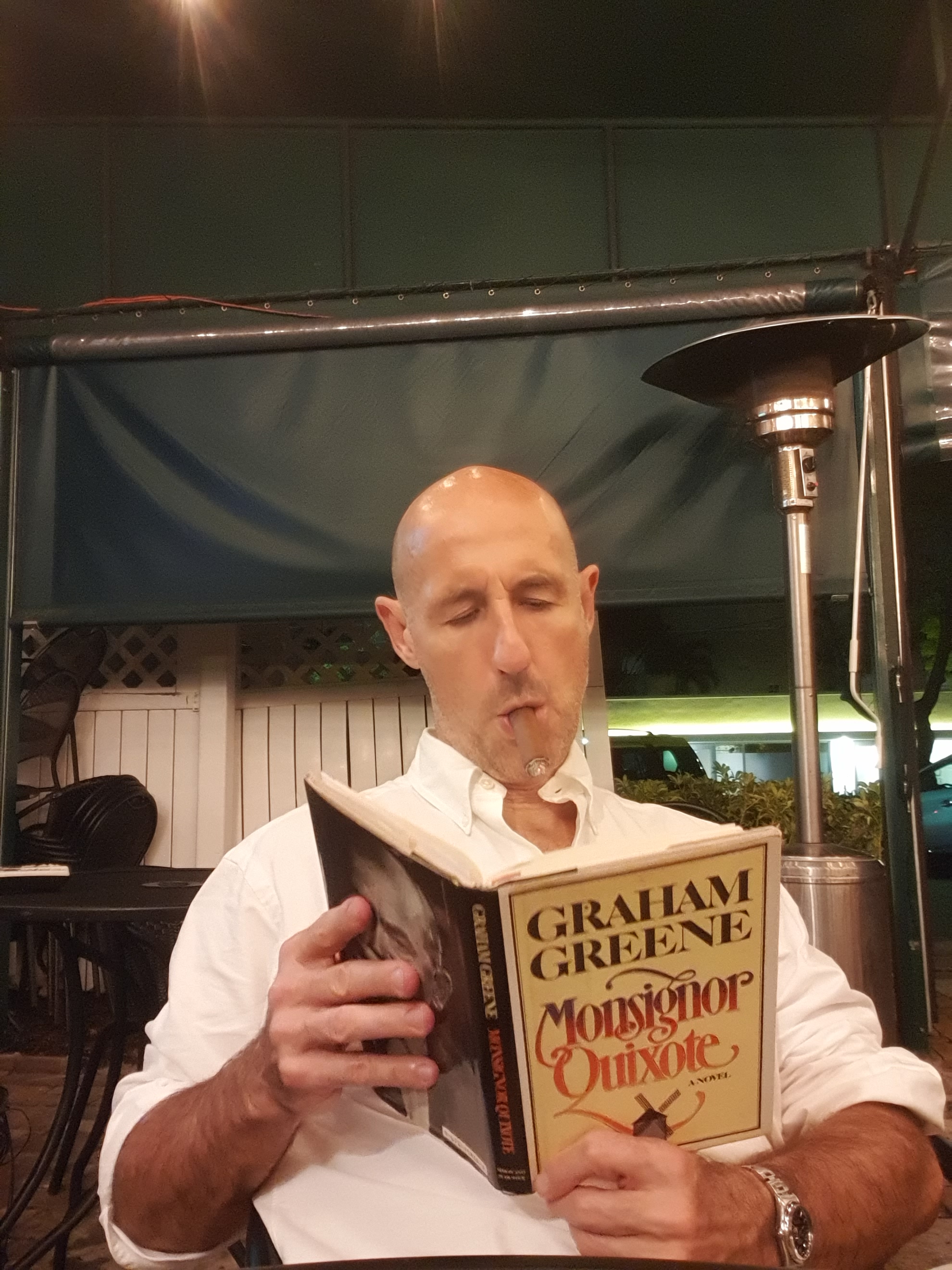
A good book and a good cigar

There are books that I re-read with certain regularity: The Old Man and the Sea, Voltaire’s Candide, the Rubaiyat of Omar Khayyam (you can read about that one here), Don Quixote only three times.

But I recently came across a book I had read as a teenager in the 80s and decided to revisit: Graham Greene’s Monsignor Quixote.

As you can see from the title -I will try not to spoil anything- in a fictional meta-reality, Monsignor Quixote deals with the adventures of a descendant of Don Quixote. There is a Rocinante and a Sancho. Greene converted to Catholicism at 22 in 1926 (you can read his bio here) and this novel deals precisely with -no spoilers- with religion, theology, and the Church in early ‘80s, post Franco Spanish society (It was published in 1982). The book is an easy, quick read, and, since I am always on the lookout for the far reaching effects of Don Quixote, I re-borrowed Monsignor Quixote (thanks Sue) and thoroughly enjoyed it.

My more faithful readers know that one of my research interests is the influence of Don Quixote on Existentialist philosophy. So my antennae are always poised to pick up on this theme. Monsignor Quixote does not disappoint! The references to the links between Don Quixote and Existentialism might have been written unknowingly by Greene, which I doubt, but they are there either way:

There is a heartfelt reference to Miguel de Unamuno who was a big fan of Don Quixote and a proto-Existentialist (read San Manuel Bueno, Mártir). This is an indication that Greene understands Cervantes.

There are explicit mentions of Monsignor Quixote acknowledging his existence, which is a big step in understanding who one is.

The novel deals with our doubts and beliefs, the Existential anguish that drove Kierkegaard (but not in those words), the father of Existentialism -which would make Cervantes the great-grandfather of Existentialism (read about that here).

Finally, as any alert reader would expect of a novel with the name Quixote in it, it talks of madness. Of course, folks -specially those who have not read the novel- often confuse Don Quixote’s drive and purpose with madness (which drives me mad). I will not elaborate but Don Quixote knows who he is, it is just that nobody understands what he is doing, so they call him mad. This leads me to my first and hopefully last political statement ever on this blog: Former President Trump was often called Quixotic, for whatever reason, and the people who labeled Trump like that have obviously never read, and/or never understood Cervantes’ novel!! A similar point is seen in the film Easy Rider when Jack Nicholson as George Hanson says:

Oh, yeah, they’re gonna talk to you, and talk to you, and talk to you about individual freedom. But they see a free individual, it’s gonna scare ’em.

I guess I could have written a more academic article about this book, and maybe I will, but for the time being, enjoy.

A good book and a good coffee