Once you find something that you are passionate about, go all in; get involved, make friends who share your passion, and join a club or association. This will make your projects much more rewarding. You are welcome. My main hobby, which is also partly my job, is literature, words, and everything related to that: books, poetry, narrative, etc., etc.
If you follow this blog at all you know that I enjoy writing book and film reviews when I find something interesting to say about them. Since my job is also scholarly and academic, I also occasionally write book reviews for academic journals (see here).
Luis Correa-Díaz is a professor, a corresponding member of the Real Academia de la Lengua both in Chile and in the US, and a great poet and friend whom I follow. If you have a good memory and you read this blog, you might remember that I have reviewed some of his latest books (La Valparadisea, El escudo de Chile, and Valparaiso puerto principal).
Because I enjoy everything Luis Correa-Díaz writes, I recently bought his most recent project: Justice League of America: Los 7 originales, a bilingual compilation of Hispanic and Latino poetry. I liked it so much, I not only wrote a review, but sent it to the influential Latino Book Review for publishing, which they miraculously did!
How do you deal with the metaphysical? That which is beyond your grasp? Your conception? Well, if you are Luis Correa-Díaz, you write poetry. If, like me, you do not have that kind of talent, you read his poetry.
Up from Georgia is a collection of 64 sestets which look innocent enough, until you read them; then get ready to have them move you.
Some poems are whimsical, even funny on the surface, like the opener, referring to the Georgia font, but with a twist at the end referencing a possible epitaph, like the surprise ending of a haiku.
What follows -and this is the trick- are poems about death and farewells, but lit with self-referential jesting, with the light from his favorite coffee shop in Athens (the Georgia one), AI, QRs, REM (also from Athens, the Georgia one), NASA, bagels, Chick-fil-A, or proto-cyborgs. But do not be fooled, those waters are deeper than they seem: they talk of Ercilla, and Thomas Merton, of Gregorio Marañón, and of course, Neruda.
It is in this dance between the mundane and the transcendental that Correa-Díaz flourishes, that he lets us into his world, into his moods, one line at a time.
This is the brilliance of Correa-Díaz, a 21st-century poet, crafting the juxtaposition of beautiful poetry, full of meaning and sentiment in a breakfast joint in Athens (the Georgia one).
As everybody knows, books are living creatures, and as such, they have their own lives. This is the story of a wonderful book.
Luis Correa-Díaz came into my life socially, during a visit to Chapel Hill a couple of years ago. Knowing that he is from Chile, when saw an old -ancient- National Geographic with the main story on Chile, I did not hesitate to send it to him, as a bit of a nostalgic curiosity. What I did not expect was that he was going to pay back that silly gesture by sending me his latest book of poems: Valparaíso, puerto principal.
I treasured this book, waiting for the right time to dive in, which was during my recent silence and meditation retreat (see previous post). As I took the book out to the monastery’s cloister garden, I was filled with excitement. Before digging in, that anticipation of starting a new book, I was called to the fountain… ¿how about some photos for the blog? So, I got clicking, until, in and adventurous and risky pose, the book was blown into the fountain (yes, I know you were expecting that, I did too, but I took my chances…)
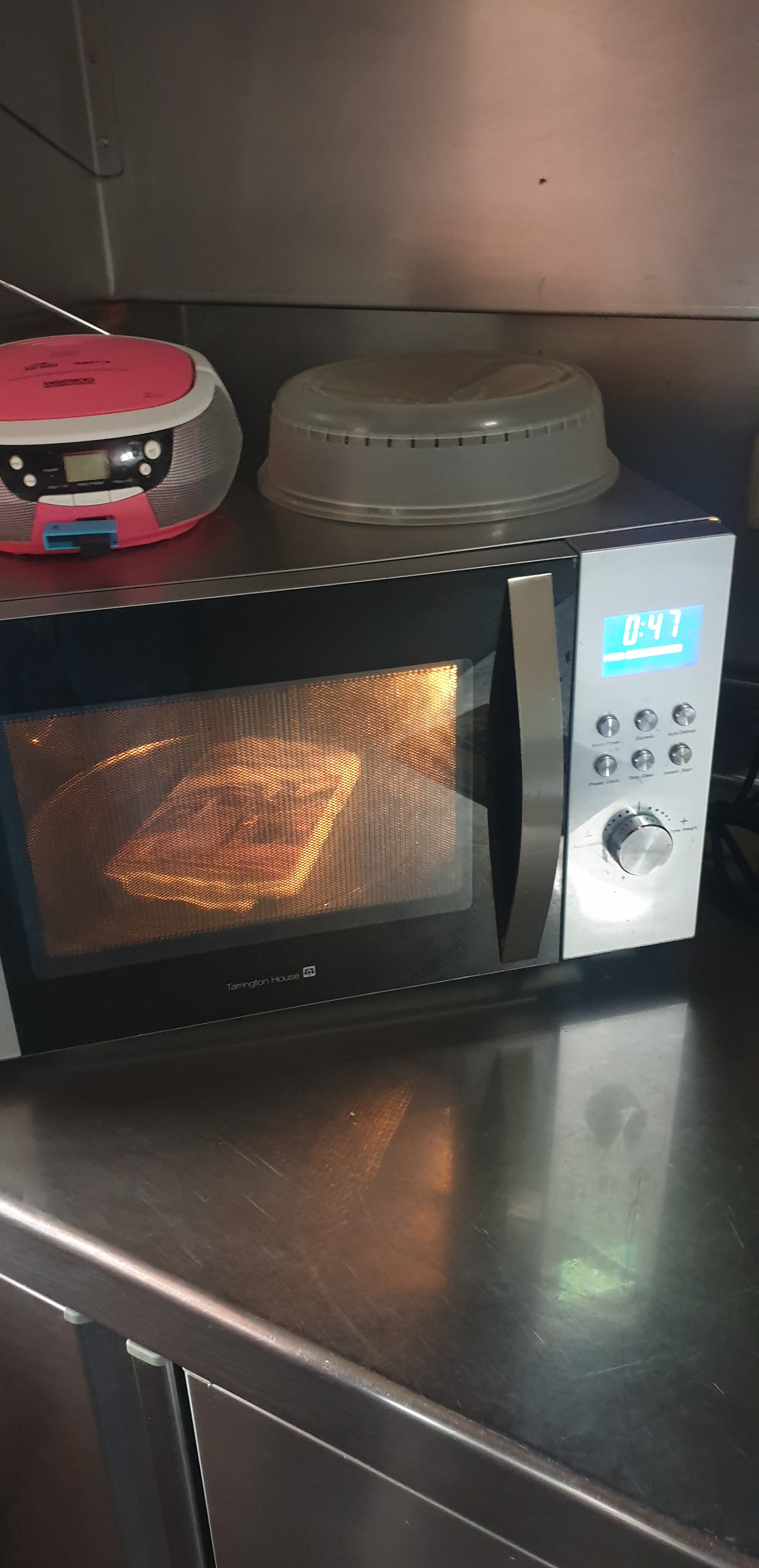
A quick rescue and a rush to the monastery kitchen soon had the book in the microwave oven for an ER intervention. Coming out steaming hot -literally- I blew the steam out making sure the words stayed put on the page. This had to be done a few times to ensure the book dried quickly. It survived, albeit with stiff, wavy pages that say: “I had an adventure” and “my owner is an idiot”.
What I love about Correa-Díaz´s writing is that it appears casual, carefree, with all sorts of English words, Millennial English words -even emoticons thrown in. But as those happy-go-lucky words sink in you see, no, you notice the feeling, the emotion of those words. In this case, his beloved Valparaiso as a home he no longer lives in (exactly how I feel about my Madrid). His writing is peppered with references to Teilhard de Chardin or Madonna, to the local coffee shops, where you can almost smell the coffee suffusing from the old walls, plus all the local references that one has to be a local to identify, reminiscent of the best Gabriel García Márquez.
This book will make you miss Valparaíso, even if, like me, you have never been there. This is what the Portuguese and Brazilians call saudade, or the Gallegos morriña (you can read about that feeling here), there is no comparable word in English, sorry.
For a long time, I just had this title sitting in my drafts box. Today I finally approached it.
Poetry and poems grow with you, some stay longer than others, some come and go, some you even forget, and some stay with you forever.
In my case Neruda and Cavafy are both engraved in my memory since my college days. Also, from my days in university, Tennyson, but he drifted out, like the many poets in the massive Victorian Prose and Poetry book we studied. Some lines stayed with me, like “’Tis better to have loved and lost than never to have loved at all.” from In Memoriam A.H.H.
But a few lines kept re-visiting me, like messages from a distant shore. When I left Spain in 2005, I memorized the whole poem, to recite it to my friends during the farewell dinner (at Alfredo’s, of course).
Then, every Summer, at my mother’s country house I reach for that big old book and search for that poem, and read it, and more often than not, cry.
Yes, the poem is famous, yes, Frasier recited it in his farewell from his TV show, and yes, M recites it in a recent James Bond film, but that does not make it any less good. On the contrary, it is a testament to the quality of the poem.
Here it is, enjoy. (If you are pressed for time, the final 15 lines are the most well known, I have marked the spot with an *.)
And if you would rather listen to the poem click here, it is a 5 minute listen.
Ulysses
It little profits that an idle king,
By this still hearth, among these barren crags,
Match’d with an aged wife, I mete and dole
Unequal laws unto a savage race,
That hoard, and sleep, and feed, and know not me.
I cannot rest from travel: I will drink
Life to the lees: All times I have enjoy’d
Greatly, have suffer’d greatly, both with those
That loved me, and alone, on shore, and when
Thro’ scudding drifts the rainy Hyades
Vext the dim sea: I am become a name;
For always roaming with a hungry heart
Much have I seen and known; cities of men
And manners, climates, councils, governments,
Myself not least, but honour’d of them all;
And drunk delight of battle with my peers,
Far on the ringing plains of windy Troy.
I am a part of all that I have met;
Yet all experience is an arch wherethro’
Gleams that untravell’d world whose margin fades
For ever and forever when I move.
How dull it is to pause, to make an end,
To rust unburnish’d, not to shine in use!
As tho’ to breathe were life! Life piled on life
Were all too little, and of one to me
Little remains: but every hour is saved
From that eternal silence, something more,
A bringer of new things; and vile it were
For some three suns to store and hoard myself,
And this gray spirit yearning in desire
To follow knowledge like a sinking star,
Beyond the utmost bound of human thought.
This is my son, mine own Telemachus,
To whom I leave the sceptre and the isle,—
Well-loved of me, discerning to fulfil
This labour, by slow prudence to make mild
A rugged people, and thro’ soft degrees
Subdue them to the useful and the good.
Most blameless is he, centred in the sphere
Of common duties, decent not to fail
In offices of tenderness, and pay
Meet adoration to my household gods,
When I am gone. He works his work, I mine.
There lies the port; the vessel puffs her sail:
There gloom the dark, broad seas. My mariners,
Souls that have toil’d, and wrought, and thought with me—
That ever with a frolic welcome took
The thunder and the sunshine, and opposed
Free hearts, free foreheads—you and I are old;
Old age hath yet his honour and his toil;
Death closes all: but something ere the end,
Some work of noble note, may yet be done,
Not unbecoming men that strove with Gods.
The lights begin to twinkle from the rocks:
The long day wanes: the slow moon climbs: the deep
Moans round with many voices. * Come, my friends,
‘T is not too late to seek a newer world.
Push off, and sitting well in order smite
The sounding furrows; for my purpose holds
To sail beyond the sunset, and the baths
Of all the western stars, until I die.
It may be that the gulfs will wash us down:
It may be we shall touch the Happy Isles,
And see the great Achilles, whom we knew.
Tho’ much is taken, much abides; and tho’
We are not now that strength which in old days
Moved earth and heaven, that which we are, we are;
Although I have a few editions, the other day I picked up a nice, used copy of The Rubaiyat of Omar Khayyam. It is one of my favorite books/poems of all time. I think it all started in the early 80s when we were living in London. My mom hired an Iranian English teacher to teach her English. I rarely saw her. I would come home from school and she would be in class with my mom. But one holiday she came to visit us in my parents’ country house outside Madrid. As a gift she brought a kilo of pistachios -which to this day I love, and a beautiful edition of the Rubaiyat.
I immediately fell in love with that book, it had an illustrated cardboard cover and beautiful illustrations. Every page had the verses in the original (more on that later) Persian or Farsi, English, and French. Right after college I purchased my first copy, and I would read it occasionally. For the last few years, I read it almost every Summer! This is not so strange, as there are several books I read and have read multiple times: Voltaire’s Candide and Hemingway’s The Old Man and the Sea are examples.
At any rate, the book is not without controversy: About the original text, about authorship, about religious interpretations, and about the translations. I have no academic interest in the text, I just enjoy the poetry. I love the flow of the verses, the circularity of the themes, the imagery. It is ancient Persian but feels totally modern. It is an appeal to stop and smell the roses, something that we so often forget to do. Take for example:
I sent my Soul through the Invisible
Some letter of that After-life to spell:
And by and by my Soul return’d to me,
And asnwer’d “I Myself am Heav’n and Hell”
While I do not consider myself an Epicurean or a Hedonist in the modern interpretation of the words, I do enjoy small pleasures in life – which is much closer to the original thought of Epicurean philosophy, to enjoy modest pleasures from tranquility. Thus, I love a good cup of coffee or glass of wine, a well-prepared meal, a well rolled cigar, a piece of music or any art. That, I believe is the message of the Rubaiyat: to enjoy the moment that is life.
Let me know what you think of the Rubaiyat in the comments section.






 Antonioyrocinante's Blog