Whenever possible, if you find the right person at the right time, get a guest speaker.
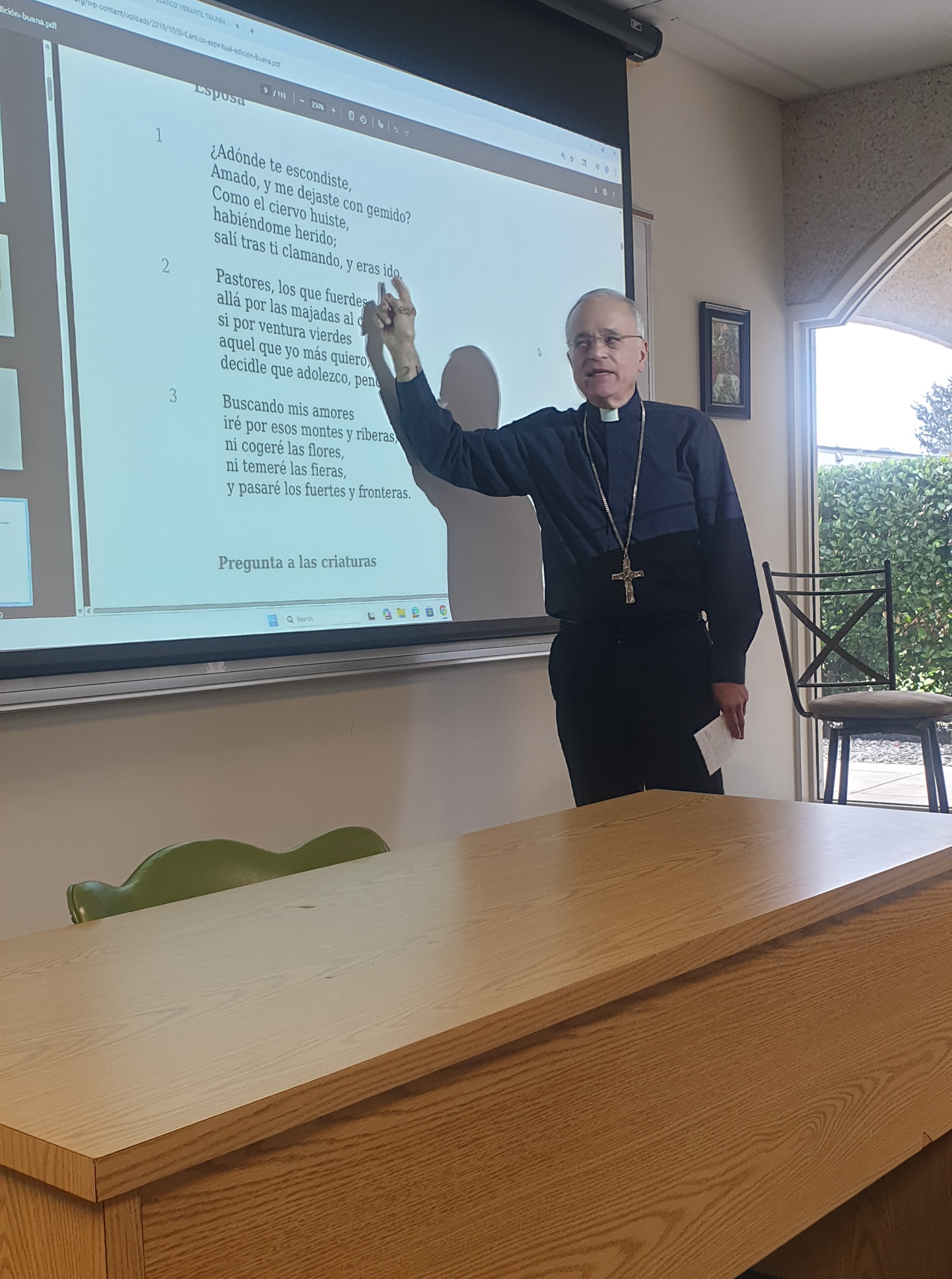
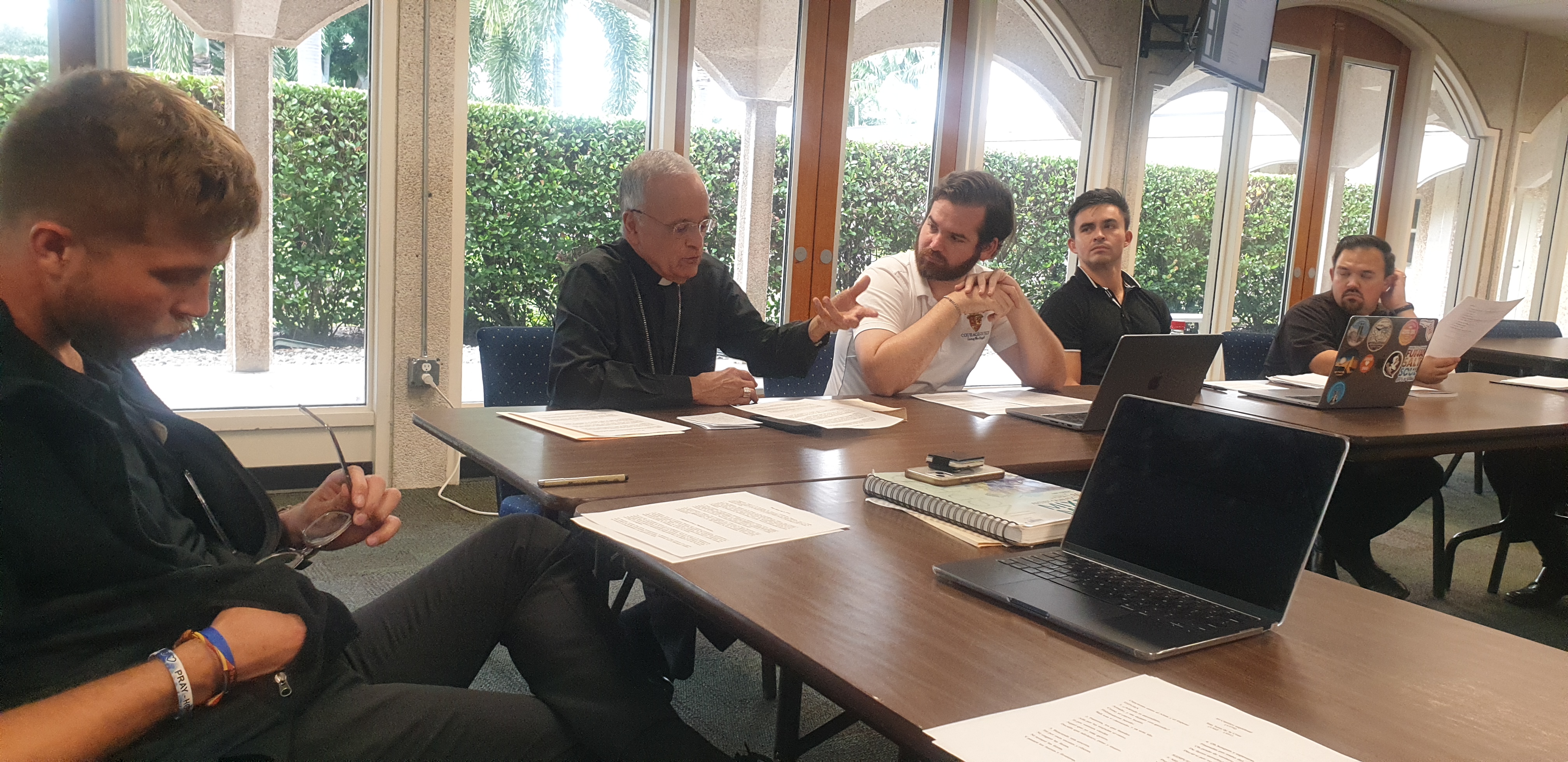
Bishop Silvio Báez @silviojosebaez of Managua is a Carmelite who just happens to work at my school. After much discussion and persuasion, I finally convinced him to attend my Spanish Art and Literature class to talk about St. John of the Cross. We arranged, organized, and scheduled, and he exceeded expectations. Bishop Báez brought his old St. John book, tattered and torn, from when he was a seminarian!
We only had time to explore the first 5 stanzas of the Spiritual Canticle, and he showed us how the writing leads directly to spirituality. Of course, St. John is the master of lyric poetry, and Bishop Baez knew exactly how to tease out St. John’s technique, method, and tricks to transport the reader to a deep spiritual realm. Bravo!
Of course, for the students, it is a new, different voice —an authority on the subject— presenting new material.
Over the years, I have managed to get the Spanish Consul in Boston and his Education Attaché to come chat. Poet Daniel Bosch explained how the very structure of Pablo Neruda’s Veinte Poemas de Amor is in itself a poem. At UNC, I met the owner of a local restaurant who spoke excellent Spanish, so I invited her to my Spanish for Business class.
On the other hand, if you can talk about a subject with some authority, then it is only fair for you to give back by being a guest speaker. I have been a guest speaker a couple of times: once on bullfighting, a couple of times on entrepreneurship, and a couple of times on public speaking.
So if the stars align and you can pull it off, get a guest speaker; your students will appreciate it.
How do you deal with the metaphysical? That which is beyond your grasp? Your conception? Well, if you are Luis Correa-Díaz, you write poetry. If, like me, you do not have that kind of talent, you read his poetry.
Up from Georgia is a collection of 64 sestets which look innocent enough, until you read them; then get ready to have them move you.
Some poems are whimsical, even funny on the surface, like the opener, referring to the Georgia font, but with a twist at the end referencing a possible epitaph, like the surprise ending of a haiku.
What follows -and this is the trick- are poems about death and farewells, but lit with self-referential jesting, with the light from his favorite coffee shop in Athens (the Georgia one), AI, QRs, REM (also from Athens, the Georgia one), NASA, bagels, Chick-fil-A, or proto-cyborgs. But do not be fooled, those waters are deeper than they seem: they talk of Ercilla, and Thomas Merton, of Gregorio Marañón, and of course, Neruda.
It is in this dance between the mundane and the transcendental that Correa-Díaz flourishes, that he lets us into his world, into his moods, one line at a time.
This is the brilliance of Correa-Díaz, a 21st-century poet, crafting the juxtaposition of beautiful poetry, full of meaning and sentiment in a breakfast joint in Athens (the Georgia one).
For a long time, I just had this title sitting in my drafts box. Today I finally approached it.
Poetry and poems grow with you, some stay longer than others, some come and go, some you even forget, and some stay with you forever.
In my case Neruda and Cavafy are both engraved in my memory since my college days. Also, from my days in university, Tennyson, but he drifted out, like the many poets in the massive Victorian Prose and Poetry book we studied. Some lines stayed with me, like “’Tis better to have loved and lost than never to have loved at all.” from In Memoriam A.H.H.
But a few lines kept re-visiting me, like messages from a distant shore. When I left Spain in 2005, I memorized the whole poem, to recite it to my friends during the farewell dinner (at Alfredo’s, of course).
Then, every Summer, at my mother’s country house I reach for that big old book and search for that poem, and read it, and more often than not, cry.
Yes, the poem is famous, yes, Frasier recited it in his farewell from his TV show, and yes, M recites it in a recent James Bond film, but that does not make it any less good. On the contrary, it is a testament to the quality of the poem.
Here it is, enjoy. (If you are pressed for time, the final 15 lines are the most well known, I have marked the spot with an *.)
And if you would rather listen to the poem click here, it is a 5 minute listen.
Ulysses
It little profits that an idle king,
By this still hearth, among these barren crags,
Match’d with an aged wife, I mete and dole
Unequal laws unto a savage race,
That hoard, and sleep, and feed, and know not me.
I cannot rest from travel: I will drink
Life to the lees: All times I have enjoy’d
Greatly, have suffer’d greatly, both with those
That loved me, and alone, on shore, and when
Thro’ scudding drifts the rainy Hyades
Vext the dim sea: I am become a name;
For always roaming with a hungry heart
Much have I seen and known; cities of men
And manners, climates, councils, governments,
Myself not least, but honour’d of them all;
And drunk delight of battle with my peers,
Far on the ringing plains of windy Troy.
I am a part of all that I have met;
Yet all experience is an arch wherethro’
Gleams that untravell’d world whose margin fades
For ever and forever when I move.
How dull it is to pause, to make an end,
To rust unburnish’d, not to shine in use!
As tho’ to breathe were life! Life piled on life
Were all too little, and of one to me
Little remains: but every hour is saved
From that eternal silence, something more,
A bringer of new things; and vile it were
For some three suns to store and hoard myself,
And this gray spirit yearning in desire
To follow knowledge like a sinking star,
Beyond the utmost bound of human thought.
This is my son, mine own Telemachus,
To whom I leave the sceptre and the isle,—
Well-loved of me, discerning to fulfil
This labour, by slow prudence to make mild
A rugged people, and thro’ soft degrees
Subdue them to the useful and the good.
Most blameless is he, centred in the sphere
Of common duties, decent not to fail
In offices of tenderness, and pay
Meet adoration to my household gods,
When I am gone. He works his work, I mine.
There lies the port; the vessel puffs her sail:
There gloom the dark, broad seas. My mariners,
Souls that have toil’d, and wrought, and thought with me—
That ever with a frolic welcome took
The thunder and the sunshine, and opposed
Free hearts, free foreheads—you and I are old;
Old age hath yet his honour and his toil;
Death closes all: but something ere the end,
Some work of noble note, may yet be done,
Not unbecoming men that strove with Gods.
The lights begin to twinkle from the rocks:
The long day wanes: the slow moon climbs: the deep
Moans round with many voices. * Come, my friends,
‘T is not too late to seek a newer world.
Push off, and sitting well in order smite
The sounding furrows; for my purpose holds
To sail beyond the sunset, and the baths
Of all the western stars, until I die.
It may be that the gulfs will wash us down:
It may be we shall touch the Happy Isles,
And see the great Achilles, whom we knew.
Tho’ much is taken, much abides; and tho’
We are not now that strength which in old days
Moved earth and heaven, that which we are, we are;
Although I started this blog years ago with some poetry: Frost’s The Road Not Taken and Cavafy’s Ithaka, I have not written as much about poetry as I should have, given how much I enjoy it, and compared to other arts. Sure, I recently wrote about Omar Khayyam’s Rubaiyat, but that is still not enough for my liking. So here is an attempt to fix that.
My first conscious appreciation of poetry came in college with Pablo Neruda. To this day I am still moved by his words, and Tu Risa is still one of my favorite poems. Alfred Lord Tennyson’s Ulysses is also right up there as well as the two poets mentioned at the beginning. But the list of favorite poets is a long one: Lorca, Bequer, Espronceda, Benedetti, Mistral, Pessoa, Milton, Manrique, Dante, EE Cummings, Wordsworth and Coleridge, Blake, Elizabeth Bishop, and on and on. But one does not have to go to the big guns to find poetry that will amaze you. Naïf, amateur or student writers can take you places you would not think. Sometimes poetry hits you when you least expect it: I was surprised and blown away by 22-year-old Amanda Gorman at Biden’s Inauguration. Quadriplegic Ramón Sampedro, euthanasia’s cause célèbre in 90s Spain also wrote some sweet lines. Check out this poem in the namesake movie:
For me, the beauty of poetry is the capacity it has to transport you in a few words, in a verse. Never mind words, Haikus only have seventeen syllables – three lines!! I love Haikus: although I knew and had read them before, I actually became a follower of Haiku poetry by reading, wait for it… Jack Kerouac’s book of Haikus! (although he does not always follow the 17-syllable rule), since then I have read and enjoyed Bashō, the master. I am in awe of poets since I cannot write my way out of a paper bag (thank you for reading this, it means a lot).
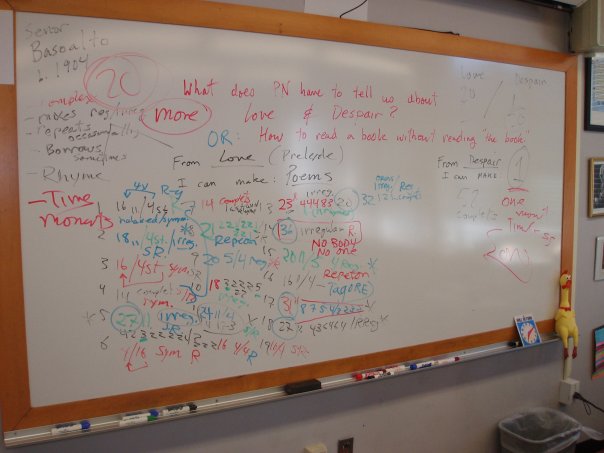
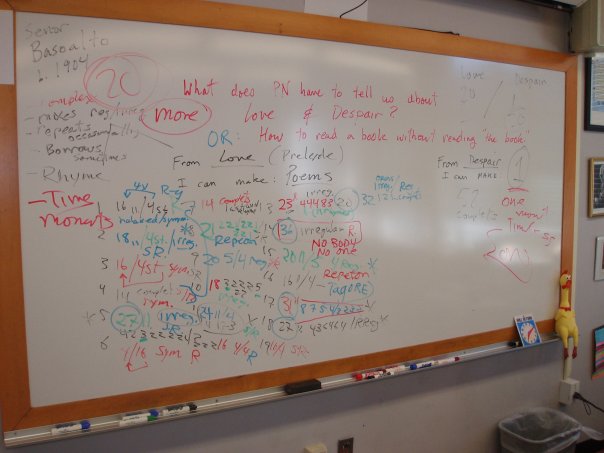
Years ago, at Walnut Hill School I got a glimpse, a backstage tour of the poetry world from the brilliant poet and teacher Daniel Bosch. I once invited him to my advanced Spanish class to talk about Neruda’s Veinte poemas de amor…, which we were studying at the time, and he blew our minds!! Daniel also wrote a hilarious poem when I got my citizenship: Song for a New American. To this day it is framed and on my wall!!
I write all this because I have just read …del amor hermoso by Chilean author and teacher Luis Correa-Díaz, and it is wonderful. His capacity to write about love, apparently in a playful manner, but not really. His poems are soaked in ecclesiastical vocabulary and structure which gives his writing an extra edge and throws you off the traditional expectation as a poetry reader. This is apparently three books in one, which again is a bit unsettling: where there originally three separate books? Is it all another manipulation of my expectations? Another old-fashioned trick, which still works is that he “found” the poems in a manila envelope, and the ones he did not find are “anonymous”. Never mind the trickery, the poems are lovely and they keep you reading and paying attention.
Locked up at home during the Coronavirus quarantine, I get to read a lot, which got me thinking of books This blog exists because of books. You see, I started this blog to report my Harley-Davidson trip visiting universities across the South for my PhD in Spanish Literature, that is: books. Yes, I am addicted to books. Having said that, I am a slow reader. So, while I enjoy books, I do not devour books like some folks do. Anyway let’s start at the beginning:
My first blurry memories of reading are of Enid Blyton, I guess like millions of children. Fortunately in high school, I had the privilege of being taught by Mrs. Soledad Sprackling. And my mind exploded with what she had me read: Borges, Neruda, Lorca, et al. That was it, I was hooked. In college my super cultured friend Silvia Velez introduced me to Gabriel García Márquez and my mind exploded again! It has been a series of explosions since.
Luckily I can read in Spanish, English and French and find it very frustrating when I cannot read every book in the original language it was written in. In fact, when I was twirling about with the idea of getting my PhD, I wanted to study comparative lit Spanish / Russian, but there was no way I was going to learn that level of Russian in a hurry, so that was the end of that thought. Miguel de Unamuno, one of my literary heroes actually learnt Danish so he could read Kierkegaard, bastard.
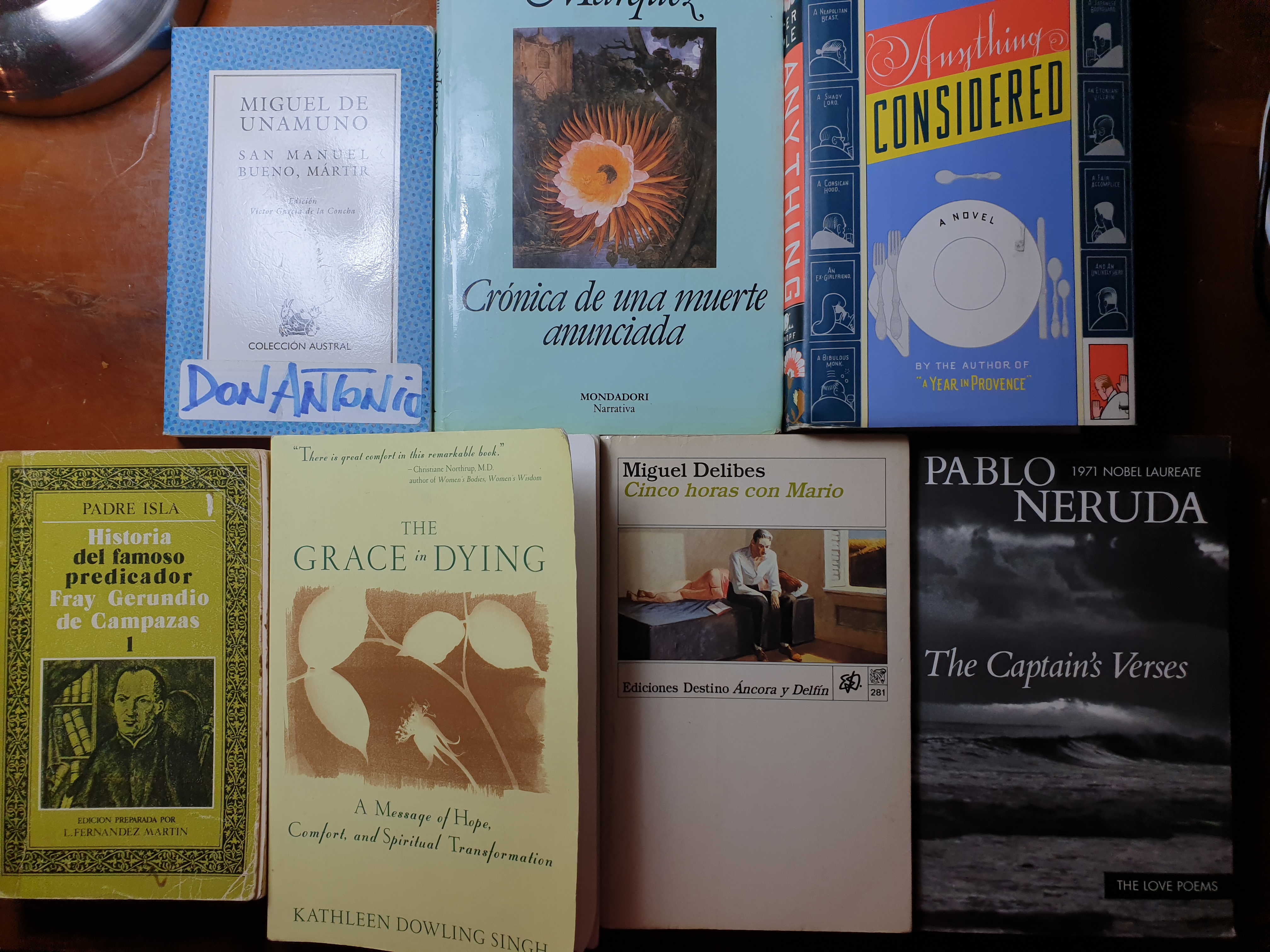
Here is a list of some of my favorite books with only number 1 in a clear position – all the rest vary according to the day you ask me:
Miguel de Cervantes – Don Quixote. I have only read it three times, once with the amazing Prof. Louise Cohen. She shared with me her passion for this book, which I have written about in previous posts.
Alexandre Dumas –The Count of Montecristo. Love, adventure, revenge, massive wealth, what’s not to like?
Leo Tolstoy – Anna Karenina / War and Peace / Death of Ivan Ilyich. Tough call on this one…
Ernest Hemingway – For Whom the Bell Tolls or The Old Man and the Sea. It takes a foreigner to describe Spain with such precision. High School is also where I got hooked on Hemingway.
Gabriel García Marquez – Cien Años de Soledad (But really any by him). Of course, nowadays, I keep thinking of Love in the Times of Cholera
Voltaire – Candide. Possibly the best satire ever written?
Miguel de Unamuno – San Manuel Bueno, mártir. Proto-existentialism at its best!
Mikhail Bulgakov – Master and Margarita. Or as the Rollings Stones interpreted it: Sympathy for the Devil…
Francisco de Isla – His early works. After all, I am the leading authority on the subject…
Of course, there are many, many more, but I don’t want to bore you, dear reader, any more.
Interestingly, my last read was. The Grace in Dying by Kathleen Dowling Singh which was recommended to me (like so many more) by my dear friend Patxi. It is about the spiritual journey of death, and how the best approach to death is meditation. I started reading it before the massive Covid outbreak and it has helped me digest the numbers in the news. I loved it. My next read, to celebrate the centenary of Benito Perez Galdos’ death will be Trafalgar, about the battle of the same name, not the square in London.
There you have it, some thoughts on reading and my some of my favorite books. Which are yours? What do you recommend? Tell me in the comments!!
That is not one of the editions of Quijote that I have read








 Antonioyrocinante's Blog