On a Sunday in January 1979, my dad and I were puttering around the garden, collecting, and chopping wood for the fireplace, listening to the radio. The news came on and explained that the Shah of Iran had fled the country into exile. I looked over at my dad, who had dropped the ax and was running up the stone stairs into the house. He took off to work at the bank -on a Sunday morning! My dad was a foreign exchange trader, and he knew the news of the Shah leaving Iran was going to cause a lot of market turmoil.
Growing up in London in the early 80s, there were many Iranian exiles. I remember going to school with a few of them. I also remember the SAS operation to liberate the Iranian embassy in 1980, a few blocks away from my best friend’s house. Even my mom’s English teacher was a beautiful, tall, elegant Iranian who brought me pistachio nuts and gave us a beautiful edition of the Rubaiyat of Omar Khayam.
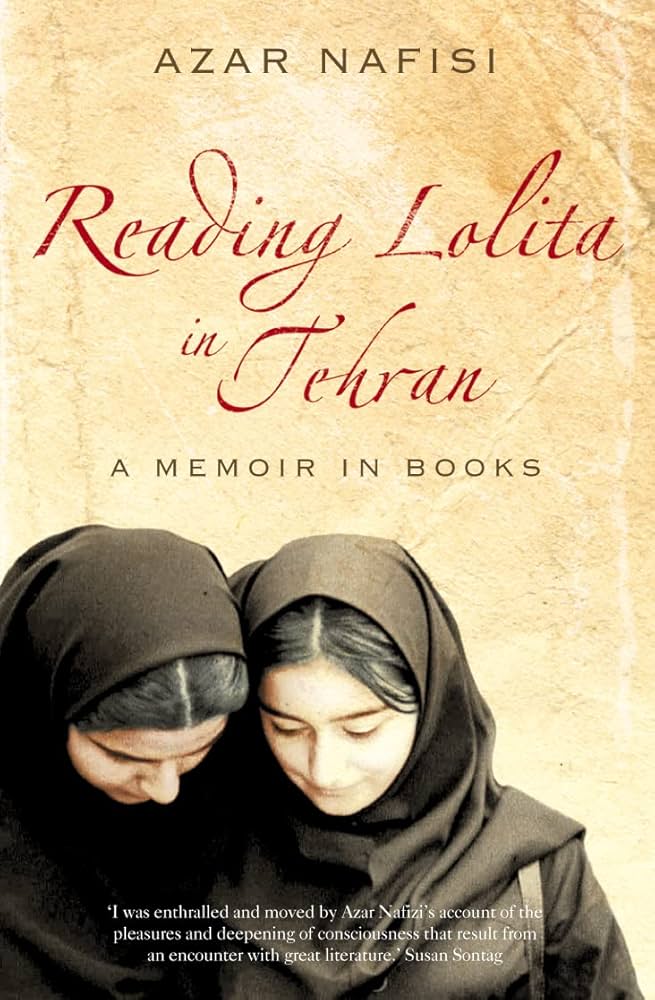
After leaving London for college in Boston in 1983, I mostly forgot the Iranian revolution. A few weeks ago, I finally picked up a copy of Azar Nafisi’s Reading Lolita in Tehran, which had been waiting on my shelf for years, not knowing really what to expect. I loved every page. (Spoiler alerts)
The book is really four books woven into one magnificent narrative, like a-forgive the cheap simile-a fine Persian rug.
The main and overarching story is the author’s own story, her memoirs, from a child in Tehran, to studying in Europe and America, to teaching in Iran, and returning to the US. It is a fascinating life story.
The second thread of that biography is Nafisi´s job as a university professor of English literature, teaching: Lolita, The Great Gatsby, Pride and Prejudice, Emma, Daisy Miller, and Washington Square… in the classroom and eventually in her living room! which is where the name of the book comes from. But Nafisi does not stop at explaining that she taught (she still does); she gives her literary critiques of all the authors mentioned! It is a brilliant and amazing third layer, reading her interpretations of all these books. Yes, I felt jealous, as I have the same job as Nafisi, but I have nowhere near her capacity or talent.
The fourth story is the history of the Iranian revolution, the origins of the Islamic Republic, the persecutions, the disappearances, the crackdowns, etc. This story reminded me of Khaled Hosseini’s 2003 novel The Kite Runner, as he describes the crumbling of Afghanistan.
Yes, Reading Lolita in Tehran came out in 2003, but if you have not read it yet, I recommend it. You are welcome.
“Do not, under any circumstances, belittle a work of fiction by trying to turn it into a carbon copy of real life; what we search for in fiction is not so much reality but the epiphany of truth.”
― Azar Nafisi, Reading Lolita in Tehran: A Memoir in Books

 Antonioyrocinante's Blog