Teaching outside the classroom (Part 2)

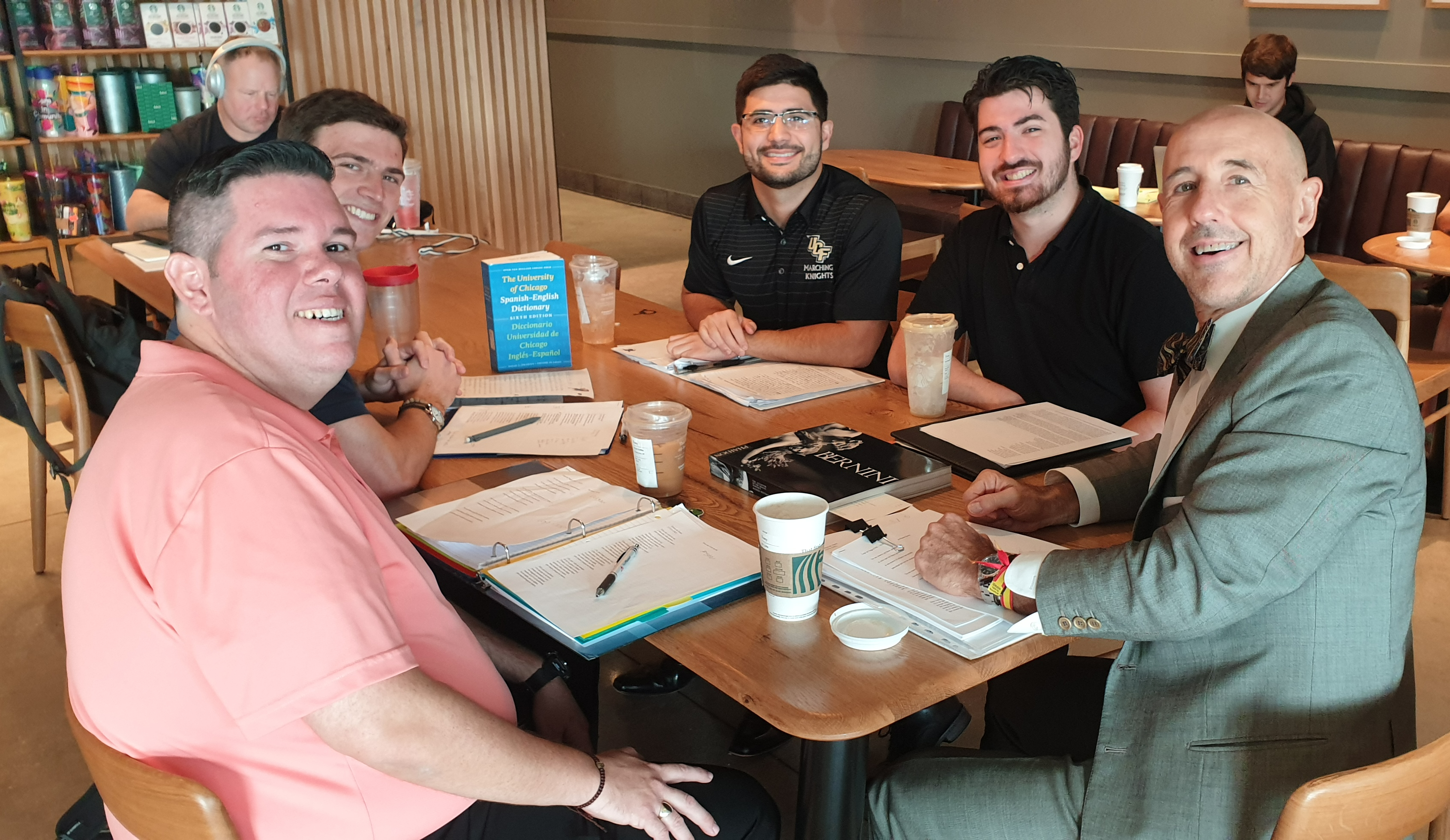
Discussing mystical literature in Starbucks!

The first part of Teaching outside the classroom was about coaching soccer, about teaching values, and teamwork, and all those “soft” skills which the classroom is not the ideal venue for. (You can read about it here)

Basically a classroom is just a room, four walls, nowadays likely packed with technology, in which your students and you meet. It is easy, you build a building, make lots of these rooms and you have a school! But we now know that these places are not the best, and not the most conducive to learning. So whenever we can, we get out of there!

Sometimes we just step outside to the garden or the dining room, steps away from the classroom. But if the course has few students and the content for the day’s class is propitious, we go to our local coffee shop (which unfortunately in our case is a Starbucks, but hey even that is better than the sterile walls of a classroom).

Outside the classroom the students seem to think “better,” more fluidly, they engage differently with the subject. I do not have the science to prove it, but those classes seem more enriching for the students.

We recently had a lesson on the great mystic Santa Teresa de Jesús and her poetry. This lesson, with only four students in the class (Advanced Spanish Language and Culture) was worth taking to the coffee shop. It worked out great, so much so that a week later I took my other section!

So if you have a small class and can do it, get out of the classroom! You are welcome.

The Camino is what the world should be like

Three months have passed since I finished my Camino for the year. I have had time to think and process my pilgrimage. In the meantime, a student from UNC interviewed me about my experience on The Camino, which helped me to vocalize my feelings about the experience.

My conclusion is that The Camino is what the world should be like. Pilgrims are generous,  considerate, and kind, we are all fairly equal, united in the task of walking to Santiago. Add to this the human and humane pace of walking, allowing you to talk to others, to enjoy the beautiful scenery, there are no unwanted interruptions, there is no need for technology. There are no hidden interests, we are all just walking and that is pretty much all there is to it. You can walk faster or slower, you can stop wherever you want. It really is a parallel world that is as much of a real world utopia as you can find.

I recently read this passage from Thomas Merton, a real modern-day mystic, and I immediately connected it to my Camino experience:

In Louisville, at the corner of Fourth and Walnut, in the center of the shopping district, I was suddenly overwhelmed with the realization that I loved all those people, that they were mine and I theirs, that we could not be alien to one another even though we were total strangers. It was like waking from a dream of separateness, of spurious self-isolation in a special world, the world of renunciation and supposed holiness. The whole illusion of a separate holy existence is a dream. . . . This sense of liberation from an illusory difference was such a relief and such a joy to me that I almost laughed out loud. . . . I have the immense joy of being [hu]man, a member of a race in which God . . . became incarnate. As if the sorrows and stupidities of the human condition could overwhelm me, now [that] I realize what we all are. And if only everybody could realize this! But it cannot be explained. There is no way of telling people that they are all walking around shining like the sun. . . . Then it was as if I suddenly saw the secret beauty of their hearts, the depths of their hearts where neither sin nor desire nor self-knowledge can reach, the core of their reality, the person that each one is in God’s eyes. If only they could all see themselves as they really are. If only we could see each other that way all the time. There would be no more war, no more hatred, no more cruelty, no more greed.

Unfortunately The Camino ends, and one returns to the world we have created. We return to noise and pollution, but even worse: to rude and aggressive people, to rushing, to everything we have constructed that separates us from peace, and beauty, and truth.