Match the author -or character (extra credit)- to the adjective (answers below)
- Kafkaesque A. In which political expediency is placed above morality, and craft and deceit areused to maintain the authority and carry out the policies of a ruler.
2. Nietzschean B. As a striving toward love of spiritual or ideal beauty.
3. Platonic C. Emphasizing the will to power as the chief motivating force of both the individual and society.
4. Orwellian D. Extravagantly chivalrous or romantic; visionary, impractical, or impracticable.
5. Machiavellian E. Describing a fictional world teeming with characters from all walks of life and social strata.
6. Quixotic F. Sacrificing spiritual values for power, knowledge, or material gain.
7. Faustian G. Marked by a senseless, disorienting, often menacing complexity.
8. Dickensian H. The totalitarian future described in his antiutopian novel 1984.
Fairly easy and short right? The reason is that very few authors -and even fewer characters- have reached the level of having their name become adjectives.
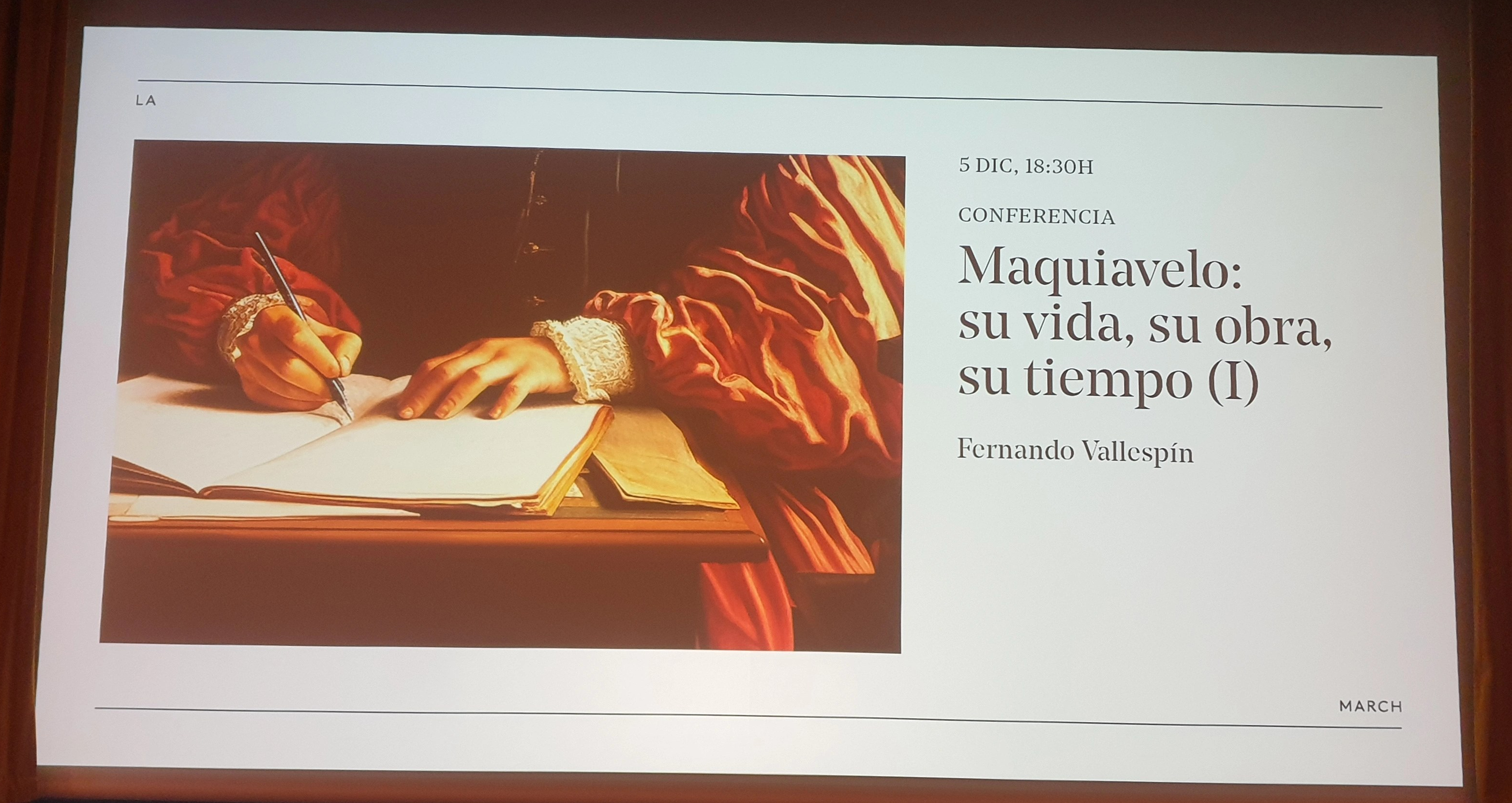
Although I am not a Renaissance specialist, I recently went to a fantastic conference on Machiavelli given by professor of Political Science at the Autonomous University of Madrid Fernando Vallespín at the fantastic Fundación Juan March.
Professor Vallespin was amazing, and his presentation was equally interesting. He obviously referenced the growing wave of Humanism that sparked and propelled the Renaissance, he commented on Giovanni Pico della Mirandola (1463–1494), he recommended Stephen Greenblat’s The Swerve, and he put Machiavelli in the context of his era. I had not read The Prince since high school back in the Pleistocene; so, it was very refreshing to re-visit Machiavelli. I remembered my Medieval Literature professor, the great Frank Dominguez mention that The Prince was written for king Ferdinand of Aragon whom Machiavelli admired. I wanted to ask Prof. Vallespin about that, but he did not stick around for Q and A…
If you are in Madrid, check out the conference cycles at the March, you will not regret it!
Answers:
1. Kafkaesque G. Marked by a senseless, disorienting, often menacing complexity.
2. Nietzschean C. Emphasizing the will to power as the chief motivating force of both the individual and society.
3. Platonic B. As a striving toward love of spiritual or ideal beauty.
4. Orwellian H. The totalitarian future described in his antiutopian novel 1984.
5. Machiavellian A. in which political expediency is placed above morality, and craft and deceit are used to maintain the authority and carry out the policies of a ruler.
6. Quixotic D. Extravagantly chivalrous or romantic; visionary, impractical, or impracticable.
7. Faustian F. Sacrificing spiritual values for power, knowledge, or material gain.
8. Dickensian E. Describing a fictional world teeming with characters from all walks of life and social strata.
*All definitions from Dictionary.com with thanks






 Antonioyrocinante's Blog