Book neutrality program

In my first full-time job at a fund manager in Boston, brilliant people surrounded me. One of those individuals was a portfolio manager named Forrest Berkley, who was brilliant and, fortunately for me, very patient. One of his adages, which he personally did not keep, was that of paper neutrality. The idea is that for every paper that came into his office, another one had to leave. This was easier said than done; his office was full of stacks of research reports from stock markets around the world! But I liked the idea, and I would occasionally mention it as a joke when I threw away some paper.

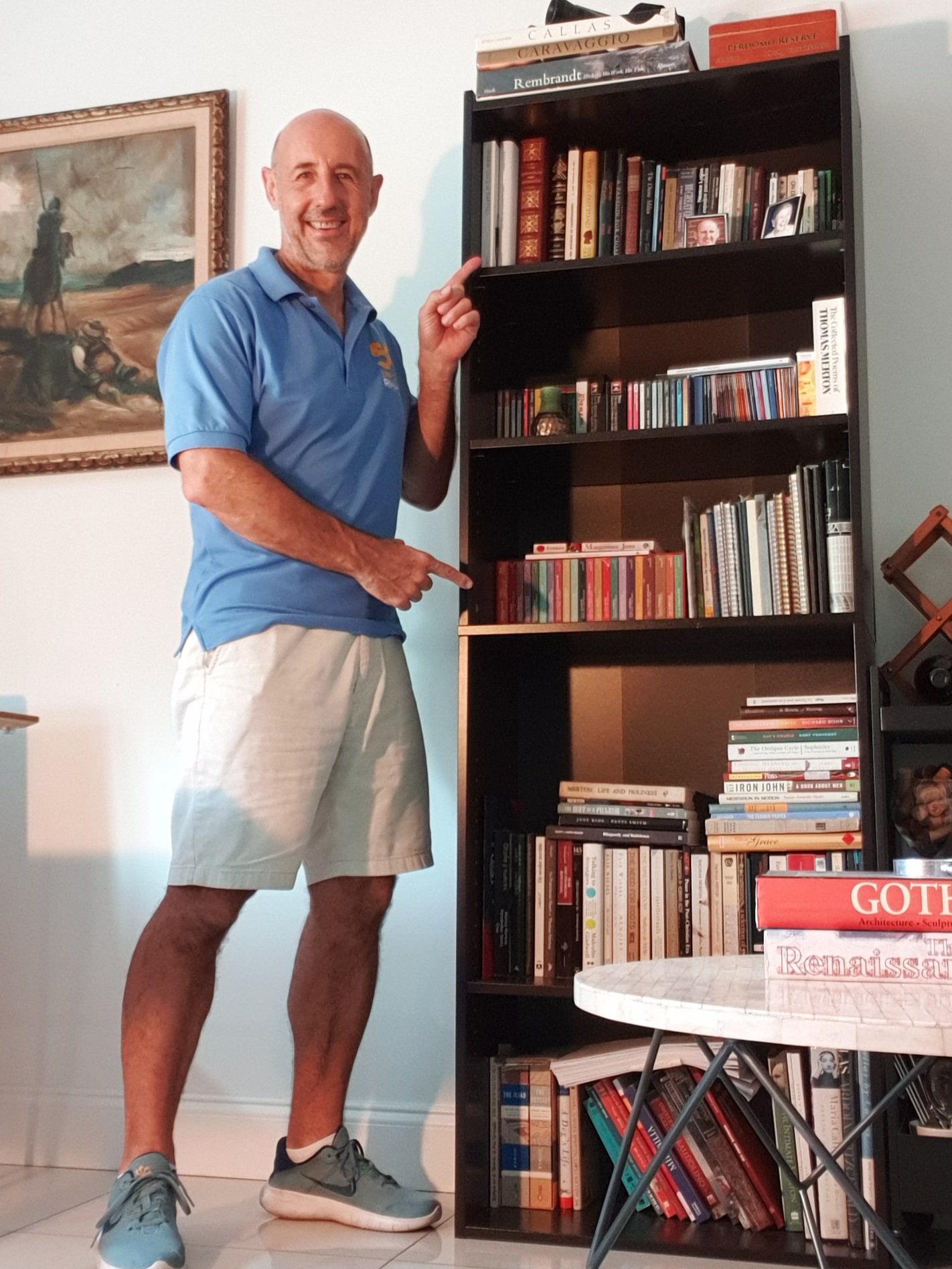
Now that I am older, I have realized that I need less and less to be happy. I have become a bit of a minimalist. While having lots and lots of books might make you look smart, you really do not need them. Once you read a book, you are rarely going to return to it for reference or to re-read it. Let’s face it, how many books have you re-read? In my case, in over 40 years of reading, I have only re-read a handful of books.* So once you read a book, give it away, donate it, sell it, you do not need it.

In that spirit, I have evoked Forrest Berkley’s old adage, and I now have a self-imposed 100-book neutrality program at home. This means that I can only have 100 books at home at any given time. This requires a lot of reading and a lot of donating and giving away books. Does it work? Yes, more, or less, sometimes I might be a bit lenient, but then I remember, and I carefully go over my shelf. Picking out books that I know I shall never get around to reading, cleaning out doubles (I just gave away a Thomas Merton repeat to my yoga teacher, Paritosh), and getting rid of books I have read.

So, unless you like collecting stuff as a hobby, implement a neutrality program. For each blank that comes into your home/office/whatever, another item has to go. You are welcome…

  • Voltaire, Candide
  • Hemingway, The Old Man and the Sea.
  • Gabriel Gárcia Márquez, Crónica de una muerte anunciada
  • Omar Khayam, Rubaiat
  • Unamumo, San Manuel Bueno, mártir
  • Federico Gárcia Lorca, La casa de Bernarda Alba
  • Cervantes, Don Quijote

Ernest Hemingway -a new ongoing series of my favorite authors.

A few years ago, in an effort to professionalize my blog, I committed to publishing every Tuesday at 5:00 pm Eastern Time (11:00pm for my Spanish readers – my second biggest following). This is a healthy challenge: having to think of something to write, having some photos to go with it, writing something, and getting it published.

Mostly I write about the Humanities: literature, art, film, but I also write about the Camino (sorry I did not have time to walk this year), Education, food, wellness, and my life in general. Another quirk of my blog is that I choose not to have categories, as I prefer the chronological set up. Which I understand makes it harder if you only want to read what I write regarding a single topic – mostly the Camino, sorry.

At any rate, going back to Literature, one of my first loves. I realize that although I write a lot of book reviews, I rarely write about my favorite authors -wow, that was a long introduction! So this might be the start of a new ongoing series of my favorite authors.

I was blessed to have a great English teacher in High School. Mr. McGovern was also my track coach, but that is for a different blog. He actually looked a bit like Hemingway. A Farewell to Arms went a bit over my head, I did not have the maturity to appreciate it at the time. On the other hand The Old Man and the Sea really hit a chord with me, it has been one of my favorite books and one that I reread often. After that I read For Whom the Bell Tolls, Death in the Afternoon, and a bunch of short stories. And I loved them all.

Ernest Hemingway is out of favor in the 21st century. His toxic machismo, his destructive masculinity, But I wonder how many people who cancel Hemingway have read any of his work. (Yes, I did read the latest New Yorker profile)

“There is nothing noble in being superior to your fellow man; true nobility is being superior to your former self.”

― Ernest Hemingway

What I love about Hemingway is his craft of writing, his ability of saying so much with so little, his emotions to words ratio. Like García Márquez (another one of my favorites), Hemingway was trained as a journalist, where every word counts, and that economy is visible in their work. Add to that solid narratives, and you get, well, a Nobel Peace Prize winner!

So put aside your hip and trendy 21st Century political correctness and go read Hemingway. The Old Man and the Sea might be a good starting point, you are welcome.

Walking my first Camino, I met James, a genial brit who was also a Hemingway fan, and we talked about him for hours. We split in Pamplona as I continued, but when we bumped into each other in Puente la Reina, he gifted me a copy he had bought for me in Pamplona! (See photo)

“There is no friend as loyal as a book.”

― Ernest Hemingway

On the importance of first lines.

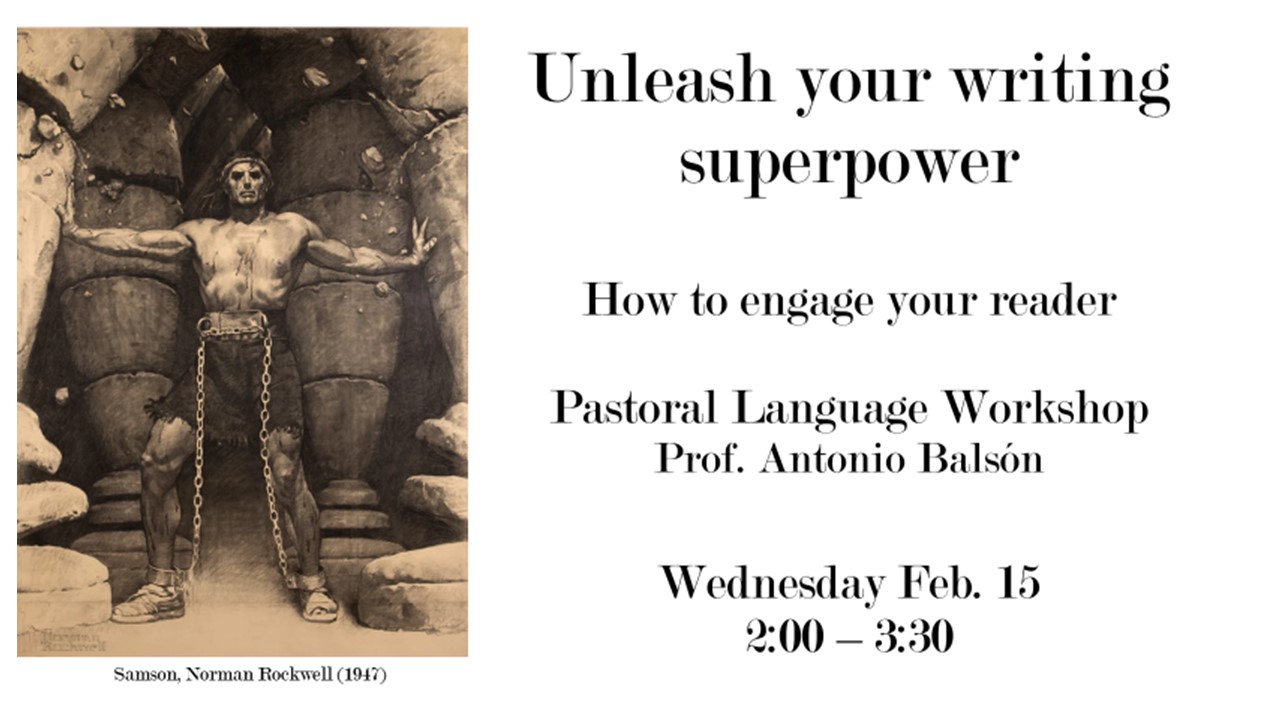
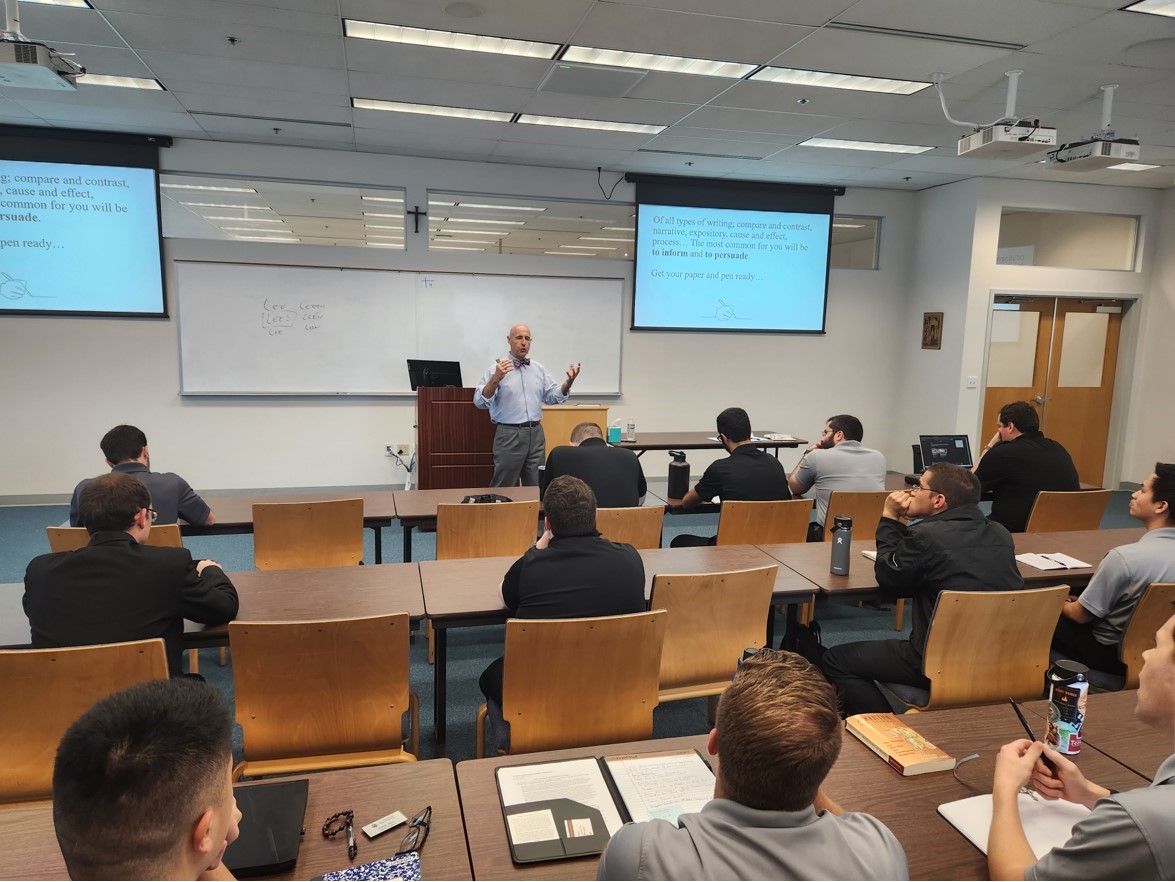
You might not know this, but first lines are really important, first lines in writing specially. I recently had an opportunity to expound on this at a Language Dept. workshop at school.

We started by talking about how skillful writing hacks your brain so that you might not know your brain has been hacked. We showed a few examples of great first sentences -of course, there are many, many more. (Try to figure out the author and book, answers below – don’t cheat!). (We played a similar game on this blog on my post about Russian Literature, check it out here.)

  1. “Here is a small fact: You are going to die.”
  2. “En un lugar de la Mancha, de cuyo nombre no quiero acordarme, no ha mucho tiempo que vivía un hidalgo de los de lanza en astillero, adarga antigua, rocín flaco y galgo corredor.”
  3. “Happy families are all alike; unhappy families are all unhappy in their own way.”
  4. “Muchos años después, frente al pelotón de fusilamiento, el coronel Aureliano Buendía había de recordar aquella tarde remota en que su padre lo llevó a conocer el hielo.”
  5. “He was an old man who fished alone in a skiff in the Gulf Stream and he had gone eighty-four days now without taking a fish.”
  6. “Lees ese anuncio: una oferta de esa naturaleza no se hace todos los días.”
  7. “Call me Ishmael.”

We had a good time going over those sentences and what made them good first sentences. Then we looked at how to write good sentences in general and especially for academic writing. The hands-on part of the workshop involved the students writing a sentence each until we had a first paragraph!

We had a good time and I hope the students left understanding the importance of first sentences!

Answers:

  1. The Book Thief. Markus Zusak
  2. Don Quijote de la Mancha, Miguel de Cervantes
  3. Anna Karenina, Leo Tolstoy
  4. Cien años de soledad, Gabriel García Márquez
  5. The Old Man and the Sea, Ernest Hemingway
  6. Aura, Carlos Fuentes
  7. Moby Dick. Herman Melville

On Bullfighting

Bullfighting is the only art in which the artist is in danger of death and in which the degree of brilliance in the performance is left to the fighter’s honor.

― Ernest Hemingway, Death in the Afternoon

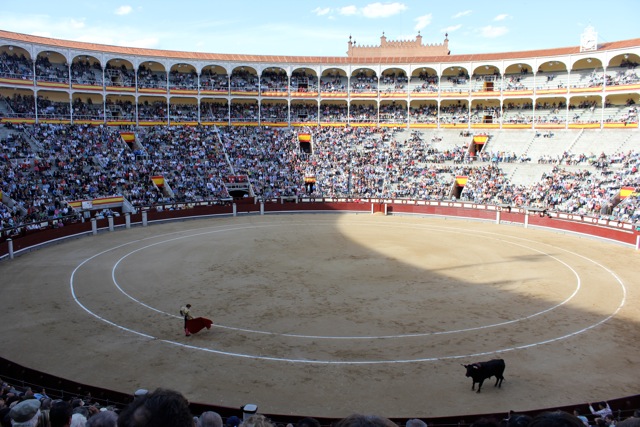
Yes, I love the bullfight. Why? Because it boils down the most basic human emotions. Here is someone (the bullfighter) willing to dance with death with a 700 lbs. (at least) beautiful, noble animal. Although the bullfighter has the edge, he must use all his skill, and valor in a highly choreographed ritual to vanquish the bull. The bullfighter does not always win, and therein lies the excitement. There is a primary, primal relationship between life and death, between the fighter and the bull, between man and animal. And only a profound understanding of that relationship, of that beauty will lead you to understand why a man will stand in front of death, and dance with it.

Of course, bullfighting dates back to the Roman circus, and even before that, to the Greek and Cretan games. This is the very stuff Greek mythology is based on (partly). Humans fighting it out with amazing animals. In a hyper material world, we think we can live forever, bullfighting reminds you of your own mortality, you understand that death is part of life and that if you get to die with dignity and grace, all the better.

If you have not been to a bullfight -and had it explained to you- I am afraid you cannot opine. The centuries of tradition, the intricate ceremony involved, the part each person plays in and out of the ring. The whole thing is nothing less than amazing.

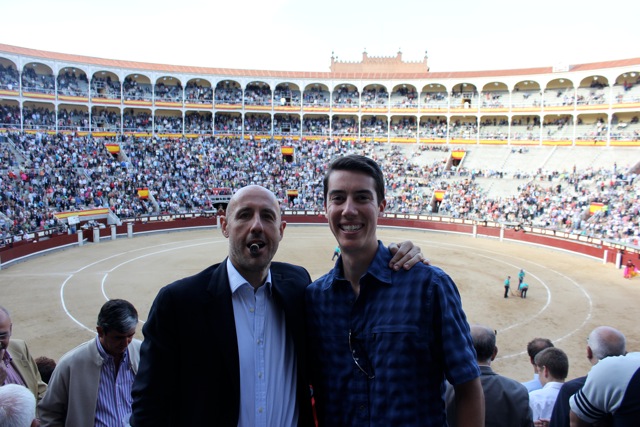
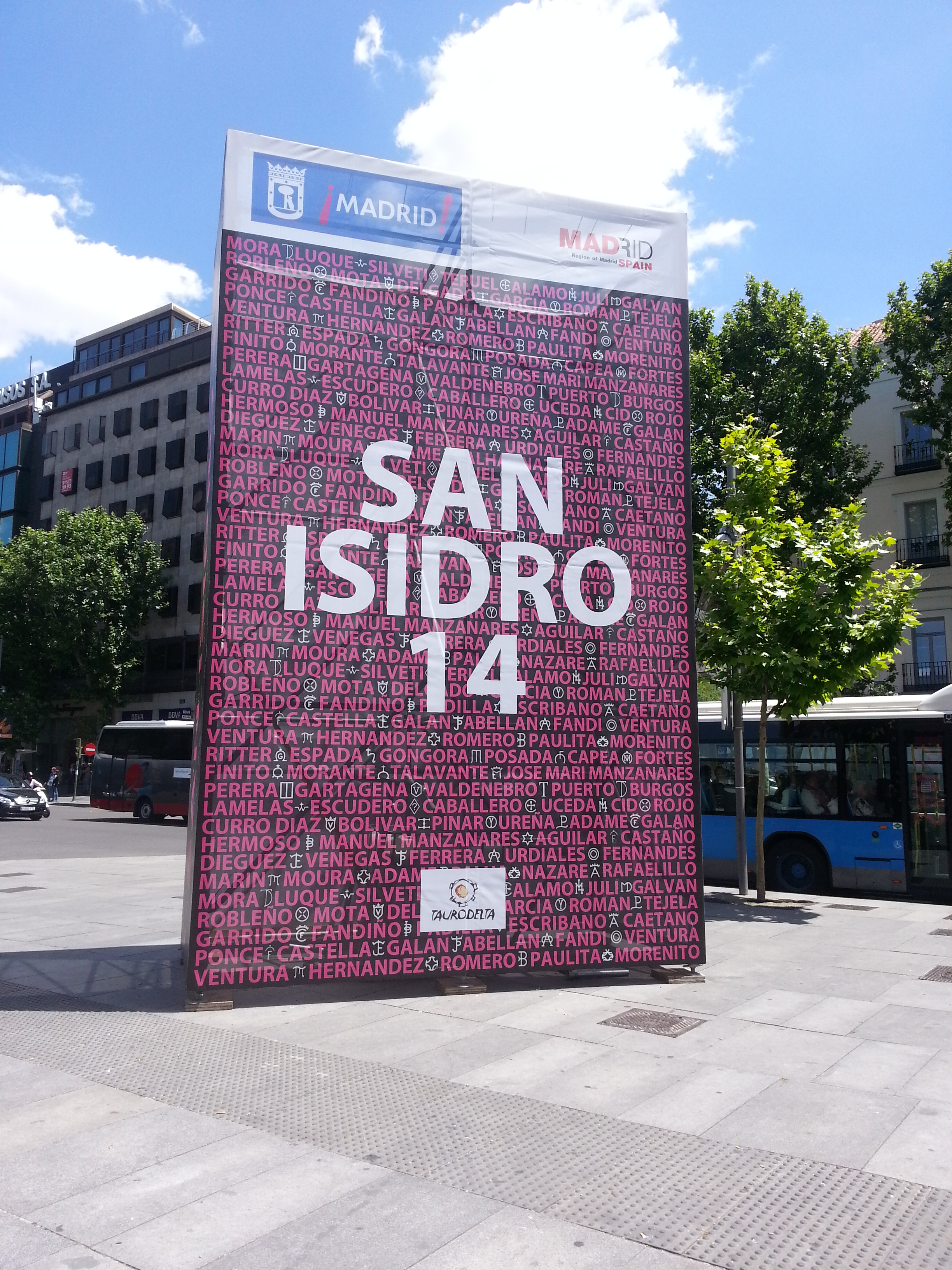
My dad was a big aficionado and he passed on his passion to me. I remember the first time he took me to the bullring; he would not let me go without socks, even when it was all the rage in the early eighties!! Although I have been to Las Ventas bullring many, many times (for bullfights and concerts: Sting, Prince, etc.) I had never actually visited the ring, nor had I visited the museum. A couple from Belgium recently booked me for a tour of Madrid and asked me to see Las Ventas. So, the day before I went to the bullring to do my homework with my niece, it was impressive! We walked around the ring checking out the bulls’ stables, the chapel, the stands, the museum, the obligatory gift shop, we even had a chance to try our hand at virtual reality bullfighting!! It was great fun!!

If you want to learn more I highly recommend Hemingway’s Death in the Afternoon. Hemingway loved the bullfight and followed them for a full Summer, getting to befriend and hang out with great fighters like Manolete.

The bullfight is a Spanish institution; it has not existed because of the foreigners and tourists, but always in spite of them and any step to modify it to secure their approval, which it will never have, is a step towards its complete suppression.

― Ernest Hemingway, Death in the Afternoon

The triumph of the short story

Good things come in small packages, they say. In Spain we say: “lo bueno, si breve, dos veces bueno” the same thinking can be applied to the short story. If you can develop characters and plot in not too many pages instead of hundreds you might have what it takes.

Your end of apprenticeship project in the Middle Ages required you to do a miniature of whatever your craft was; If you were a carpentry apprentice you had to make a tiny piece of furniture. These pieces where far more difficult to make than a regular sized piece. Again, the same goes for short stories. Boiling down a full story to a few pages requires a craftmanship not all writers have.

Short stories are the reason I fell in love with Literature (yes, with capital L). My high school Spanish lit teacher Soledad Sprackling had me reading Borges, and García Márquez. Later on I devoured Poe, Hemingway, Cortázar, Cervantes’ Novelas Ejemplares, Rosario Castellanos, Fuentes, etc. etc.

I recently read back-to-back books of shorts stories and was surprised to see that I have never written about short stories in this blog.

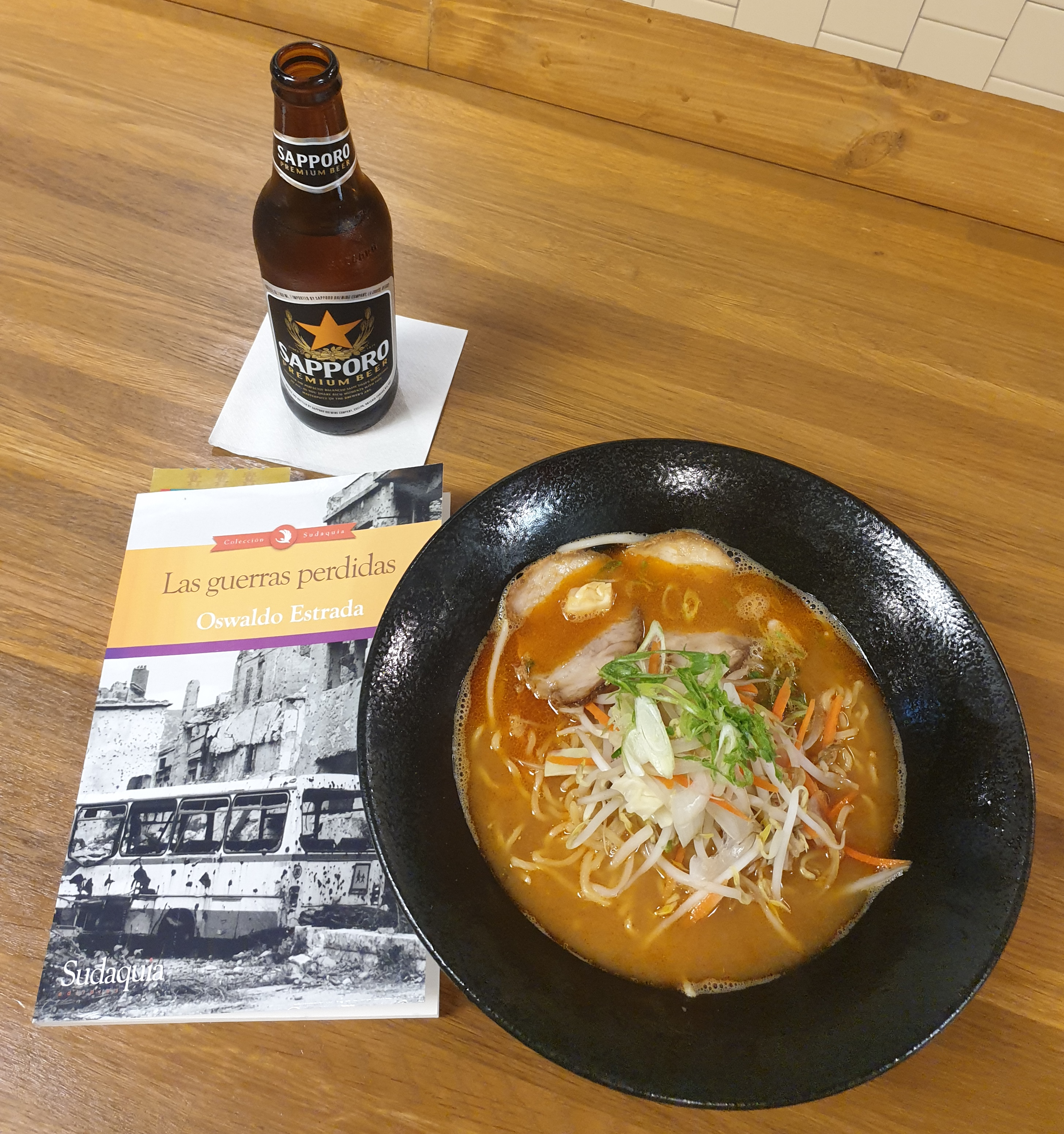
Las guerras perdidas is by Oswaldo Estrada, a dear friend and professor at UNC. Unfortunately, I never took any of his courses since our research interests did not match. Regardless, we became good friends. Last year on a weekend trip to Chapel Hill he even hosted a tapas dinner for me. His bittersweet short stories about loss and pain are beautifully written, his prose is reminiscent of García Márquez “Y aunque te bañes y perfumes, siempre hueles a tristeza.” Estrada’s insight into the human condition is precise, but sweetly narrated, which makes for a wonderful read. Highly recommended, five stars, two thumbs up!

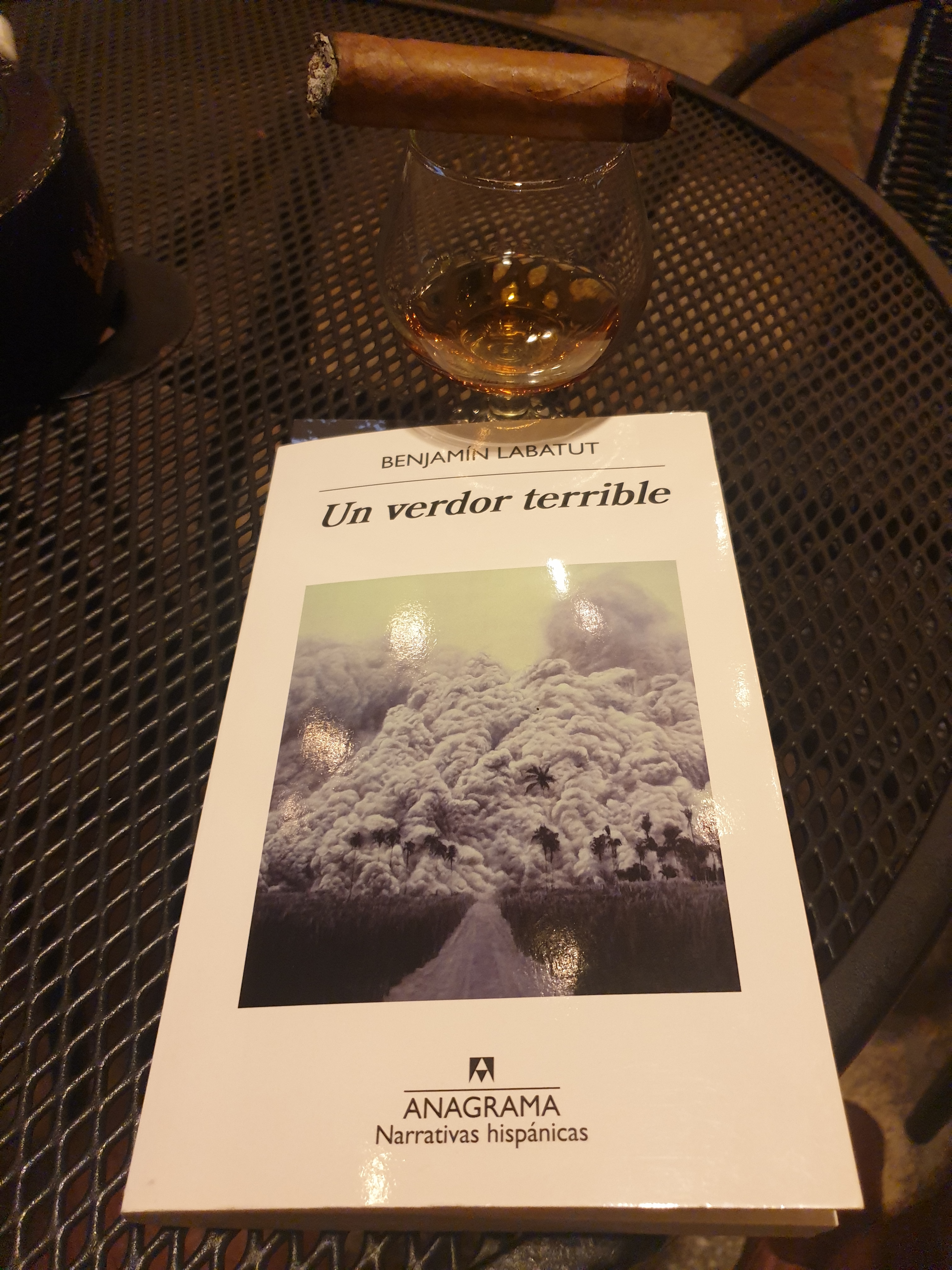
Chilean Benjamín Labatut writes Un verdor terrible (oh yes sorry, both books are in Spanish). Labatut focuses his stories on physicists and chemists, scientists and their discoveries during the first half of the XX C. These are deeply researched stories that mix fiction and history in unknown (to the reader) quantities. It makes for scary but rewarding reading, riveting.

If you like short stories and read Spanish, I recommend both of these books. You are welcome.

Please leave your comments and recommendations below!

The Rubaiyat of Omar Khayyam

The Rubaiyat of Omar Khayyam

Although I have a few editions, the other day I picked up a nice, used copy of The Rubaiyat of Omar Khayyam. It is one of my favorite books/poems of all time. I think it all started in the early 80s when we were living in London. My mom hired an Iranian English teacher to teach her English. I rarely saw her. I would come home from school and she would be in class with my mom. But one holiday she came to visit us in my parents’ country house outside Madrid. As a gift she brought a kilo of pistachios -which to this day I love, and a beautiful edition of the Rubaiyat.

I immediately fell in love with that book, it had an illustrated cardboard cover and beautiful illustrations. Every page had the verses in the original (more on that later) Persian or Farsi, English, and French. Right after college I purchased my first copy, and I would read it occasionally. For the last few years, I read it almost every Summer! This is not so strange, as there are several books I read and have read multiple times: Voltaire’s Candide and Hemingway’s The Old Man and the Sea are examples.

At any rate, the book is not without controversy: About the original text, about authorship, about religious interpretations, and about the translations. I have no academic interest in the text, I just enjoy the poetry. I love the flow of the verses, the circularity of the themes, the imagery. It is ancient Persian but feels totally modern. It is an appeal to stop and smell the roses, something that we so often forget to do. Take for example:

I sent my Soul through the Invisible

Some letter of that After-life to spell:

And by and by my Soul return’d to me,

And asnwer’d “I Myself am Heav’n and Hell”

While I do not consider myself an Epicurean or a Hedonist in the modern interpretation of the words, I do enjoy small pleasures in life – which is much closer to the original thought of Epicurean philosophy, to enjoy modest pleasures from tranquility. Thus, I love a good cup of coffee or glass of wine, a well-prepared meal, a well rolled cigar, a piece of music or any art. That, I believe is the message of the Rubaiyat: to enjoy the moment that is life.

Let me know what you think of the Rubaiyat in the comments section.

Summer excursion

The other day my dear friend and fine art restorer extraordinaire took me on a whirlwind excursion to see some of his recent work. We took the opportunity to enjoy a nice lunch and ended by visiting our friends at the Paular monastery and to check up on them with the whole pandemic to-do.

Our day started with our traditional morning coffee at our local village café/bar/restaurant/social center: Marcelino. From there we drove over the Guadarrama mountains (yes, the ones where Hemingway’s For Whom the Bell Tolls is based) to the lovely village of Rascafría. We had a leisurely lunch at a cool garden restaurant “La Pradera” (the natural translation “prairie” has taken the American meaning and spirit, being much larger than a Spanish “pradera” which is more of a field, but enough etymologies, and translation theory!)

After lunch we drove to the small village of Canencia. The root Can from the Latin “canis” for dog (oh no, back to etymologies) is because this village is where the kings’ dogs where bred during the Middle Ages. Jaime restored the gorgeous Gothic pulpit at the church last year. A stone’s throw away from the village is a very elegant Medieval stone bridge.

A short drive away is the town of Lozoya. A manorial village as testified by the many coat of arms decorating entrances. The main door of the church is in a beautiful Plateresco style, which is unique to Spain because it keeps the Gothic style but incorporates Renaissance elements. Jaime is scheduled to restore the pulpit there, a delicate Renaissance piece.

A tiny hamlet nearby is Pinilla del Valle, again with a lovely old church and town square. Jaime is working to secure the restoration of the portico of the church, damaged through the centuries.

We ended our excursion visiting our dear friends the monks at the Paular monastery. They are all fine, including the oldest ones. We snuck in for a quick visit. You see, Jaime restored that monastery from scratch years ago, so he knows it well and I have gone on two retreats there -as you might know from previous posts, so I also know it a bit.

After that visit, it was time to head home over the mountains.

Books, books, books

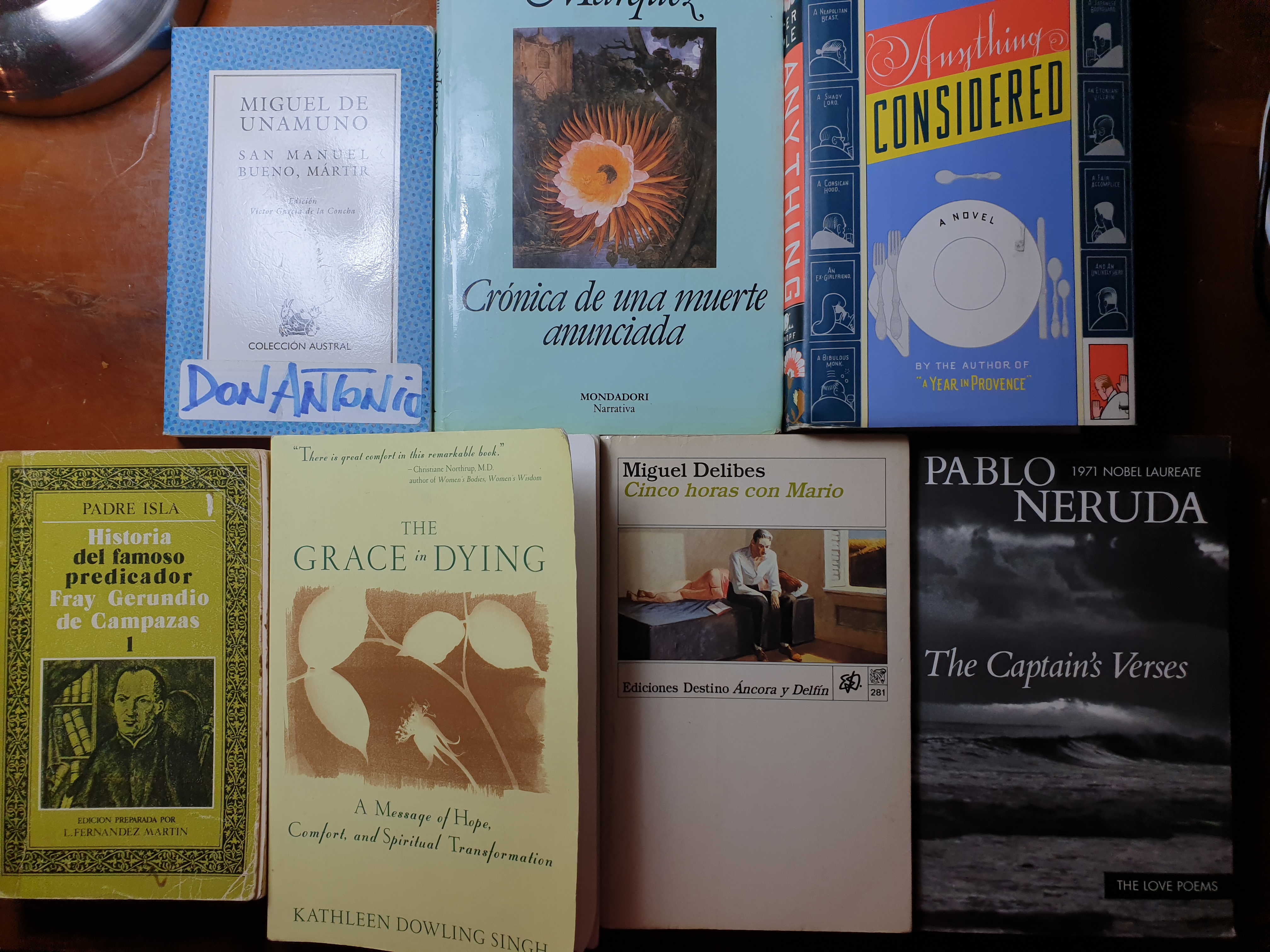
Some of the books I had lying around

Some of the books I had lying around

Locked up at home during the Coronavirus quarantine, I get to read a lot, which got me thinking of books This blog exists because of books. You see, I started this blog to report my Harley-Davidson trip visiting universities across the South for my PhD in Spanish Literature, that is: books. Yes, I am addicted to books. Having said that, I am a slow reader. So, while I enjoy books, I do not devour books like some folks do. Anyway let’s start at the beginning:

My first blurry memories of reading are of Enid Blyton, I guess like millions of children. Fortunately in high school, I had the privilege of being taught by Mrs. Soledad Sprackling. And my mind exploded with what she had me read: Borges, Neruda, Lorca, et al. That was it, I was hooked. In college my super cultured friend Silvia Velez introduced me to Gabriel García Márquez and my mind exploded again! It has been a series of explosions since.

Luckily I can read in Spanish, English and French and find it very frustrating when I cannot read every book in the original language it was written in. In fact, when I was twirling about with the idea of getting my PhD, I wanted to study comparative lit Spanish / Russian, but there was no way I was going to learn that level of Russian in a hurry, so that was the end of that thought. Miguel de Unamuno, one of my literary heroes actually learnt Danish so he could read Kierkegaard, bastard.

Here is a list of some of my favorite books with only number 1 in a clear position – all the rest vary according to the day you ask me:

  1. Miguel de Cervantes – Don Quixote. I have only read it three times, once with the amazing Prof. Louise Cohen. She shared with me her passion for this book, which I have written about in previous posts.
  2. Alexandre Dumas – The Count of Montecristo. Love, adventure, revenge, massive wealth, what’s not to like?
  3. Leo Tolstoy – Anna Karenina / War and Peace / Death of Ivan Ilyich. Tough call on this one…
  4. Ernest Hemingway – For Whom the Bell Tolls or The Old Man and the Sea. It takes a foreigner to describe Spain with such precision. High School is also where I got hooked on Hemingway.
  5. Gabriel García Marquez – Cien Años de Soledad (But really any by him). Of course, nowadays, I keep thinking of Love in the Times of Cholera
  6. Voltaire – Candide. Possibly the best satire ever written?
  7. Miguel de Unamuno – San Manuel Bueno, mártir. Proto-existentialism at its best!
  8. Mikhail Bulgakov – Master and Margarita. Or as the Rollings Stones interpreted it: Sympathy for the Devil
  9. Francisco de Isla – His early works. After all, I am the leading authority on the subject…

Of course, there are many, many more, but I don’t want to bore you, dear reader, any more.

Interestingly, my last read was. The Grace in Dying by Kathleen Dowling Singh which was recommended to me (like so many more) by my dear friend Patxi. It is about the spiritual journey of death, and how the best approach to death is meditation. I started reading it before the massive Covid outbreak and it has helped me digest the numbers in the news. I loved it. My next read, to celebrate the centenary of Benito Perez Galdos’ death will be Trafalgar, about the battle of the same name, not the square in London.

There you have it, some thoughts on reading and my some of my favorite books. Which are yours? What do you recommend? Tell me in the comments!!

That is not one of the editions of Quijote that I have read

That is not one of the editions of Quijote that I have read

Prepping for El Camino

Despite the fact that this is going to be my third Camino, it is still as exciting as the first, I guess it must be the expectation of adventure. So here are some thoughts and advice on preparing for the Camino:

Knowing that the pilgrimage to Santiago has been around for centuries (there was a pagan trek to Finisterre (the end of the world in Latin) before Christianity modified it to their needs) means that it can be done – and should be done with minimum amount of technology, help, etc. For me the Camino is a return to basics, so I do not book hotels, I do not use a phone app, nor use high tech clothes (other than shoes). This allows for a freer mind.

Because of this minimalist approach I do not have to worry about packing: just 3 pairs each of socks, underwear, shorts, T-shirts, a poncho, a sweatshirt, flip flops, Marseille soap for body and laundry, dopp kit, swiss army knife, water bottle, hat, walking stick, sunglasses, little else actually.

A more pressing issue for me is what to read on the Camino. There are at least a couple of schools of thought: one is to read something that has nothing to do with your journey. The second is to read something germane with your trip. I am in the second camp. My first outing I read a book on the parable of Abraham and Isaac and the Book of Job. On my second outing I re-read Hemingway’s The Old Man and the Sea, that fellow pilgrim James gave me on the first outing! This year I had a few options: Flaubert’s Madame Bovary which I finally have in French, Kathleen Dowling Singh The Grace in Dying, and finally the chosen option The Way of Ignatius, A Prayer Journey Through Lent, by Gemma Simmonds who was my sister’s teacher in school! Granted, Lent is over, but one should always be ready for a “prayer journey”.

As important as the kit is the actual physical preparation. This year I also had to break in new shoes, so I killed two proverbial birds with one proverbial stone: breaking in new shoes and training. The trick is to slowly add miles and weight to your pack in training with the goal of breaking in the shoes and your back!! This year I did a few solo outings and one with a couple of friends – and their dog – in nearby El Pardo natural park.

This week I bought my train ticket to Irún and a pair of socks (to replace a lost pair), but these are no ordinary socks, 60% Merino wool, no seams, and cushion. The original ones were Darn Tough socks from Vermont, this pair is Icebreaker from New Zealand.

The final details involve getting stuff done before leaving for a month, and getting the last items purchased and prepared. Follow my Instagram (Tonxob) or Facebook (tonxo balson) for daily photo uploads of the trip, starting June 3…

A (much needed) silence and meditation retreat.

The last few months have been a bit challenging, so when the opportunity came to spend a few days in the Monasterio de El Paular in a retreat of silence and meditation, I jumped.

I have written before about El Paular, it’s magic and the wonderful monks since I have visited every summer for a few years,  But I had never spent more than a couple of hours there. Since I returned to Spain in the Fall, I called the monk in charge of retreats, the Guest Master, but could never find the right timing. Finally I chose a weekend with no other people staying over, and headed for the mountains…

Although the monastery is less than two hours away from Madrid, it feels a world away, as one has to go up the Guadarrama mountains (that would be where Hemingway based his For Whom the Bell Tolls) and down the other side. When I went, the mountains were all snowed, fortunately the road was clear, so I did enjoy a good drive up and down.

Once you enter the Monastery you notice your blood pressure drops and your serenity reaches levels you did not know were possible. You get a simple cell with a bed, a desk, a proper bathroom and amazing views of the mountains. I was free until vísperas (vespers) at 8pm so I went for a walk. My first steps of that walk where a rush, a tsunami of peace. In fact, it took a while to accept the silence as a companion.

As I mentioned in my posts about the Camino de Santiago, Medieval folk had a real spiritual affinity for choosing where to put churches, chapels or monasteries. This one is flanked by a gorgeous river and many streams which were running full during my visit. It is also at the base of the mountain, making it a very secure location. According to Feng Shui, if you were to draw a dragon using the available landscape, the best – and safest – place to build would be where the dragon’s genitals would be, that is where El Paular sits.

As advised by the Guest Master, I arrived early for Vísperas prayer. All 5 (6 when there is mass) daily prayers take place in a very cozy square chapel off of the cloister. The prayer breaks down into singing and speaking and into Latin and Spanish, but that really does not matter, as what matters is the repetition of the prayers that make the event magical.

Dinner comes right after vespers and happens in silence. A monk serves you and you eat while another monk reads a religious text. After special meals, the Abbot rings a little bell and you are allowed to speak, but not to get up from the table!

The final prayer, Completas (Compline) is a at ten, and you must keep silence until after Maitines (Maitins) at 6:30am the next day. You pray Laudes at 8am and have breakfast right after. Then the monks might have communal work. When I was there we had to clean up the monk’s tombs in the cloister and plant pansies that would withstand the cold. It was nippy out in the cloister, but the sun was shining and soon warmed us up. The work was rewarding as Abbot Miguel regaled us with stories of the dead monks and other folks buried there: an American fellow who was very fond of the monastery, or a child who drowned nearby, all very touching. After our work we snuck into to kitchen for a hot cup of coffee and madeleines made by the monks. I still had time for a walk in the forest before Sexta (Sext) and lunch.

And so the hours and the days pass: meditating, walking, eating in silence and praying. The weekend I was there the monks were celebrating Saint Scholastica, the sister of the founder of the Benedictine order. I had never heard of her, but her motto is very moving, something like whoever loves more has more power (más puede quien más ama) which became one of the cornerstones of my meditation while at the monastery. Once it got dark I would walk around and around the magnificent cloister which is surrounded by massive Vicente Carducho paintings (I think I will devote a blog post just for that bit…).

It is difficult to explain the monastic experience. The concept of time is totally different from that in the outside world, actually, outside might be the key word there as in the monastery it is all about inside you, your inner beauty, your inner holiness, your inner time, your inner everything!

On my last day I had a nice chat in the library with one of the senior monks. His advice to me? Empty yourself, a process the ancient Greeks called kenosis and something I have been working on since it was also recommended by Richard Rohr in his daily meditations.

Leaving the monks and the monastery was very sad, entering back into the crazy world we have created was tough, but I know I will be back to spend some of that special time with the monks at El Paular.