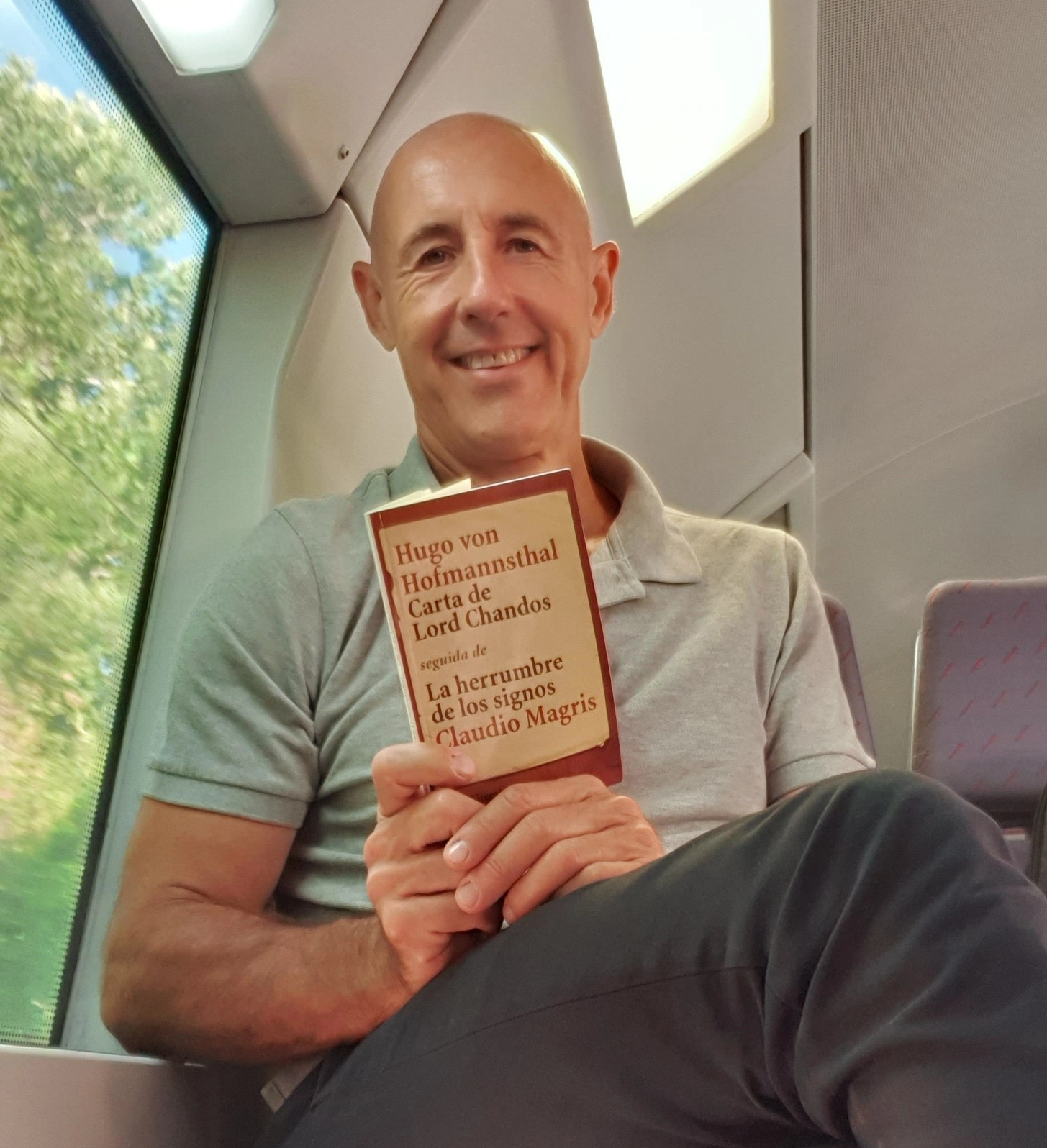
Mahler, Roth, von Hofmannsthal, and Magris, fin de siècle Vienna and the fall of the Austro-Hungarian empire.

Lord Chandos on a train

A couple of years ago I wrote about Mahler and Joseph Roth and the coincidence that they both lived in the turn of the Century Vienna. It was very much a gut feeling post (you can read it here) since I am not a history scholar, even less an Austro-Hungarian history scholar specializing in the fall of the empire.

What you read on the Camino is very important. I usually choose spiritually enlightening books. (The Book of Job, Gemma Simmonds The Way of Ignatius A Prayer Journey through Lent (she was my sister’s teacher!), Willigis Jager The Wave is the Sea, even a collection of Zen stories!) They also have to be physically light and small due to backpacking requirements. This year under my friend Paco’s recommendation I took an intellectually challenging book: Hugo von Hofmannsthal Ein Brief (Brief des Lord Chandos) – Letter to Lord Chandos followed by Claudio Magris’ analysis of the Letter in La Lettera Di Lord Chandos.

Hofmannsthal’s (fictional) letter from Lord Chandos to Francis Bacon is a short (22 pages) but fascinating essay on language. Magris’ analysis of the letter is a mind-blowing tour de force of fin de siècle Vienna and the fall of the Austro-Hungarian empire and what was to follow in Europe. After a master’s and a PhD in literature, I was surprised to find that this is by far the densest reading I have ever encountered. It is rich, thick -but readable- and chock full of references: Kafka, Wittgenstein, Heidegger, Freud, and Nietzsche (obviously), Borges, Saussure, Kubrick, Eco, Pasolini, Plato, Seneca, and Cicero, Roth, Kierkegaard, Klee, Van Gogh… and a whole bunch of other names I confess I have no clue who they are. But the point is that Magris explains in philosophical and existential detail the fall of the Austro-Hungarian Empire, turn of the Century Vienna and what would follow in postmodern Europe. It was also very rewarding to read a real essay on what I wrote as a hack blog post…

In conclusion, this is a short, small book, perfect for travelling but dense and rich and glorious academic reading! Enjoy, you are welcome!

PS: If you want to read more about Chandos check out this article:

Greaney, Patrick. “On the Chaos in Chandos: Hofmannsthal on Modernity’s Threshold.” MLN 129.3 (2014): 563-573.

Prepping for El Camino

Despite the fact that this is going to be my third Camino, it is still as exciting as the first, I guess it must be the expectation of adventure. So here are some thoughts and advice on preparing for the Camino:

Knowing that the pilgrimage to Santiago has been around for centuries (there was a pagan trek to Finisterre (the end of the world in Latin) before Christianity modified it to their needs) means that it can be done – and should be done with minimum amount of technology, help, etc. For me the Camino is a return to basics, so I do not book hotels, I do not use a phone app, nor use high tech clothes (other than shoes). This allows for a freer mind.

Because of this minimalist approach I do not have to worry about packing: just 3 pairs each of socks, underwear, shorts, T-shirts, a poncho, a sweatshirt, flip flops, Marseille soap for body and laundry, dopp kit, swiss army knife, water bottle, hat, walking stick, sunglasses, little else actually.

A more pressing issue for me is what to read on the Camino. There are at least a couple of schools of thought: one is to read something that has nothing to do with your journey. The second is to read something germane with your trip. I am in the second camp. My first outing I read a book on the parable of Abraham and Isaac and the Book of Job. On my second outing I re-read Hemingway’s The Old Man and the Sea, that fellow pilgrim James gave me on the first outing! This year I had a few options: Flaubert’s Madame Bovary which I finally have in French, Kathleen Dowling Singh The Grace in Dying, and finally the chosen option The Way of Ignatius, A Prayer Journey Through Lent, by Gemma Simmonds who was my sister’s teacher in school! Granted, Lent is over, but one should always be ready for a “prayer journey”.

As important as the kit is the actual physical preparation. This year I also had to break in new shoes, so I killed two proverbial birds with one proverbial stone: breaking in new shoes and training. The trick is to slowly add miles and weight to your pack in training with the goal of breaking in the shoes and your back!! This year I did a few solo outings and one with a couple of friends – and their dog – in nearby El Pardo natural park.

This week I bought my train ticket to Irún and a pair of socks (to replace a lost pair), but these are no ordinary socks, 60% Merino wool, no seams, and cushion. The original ones were Darn Tough socks from Vermont, this pair is Icebreaker from New Zealand.

The final details involve getting stuff done before leaving for a month, and getting the last items purchased and prepared. Follow my Instagram (Tonxob) or Facebook (tonxo balson) for daily photo uploads of the trip, starting June 3…