My favorite authors series, Part II: Gabriel García Márquez

Ooops. I just realized that in 14 years of writing this blog, I have never dedicated a post to Gabriel García Márquez, shame on me.

You see, García Márquez is one of the reasons I love literature, one of the reasons I made books my livelihood. My dear college friend Silvia recommended One Hundred Years of Solitude, and when I read it, my mind was blown to smithereens! I was hooked and proceeded to read most of Marquez’s novels.

La hojarasca (1955)

El coronel no tiene quien le escriba (1961)

Cien años de soledad (1967)

El otoño del patriarca (1975)

Crónica de una muerte anunciada (1981)

El amor en los tiempos del cólera (1985)

El general en su laberinto (1989)

Del amor y otros demonios (1994)

Memoria de mis putas tristes (2004)

I also read many of his short stories and one of his books of short stories:

Doce cuentos peregrinos (1992)

To top it all off, I even read one of his more famous interviews.

El olor de la guayaba (1982), con Plinio Apuleyo Mendoza.

When you speak of García Márquez, everybody mentions Magical Realism. Which he did not invent (it started in Germany). Oh, just so we are clear on what Magical Realism is, it is when extraordinary, often fantastical things occur, and the people who witness or live the event don’t even bat an eyelash; it is a common, everyday thing for them. One Hundred Years of Solitude has a lot of Magical Realism; it is the flagship for Magical Realism, but much of his other work has much less, or even no Magical Realism. By the way, many other authors incorporate this genre, including Isabel Allende in Casa de los Espíritus.

“Yo conservaba un recuerdo muy confuso

de la fiesta antes de que hubiera decidido

rescatarla a pedazos de la memoria ajena”

Gabriel García Márquez, Crónica de una muerte anunciada

But that is not the reason I love GM —although I do enjoy those moments! I love how extraordinarily well he writes, but at the same time, how normal it appears; there is no showing off, no showboating, no “look at that sentence” that many authors with far less talent leverage.

I also love how García Márquez brings you into the setting and the story, how easy it feels to be an observer of his world. Granted, all his work comes from true stories, which makes it even more fascinating to feel a part of them.

“Era una síntesis de los últimos acontecimientos nacionales

impresa en mimeógrafo para la circulación clandestina.”

Gabriel García Márquez, El Coronel no tiene quien le escriba

A favorite? I don´t really have a favorite. Amor en los tiempos del cólera is my favorite love story and one of my favorite books. Crónica de una Muerte anunciada is the book I have read the most, since I teach it and will often read it before the course starts and again with the students, which is what has prompted this blog post 😊

So if you have not yet read any of Gabriel García Marquez’s work, and you feel ambitious, go for One Hundred Years of Solitude. If you prefer to dip your toes in the water and just get a feel, read a short story, or better yet, one of the shorter books like Crónica de una muerte anunciada or Memoria de mis putas tristes.

“Las vidas no se acaban sólo con la muerte”, dijo el general.

“Hay otros modos, inclusive algunos más dignos.”

Gabriel García Márquez, El general en su laberinto

García Márquez died in 2015. I will always remember it because it was the weekend I had to write my doctoral exams. And although I was writing about 18th C Spanish Satire, Colonial Satire, and Medieval Satire, I still put a García Márquez epigram to each of my essays in honor. Here they are (of course, without the whole essay, these epigrams lose their context…)

So, if you have not yet read any Gabo, you have my full recommendation. You are welcome.

Andrei Tarkovsky’s The Mirror

You have been a member of Film Club for 4 years now, you have seen many movies throughout your life, and you have even taken a couple of film classes -in graduate school! So you consider yourself a bit of a film connoisseur, a snob. You have seen the mesmerizing photography of The Proposition, the achingly beautiful La Grande Belleza, The Godfather trilogy, Oscar winners, you name it. Then you watch Andrei Tarkovsky’s The Mirror, and you realize that you have never seen a film like that, that you had no clue of what can be done with film, of how a story can be told through film. You feel like a beginner, an amateur. And it’s a 1975 film!

Imagine sitting on a long road trip and your travel partner reciting childhood stories, dreams, memories, and the like, nonstop, with no transitions, oh, and with beautiful music playing like Bach’s St. Matthew’s Passion. And that partner is Russian, so they have a very acute sense of the absurdity of life, and of history; of the Spanish Civil War, of WWII, that film is The Mirror.

If you read the reviews, they all mention stream-of-consciousness as the driving technique in this film, but this being a film, not printed page, it does not fully convey the power of the images, the ambiguity, the anxiety, and most importantly the beauty of the film.

Although the film is not about Magical Realism, it feels that way, like you are reading a Gabriel García Márquez novel (I have yet to see a good representation of Magical Realism on film, if you have a recommendation, drop in the comments, thanks). Yes, the camera work, the tracking angles, the lighting, it is all there, and you can talk about the technical bits, but at the end of the day, it is a beautiful film, one that blows your mind and changes the way you experience film forever.

I cannot wait to see more Tarkovsky films.

Story of a Book, a return to poetry: Valparaíso, puerto principal by Luis Correa-Díaz

As everybody knows, books are living creatures, and as such, they have their own lives. This is the story of a wonderful book.

Luis Correa-Díaz came into my life socially, during a visit to Chapel Hill a couple of years ago. Knowing that he is from Chile, when saw an old -ancient- National Geographic with the main story on Chile, I did not hesitate to send it to him, as a bit of a nostalgic curiosity. What I did not expect was that he was going to pay back that silly gesture by sending me his latest book of poems: Valparaíso, puerto principal.

I treasured this book, waiting for the right time to dive in, which was during my recent silence and meditation retreat (see previous post). As I took the book out to the monastery’s cloister garden, I was filled with excitement. Before digging in, that anticipation of starting a new book, I was called to the fountain… ¿how about some photos for the blog? So, I got clicking, until, in and adventurous and risky pose, the book was blown into the fountain (yes, I know you were expecting that, I did too, but I took my chances…)

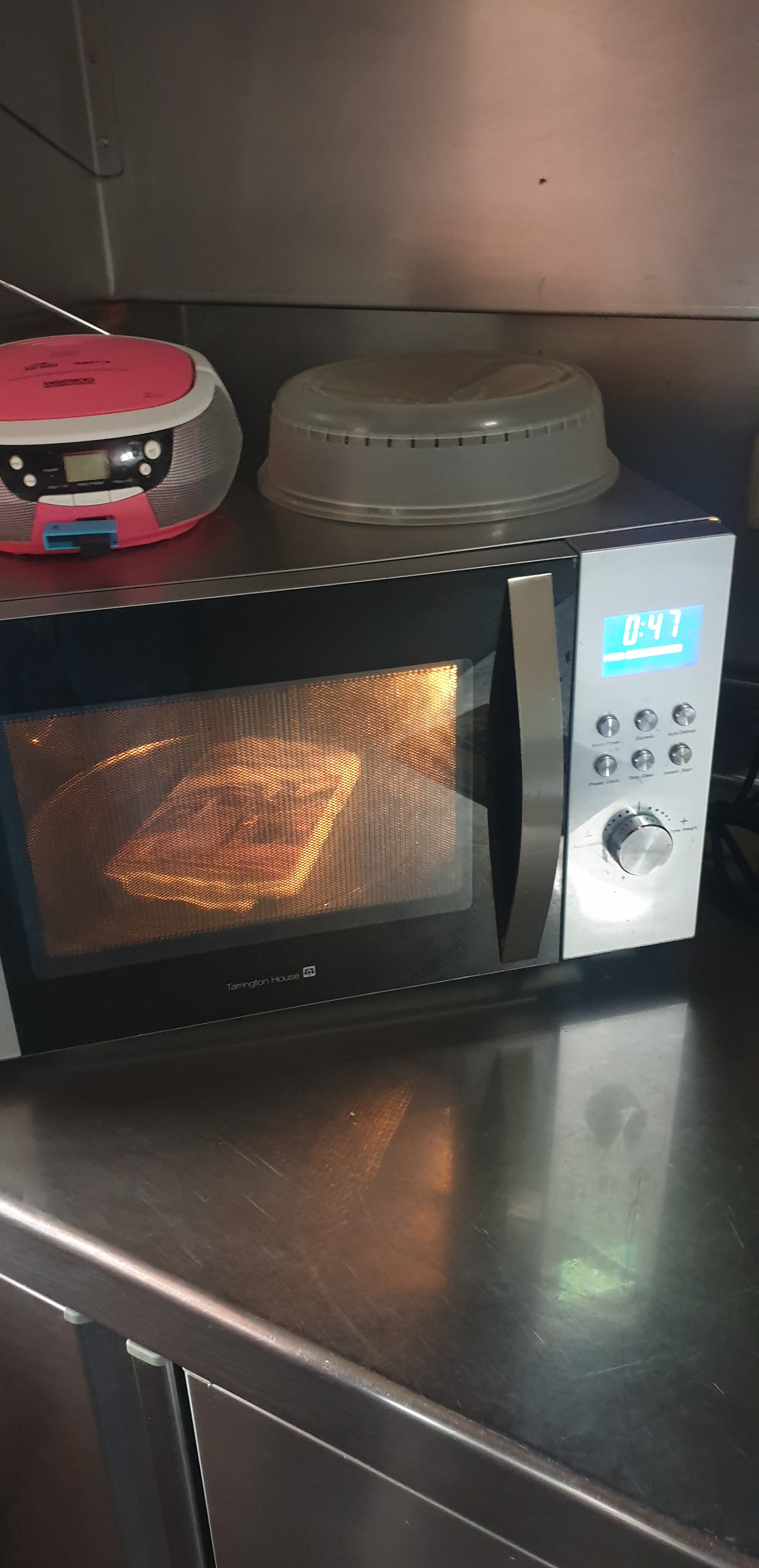
A quick rescue and a rush to the monastery kitchen soon had the book in the microwave oven for an ER intervention. Coming out steaming hot -literally- I blew the steam out making sure the words stayed put on the page. This had to be done a few times to ensure the book dried quickly. It survived, albeit with stiff, wavy pages that say: “I had an adventure” and “my owner is an idiot”.

What I love about Correa-Díaz´s writing is that it appears casual, carefree, with all sorts of English words, Millennial English words -even emoticons thrown in. But as those happy-go-lucky words sink in you see, no, you notice the feeling, the emotion of those words. In this case, his beloved Valparaiso as a home he no longer lives in (exactly how I feel about my Madrid). His writing is peppered with references to Teilhard de Chardin or Madonna, to the local coffee shops, where you can almost smell the coffee suffusing from the old walls, plus all the local references that one has to be a local to identify, reminiscent of the best Gabriel García Márquez.

This book will make you miss Valparaíso, even if, like me, you have never been there. This is what the Portuguese and Brazilians call saudade, or the Gallegos morriña (you can read about that feeling here), there is no comparable word in English, sorry.