You should be meditating.

Stop, inhale, focusing on the air entering your nostrils or your lungs. Exhale, focusing on the air leaving your lungs or your nostrils. There, you did it!! For a brief time, you didn’t worry about what’s for dinner, your bills, the weather, what you were going to tell your boss, your customer, or your friend. You didn’t think about politics, and you weren’t scrolling through social media. You had a moment —albeit a very short one—of meditation. The trick is to do that exact exercise with your breathing for 5, 10, 20 minutes, or half an hour. The longer you do it, and the more often you do it, the better you will feel.

My dear friend Paco encouraged me to try meditating while I was in a deep, dark depression over ten years ago. It was not easy for a hyperactive fellow like me to embrace it, but now I cannot live without some quiet time every day. And although I have written about meditation here before, it was usually in passing while talking about health and mental health in general.

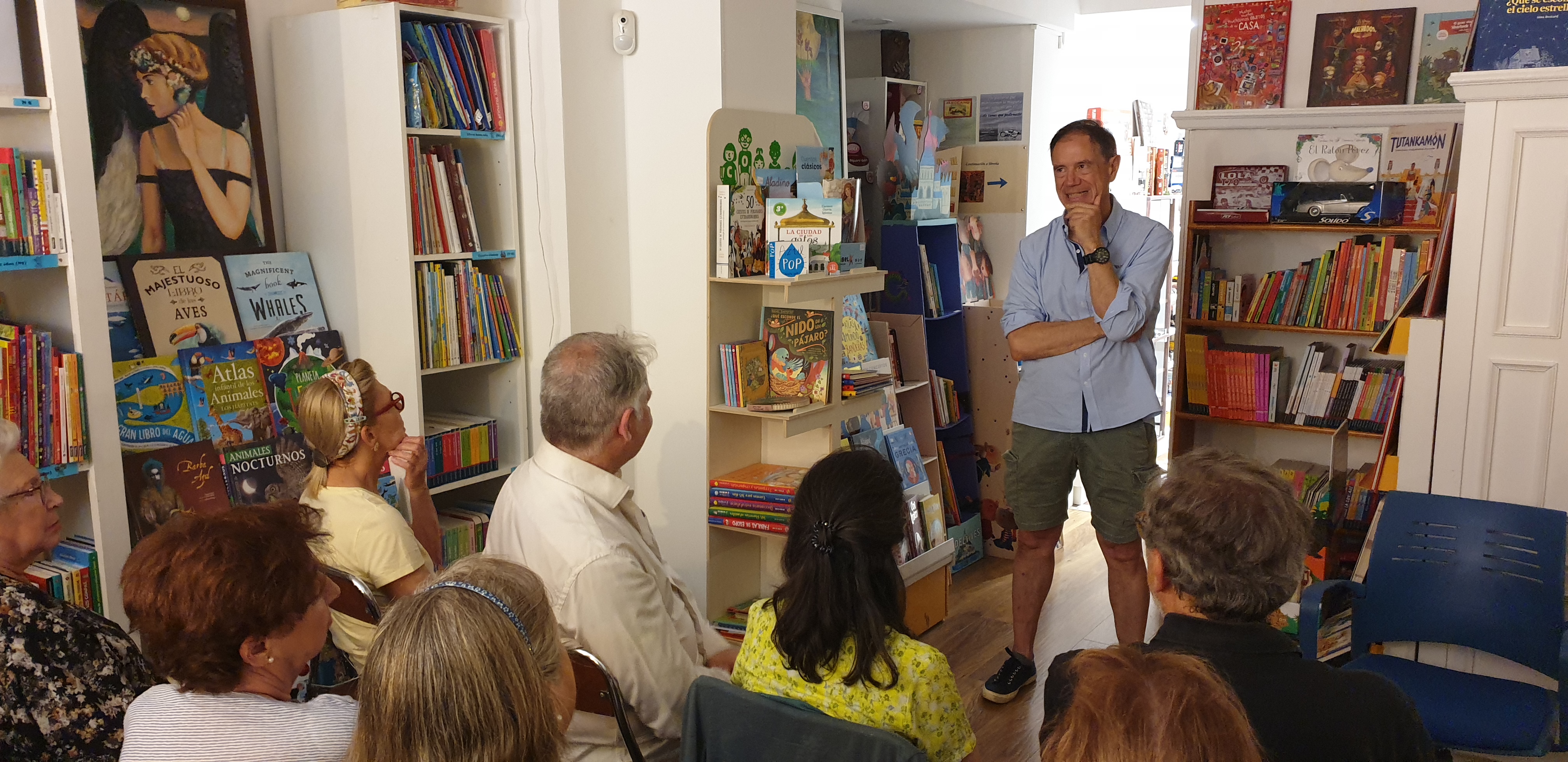
This all comes to mind because I recently had the opportunity to see and hear Paco give a presentation on Christian Meditation at the Antonio Azorín bookstore in El Escorial. He filled the room and had a wonderful talk. I originally thought the attendees were curious about meditation, but during the Q&A, I realized some of them were very advanced, although from different “schools” of meditation —see below.

There are many labels for meditation, just like there are many different philosophies and methods: Mindfulness Meditation, Mantra Meditation, Zen Meditation (Zazen), Vipassana Meditation, Transcendental Meditation (TM), or Body Scan Meditation. The ancient Fathers and Mothers of the desert, the early Christians, also developed a method of meditation which nowadays is called Christian meditation, or even centering prayer. Some recent Catholic proponents of meditation might be Thomas Keating, Thomas Merton, or Richard Rohr.

Whichever way you choose to sit down in silence is fine. Of course, nowadays you can use an app on your phone to time your sits, or to guide you. I have been using Insight Timer for years, and I love it!

Every class I teach at school starts with one minute of silence. This time is a buffer between whatever the students were doing before and class, between English and Spanish; it is a moment to regroup, to breathe, and for me, it is a minute of meditation.

Recently, Maria Popova also wrote about the importance of spending time alone and in silence, not exactly meditation, but close to it. Check it out here.

So carve out a few minutes from your day: when you wake up, before you go to sleep, in the middle of the day, or, paradoxically, if you are really busy, more than once a day. Whatever works for you, sit down, and start focusing on your breathing. You are welcome.

Oh, you should definitely check out this video of Villanova’s Fr. Martin Laird on the benefits of meditation. It is a bit long, but worth it!!

Desperate Literature (or interesting bookstores and libraries)

I fell in love with literature at the American School in London with a couple of great teachers: Soledad Sprackling for Spanish Literature and James McGovern for English. But I did not fall in love with books until college.

At Bentley University I discovered the Bowles Reading Room which had beautiful books. It was glassed in from the rest of the library and every day I went there to do my homework but would invariably end up looking at the wonderful books. I loved that room so much that at the end of my studies, I donated a book about Spain to the Collection. (I contacted the librarians who got me this rare photo of the Reading Room for this post, thanks!).

Bowles Reading Room 1992 (After I graduated) (PC: Bentley Archives)

Bowles Reading Room 1992 (After I graduated) (PC: Bentley Archives)

But I would have to wait until after college to have enough disposable income to buy books, which, living in Boston, was very easy. Some days on my lunch break I would sneak to Goodspeed’s to look for treasures. Such is my love for books and literature, that years later, I ended up getting a PhD in Spanish Literature! (see previous posts)

Speaking of UNC, one of the highlights are the libraries. Plural. The old library is the Wilson Library (which is featured prominently in Robin Williams’ great film Patch Adams). I spent hours studying in this library and a couple of times studying very old books in the Rare Book Collection. The big, modern library is the Davis Library with its 7 million books. There, I soon made best friends with the Spanish book librarians Teresa and Becky. I would walk to their office deep in the heart of the library and talk books, (and gossip). This library is as close to the Borges idea of a library as I have ever been: massive and repetitive, but with a soul.

During my studies at UNC, one summer I got a Fellowship to do research at the Biblioteca Nacional in Madrid. What an experience! To get to the rare book collection you have to pass not one, but two security checks, you cannot bring in any pens, books, phones, etc. Books there are treated with the care and reverence one would expect of -in my case- over two hundred year old books. I spent every morning that summer reading most of Francisco de Isla’s first editions, manuscripts, and other pieces attributed to him but not his. That experience is one of the highlights of my academic career. (Their coffee shop in the basement was also excellent – and subsidized! but that is for another post)

Biblioteca Nacional, Madrid

Biblioteca Nacional, Madrid

After UNC I moved to Southern Florida, which is a wasteland for books -must be the humidity. But, in 2016 I did read this great article in Vanity Fair, (to which I have subscribed and read every issue from cover to cover since around 2006) about this magical book store in Santorini called Atlantis Books.

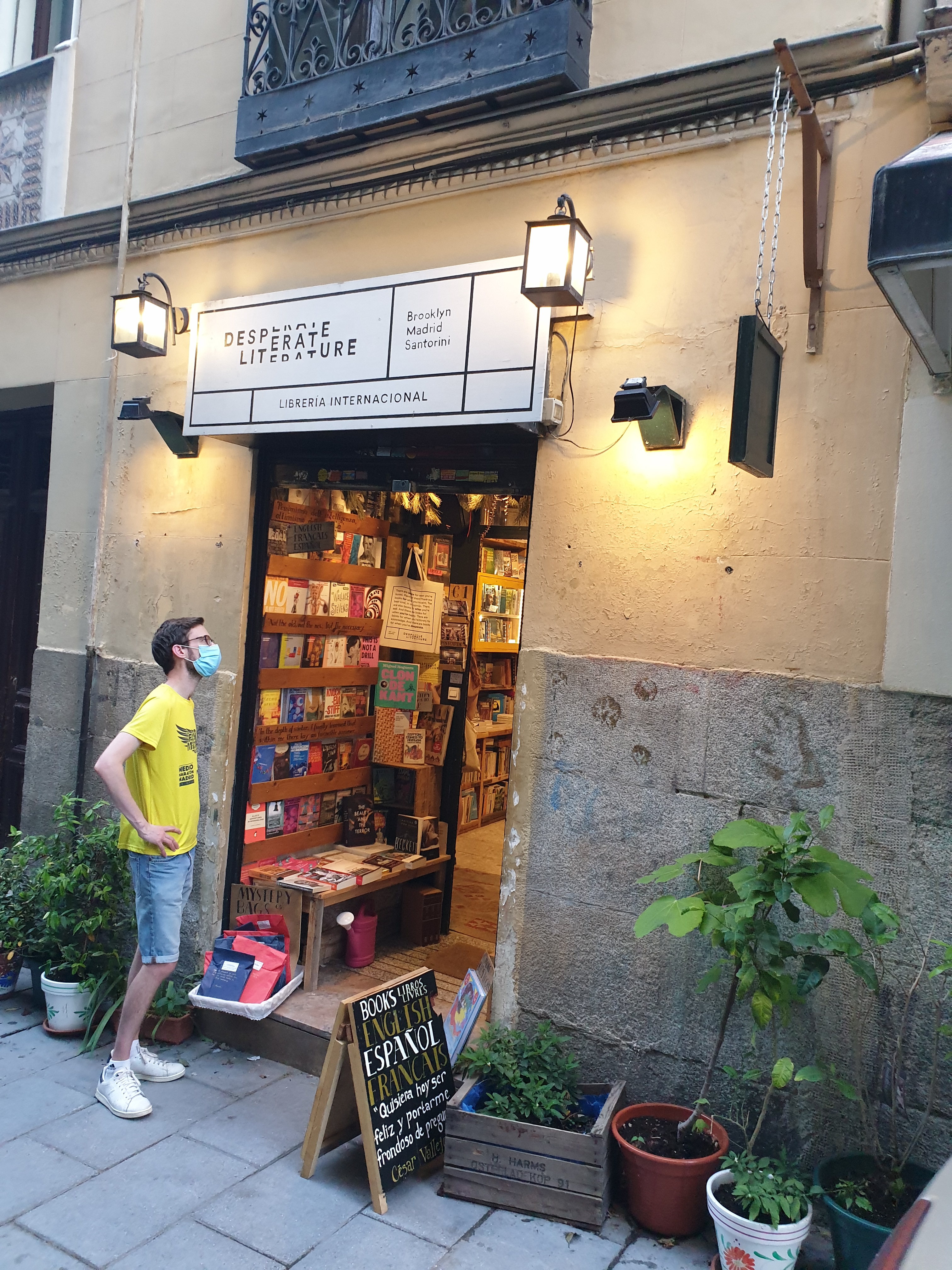
Fast forward to 2018 when my dear friend Matthew came to visit me in Madrid. He stayed at a hotel in the old part of town. One evening after I dropped him off, around the corner from the hotel, on narrow Campomanes street, I bumped into Desperate Literature. I was ecstatic! What a discovery, what a find! A tiny bookstore, but filled with books mostly in English, with a few in Spanish and French for good measure. It was a tiny paradise, an oasis of… books!

Books in time of Covid

Books in time of Covid

I soon found out that this bookshop is part of Atlantis Books which I had read about in that Vanity Fair article. It all fit in, a collection of magical bookstores.

During this Covid-19 pandemic I found out they were sending books to folks. I ordered one and I was able to make use of my workout time to ride my bicycle to pick it up.

In conclusion: support your local -hopefully quirky- bookstores, and read.


Wrapping up another semester, #5

Part of the problem with being an eternal optimist is that one always thinks things are going to be easier than they are. This last semester is a good example. The semester started off uphill, with me losing my washer and dryer (see previous post), getting a speeding ticket, and more importantly having to finesse my doctoral committee and getting my prospectus approved.

The exam was on November 7. You can read my previous post about it, but is was at the same time a grueling yet highly enriching experience. That afternoon I celebrated by playing soccer with my colleagues (more on that later) and then by going to see Benjamin Britten’s opera, Curlew River, inspired by the Japanese Noh theater (more on that also later). And of course, after all that by having a drink (or two) at my favorite bar, Zog’s.

After passing my exam I slumped into a bit of a post prospectus depression. My next goal is defending my dissertation, but that is not planned until the Spring of 2016. So all of a sudden I was without an immediate goal. This required some getting used to. I could finally, after three years, watch movies (more on that later), or enjoy dead time. That first Saturday I celebrated with a glorious breakfast at my favorite breakfast place Ye Olde Waffle Shop, and waltzing around Chapel Hill as if I owned it. Stopping at this store and that, hanging out at the old bookstore, and the museum.

As always teaching is my passion and this semester did not disappoint. I taught two sections of Intermediate Spanish 203, one of them in the Philosophy building. This allowed me to enjoy their philosophical bathroom graffiti.

Nature abhors a vacuum, so I soon changed my rhythm and got busy. I talked strategy with my professors to attack the dissertation, Prof. González Espitia named me to be a grad student editor of the department´s literary journal Hispanófila, and I started to prepare my dissertation by re-visiting the first four works of my beloved Padre Isla.

This slideshow requires JavaScript.