The Marginalian by Maria Popova, a blog about a blog, would that be a metablog?

As a blogger myself, I must admit that I do not subscribe to many blogs, newsletters, etc., just a handful:

Although not technically a blog, I get the Center for Action and Contemplation’s Daily Meditation, originally written by Richard Rohr, but as he is getting older, it is now written partly by him but also by the CAC team. Check it our here, and subscribe!

Every week I also get Un salto a Galicia about travel to the northwest corner of Spain, Galicia. (Click here)

But what I want to talk about today is The Marginalian by Maria Popova.

Every week Popova writes brilliantly about how an author talks about certain things. Some recent examples are:

Philosopher R.L. Nettleship on Love, Death, and the Paradox of Personality

The Poetic Physicist Alan Lightman on Music and the Universe

Iris Murdoch on Unselfing, the Symmetry Between Art and Morality, and How We Unblind Ourselves to Each Other’s Realities

Dervla Murphy’s Fierce and Poetic Account of Traversing the World on Two Wheels in the 1960s

Popova combines her own beautiful writing (yes, this hack is jealous) with quotes from the authors featured and gorgeous illustrations. It makes for an enlightening read.

Popova is so inspiring, that I have added her Wednesday email into my reflection time, my mediation, my Lectio Divina, if you will.

If you are not yet subscribed, I cannot recommend it enough. Check it out here.

You are welcome.

Ernest Hemingway -a new ongoing series of my favorite authors.

A few years ago, in an effort to professionalize my blog, I committed to publishing every Tuesday at 5:00 pm Eastern Time (11:00pm for my Spanish readers – my second biggest following). This is a healthy challenge: having to think of something to write, having some photos to go with it, writing something, and getting it published.

Mostly I write about the Humanities: literature, art, film, but I also write about the Camino (sorry I did not have time to walk this year), Education, food, wellness, and my life in general. Another quirk of my blog is that I choose not to have categories, as I prefer the chronological set up. Which I understand makes it harder if you only want to read what I write regarding a single topic – mostly the Camino, sorry.

At any rate, going back to Literature, one of my first loves. I realize that although I write a lot of book reviews, I rarely write about my favorite authors -wow, that was a long introduction! So this might be the start of a new ongoing series of my favorite authors.

I was blessed to have a great English teacher in High School. Mr. McGovern was also my track coach, but that is for a different blog. He actually looked a bit like Hemingway. A Farewell to Arms went a bit over my head, I did not have the maturity to appreciate it at the time. On the other hand The Old Man and the Sea really hit a chord with me, it has been one of my favorite books and one that I reread often. After that I read For Whom the Bell Tolls, Death in the Afternoon, and a bunch of short stories. And I loved them all.

Ernest Hemingway is out of favor in the 21st century. His toxic machismo, his destructive masculinity, But I wonder how many people who cancel Hemingway have read any of his work. (Yes, I did read the latest New Yorker profile)

“There is nothing noble in being superior to your fellow man; true nobility is being superior to your former self.”

― Ernest Hemingway

What I love about Hemingway is his craft of writing, his ability of saying so much with so little, his emotions to words ratio. Like García Márquez (another one of my favorites), Hemingway was trained as a journalist, where every word counts, and that economy is visible in their work. Add to that solid narratives, and you get, well, a Nobel Peace Prize winner!

So put aside your hip and trendy 21st Century political correctness and go read Hemingway. The Old Man and the Sea might be a good starting point, you are welcome.

Walking my first Camino, I met James, a genial brit who was also a Hemingway fan, and we talked about him for hours. We split in Pamplona as I continued, but when we bumped into each other in Puente la Reina, he gifted me a copy he had bought for me in Pamplona! (See photo)

“There is no friend as loyal as a book.”

― Ernest Hemingway

Authors (and characters) as adjectives a quiz, Niccolo Machiavelli a conference, revisiting the Renaissance

Match the author -or character (extra credit)- to the adjective (answers below)

  1. Kafkaesque     A. In which political expediency is placed above morality, and craft and deceit areused to maintain the authority and carry out the policies of a ruler.

2. Nietzschean    B. As a striving toward love of spiritual or ideal beauty.

3. Platonic           C. Emphasizing the will to power as the chief motivating force of both the individual and society.

4. Orwellian        D. Extravagantly chivalrous or romantic; visionary, impractical, or impracticable.

5. Machiavellian E. Describing a fictional world teeming with characters from all walks of life and social strata.

6. Quixotic          F. Sacrificing spiritual values for power, knowledge, or material gain.

7. Faustian          G. Marked by a senseless, disorienting, often menacing complexity.

8. Dickensian      H. The totalitarian future described in his antiutopian novel 1984.

Fairly easy and short right? The reason is that very few authors -and even fewer characters- have reached the level of having their name become adjectives.

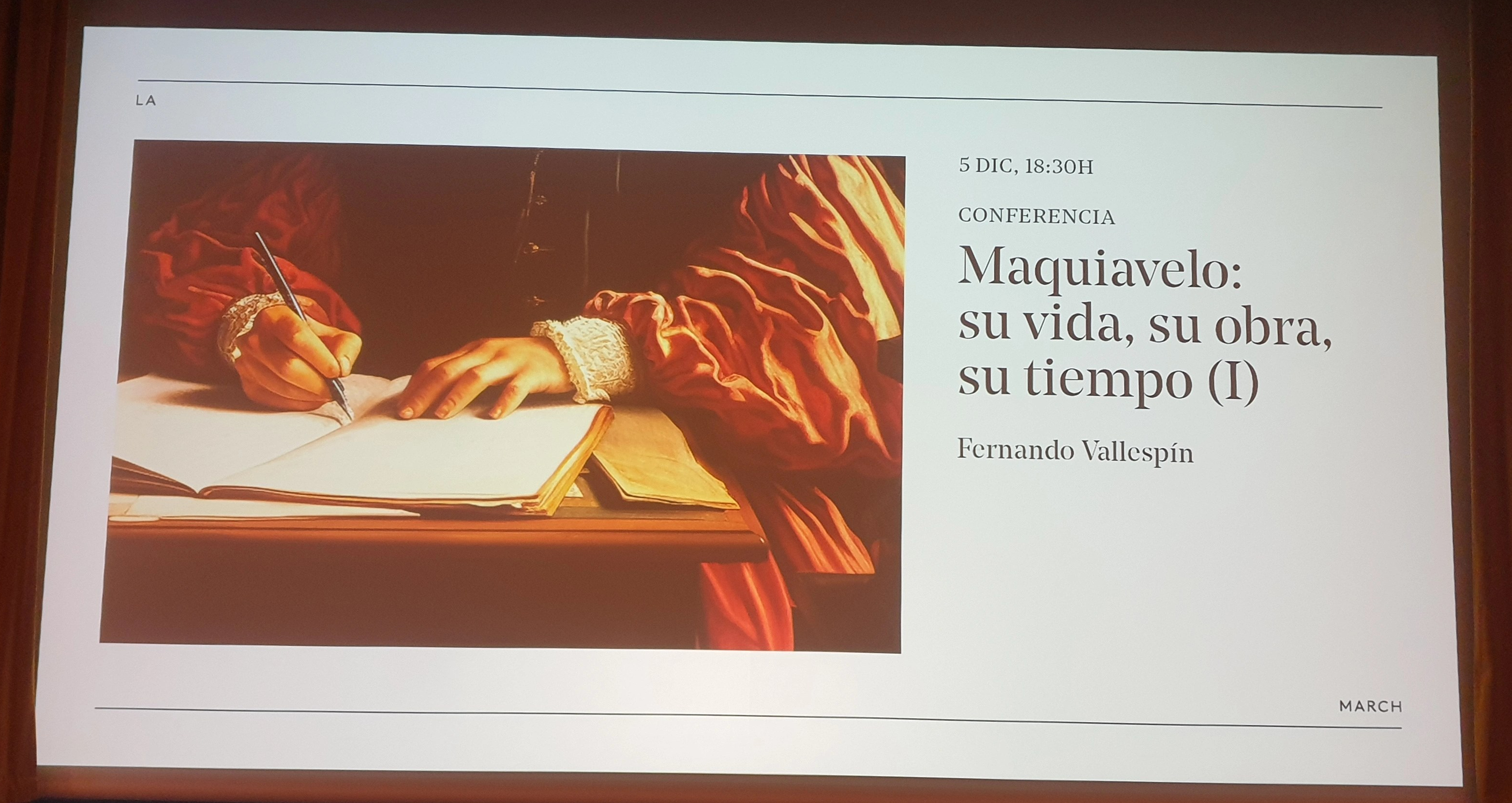
Although I am not a Renaissance specialist, I recently went to a fantastic conference on Machiavelli given by professor of Political Science at the Autonomous University of Madrid Fernando Vallespín at the fantastic Fundación Juan March.

Professor Vallespin was amazing, and his presentation was equally interesting. He obviously referenced the growing wave of Humanism that sparked and propelled the Renaissance, he commented on Giovanni Pico della Mirandola (1463–1494), he recommended Stephen Greenblat’s The Swerve, and he put Machiavelli in the context of his era. I had not read The Prince since high school back in the Pleistocene; so, it was very refreshing to re-visit Machiavelli. I remembered my Medieval Literature professor, the great Frank Dominguez mention that The Prince was written for king Ferdinand of Aragon whom Machiavelli admired. I wanted to ask Prof. Vallespin about that, but he did not stick around for Q and A…

If you are in Madrid, check out the conference cycles at the March, you will not regret it!

Answers:

1.         Kafkaesque     G. Marked by a senseless, disorienting, often menacing complexity.

2.         Nietzschean    C. Emphasizing the will to power as the chief motivating force of both the individual and society.

3.         Platonic           B. As a striving toward love of spiritual or ideal beauty.

4.         Orwellian        H. The totalitarian future described in his antiutopian novel 1984.

5.         Machiavellian A. in which political expediency is placed above morality, and craft and deceit are used to maintain the authority and carry out the policies of a ruler.

6.         Quixotic          D. Extravagantly chivalrous or romantic; visionary, impractical, or impracticable.

7.         Faustian          F. Sacrificing spiritual values for power, knowledge, or material gain.

8.         Dickensian      E. Describing a fictional world teeming with characters from all walks of life and social strata.

*All definitions from Dictionary.com with thanks