A good cigar

It looks like I have never dedicated a blog post to my love of cigars. Today I visited my favorite cigar shop in Madrid and realized it is time to change that.

The thing is, one has to focus on the little pleasures of life, the little things that give one some respite from this mad, mad world we have created. A decent cup of coffee or tea sitting down reading, writing, chatting with a friend/s or contemplating, not a gallon coffee when you are running around or working like some crazy Americans I see. A little walk somewhere that lets you breathe. Chocolate, a nice drink, a while with friends, sport, many things can be a recess.

One of those occasional pleasures for me is a good cigar. I have enjoyed cigars since my first job after college, around 1988, when I could finally afford some nice things. My first cigars where bought at L.J. Peretti in Boston, but when I came to Spain and discovered Cubans that was the end of non Cuban cigars, unless one was under duress, as one sometimes is.

Montecristo Nº 4 is my standard smoke. Ideal in most circumstances and one of the best balanced cigars you can smoke. Special occasions require different choices. For example the bullfight requires a longer smoke. An after breakfast smoke requires a softer touch, and so on. A lot also depends on what you are going to have with it, rum? Brandy? Cognac? Bourbon? Wine? Coffee? Decisions, decisions.

When I returned to Boston in 2005 I was blessed to find Gloucester Street Cigars. José was a true gentleman. That was my little escape place. When I moved to downtown Boston they held the spare set of keys to my apartment! We also did two phenomenal cigar night fundraisers for Dana Farber Cancer Institute in Boston, raising well over $3000.

Now in Chapel Hill I am fortunate to have a small porch on which to enjoy a good smoke. I have corrupted my dear friend Jedd to join me in my cigar smoking pleasure, to the point that he has become quite an aficionado and even has a nice cigar cabinet where he sells cigars at Zog’s. This might be a case where the teacher surpasses the master!

Like any good hobby, cigars takes time. They must be kept in perfect conditions. Then there is the lighting ceremony in order to get an even start, and then enjoy. Very important, when you are finished never extinguish, squash, crush, or in any way tamper with the dignity of the cigar in its last moments. Just let it quietly drift away. Anything else will burn the precious oils and make the cigar furious and it will stink (literally).

Now that the US and Cuba are normalizing relations I can go to my favorite and Madrid’s best cigar store (which must make it a top place worldwide) on calle Barquillo to stock up until Christmas break!

If you enjoy cigars and want to learn more I definitely recommend Gabriel Cabrera Infante’s Holy Smoke a hilarious history, guide and manual for cigar smokers.

Rocinante does not like my cigar smoking, after all it is tricky to concentrate on two things that require attention at the same time. So I have to wait until a break in the riding to enjoy a smoke.

What am I smoking now? When I visited Greece, my dear friend Alfonso gave me a box of Trinidad Fundadores, a smooth Laguito cigar!

Lauren Mackler, career and life coach

So there I was, having just closed my company and sold our beautiful apartment in Madrid overlooking the Retiro Park. Just moved back to Boston and struggling in my new career as a teacher in a tough public school. Reading the Boston Globe Sunday Magazine one day, there was an article about career recycling, reinventing yourself, blah, blah, blah. The “more info” bullets had a couple of career coaches names. So I called one of them.

My previous life in the photo business

My previous life in the photo business

It was Lauren Mackler. We agreed to (I think) a twelve session program and she kicked my ass (figuratively). We went back to my core values, my upbringing, my education, my deep needs and professional desires. She wrote everything down on big sheets of paper. We did the Myers Briggs test – and a bunch of others – surprise, my ideal job is teacher (only after preacher which is pretty similar).

We worked in the nicely done basement of her house, really well and hard for the whole program, she is tough and had me in tears a few times. I learnt so much about myself: where I really wanted to be in the future, where I could and would work best, etc. etc. I still have all her notes and occasionally go over them with colleagues who are a bit lost professionally.

Ten years later and Lauren has done very well for herself: published a book, spoken at the Harvard Business School, on TV and become a bit of a celebrity in the coaching business, good for her! As for myself, I am happy I worked with her and that she helped me unleash my potential. Did we expect me to be getting a PhD in 18th C. Spanish literature at UNC? Well no, but that is beside the point. The point is that she is a great coach and I am happy to recommend her if you need any sort of career help.

PS: This blog is totally independent, and I only write what I feel like writing!

Shameless self promotion / Job search Fall 2016

Ah yes, that time again when one has to start thinking of finding a job. Since this will be (Insha’Allah) my last (academic) year at UNC. I have to start thinking of what I will be doing come September of 2016…

One of the few things I am certain of is that I am passionate about teaching, especially my language, my culture, my literature. I am hopeful that someone somewhere will need a Spanish teacher with over ten years teaching experience and a PhD in Spanish Literature for next year.

Narrowing down my job options, I would love to be the coordinator of an American university’s study abroad program in Spain – ideally in Spain, near my family. But I know I will thrive teaching at a small liberal arts college or at a secondary school where I can also be a “dorm parent” and coach, what they call in the business a “triple threat”.

Where? You ask. Well I must confess I have fallen in love with the South – who wouldn’t? and I do love the East coast, its history, culture, and relative proximity to Europe. But I would love to explore new grounds: Asia, Korea or Japan, the Middle East, Africa, Oceania, and of course old Europe, make me an offer!!

Experience? In my first job I was in charge of training / coaching / herding? the summer interns that came to Grantham Mayo and Van Otterloo in Boston. From then on in the late 80s I have always enjoyed the training and mentoring part of my jobs. During my stint as a stockbroker in Madrid since I was not doing much in the teaching/coaching/mentoring realm I volunteered to teach English at the Colegio de Huerfanos de la Guardia Civil in Madrid  As a sales manager I was in charge of team training and later as consultant I would do the same around Latin America. Once I had my own company from ´94 to ´04 I loved all the training that happened for new employees. We even organized yearly retreats with a coach to help us improve. In 2005 I started my professional teaching career teaching at public schools, private schools and at UNC for the last three years.

They say in Spain “el movimiento se demuestra andando” (something like movement is proven by walking) so here are a couple of videos of me trying to teach. One at Walnut Hill, the oldest private arts school in the US and my first semester at UNC. In case you are really interested I have also included my abridged CV, feel free to ask for any more info!!

Antonio Balsón CV Academic -abridged-

Brother Eulogio, El Paular monastery, and the Lozoya river

My childhood friend Jaime introduced me to brother Eulogio in the summer of 2011. I was floored by this man’s overflowing spirituality, granted he is a pro, but still. We got to spend the day with him and I was mesmerized.

The other day without Jaime’s two kids we drove over the Guadarrama mountains with our bicycles in his van to the monastery at El Paular to meet with brother Eulogio again.

Brother Eulogio is a “retired” 82 year old Benedictine monk. He was a Vespa mechanic before becoming a monk at 23. At the monastery he was put in charge of meeting with couples that wanted to get married there, later he managed just about all the other jobs at the monastery.

El Paular was built as a Carthusian monastery in 1390. By the time it got dismantled in the confiscations of Mendizábal of 1835, it was mentioned in Juan Ruiz’s Libro de buen amor, as its protagonist embarks from there on one of his “excursions” where he will meet the terrible Serranas. It housed the monk that wrote a Glosa to the Coplas por la muerte de su padre by Jorge Manrique. It also housed Enlightenment writer and first romantic (according to Russell Sebold) José de Cadalso, among others.

In 1958, the monastery was reopened under the Benedictine order. Eventually a luxury hotel was opened next door – which is now closed. Nowadays there are only 6 monks left and a couple of “visiting” monks. The monastery houses guests that can stay and take part in the monastic lifestyle. Jaime spent years there doing great restoration work in the beautiful chapel and the cloister, so he knows the monks very well, so much so that he just walks in, the other day, through the kitchen!

Some of the recent accomplishments of the monastery have been reuniting all the Vicente Carducho paintings that lined the cloister and had been scattered after the confiscation as with the choir engraved wood chairs.

Jaime and I spent the morning chatting with brother Eulogio. He asks pointed questions and reasons with you. It is one of the most – if not the most – intense and spiritual experiences for me.

We had not asked to stay for lunch, so we said our goodbyes, picked up our bicycles and started an excursion to the top of the Peñalara hills. We had a lovely pic-nic by the side of the Lozoya river and carried on until we had to ditch the bikes and continue hiking for a good hour until we arrived at the source of the Lozoya, the Cascadas del Purgatorio. We had a refreshing swim in the pools before heading back down. Near the end of our trip Jaime got a flat so we had to walk the last couple of miles to the car.

This slideshow requires JavaScript.

Manuel Balsón, “El Jefe” (1934 – 2015)

Many personal obituaries start by mentioning a favorite memory, or a first memory they have of the departed. This, besides being personal, offers the opportunity for a funny or intimate story or anecdote. On the other hand, professional (read press) obituaries focus on the achievements of the departed.

For my father I am throwing out both styles and let’s see what we get. Part of the reason for this is that I do not have a specific memory, or a funny memory, or a first memory. Well, I have many and not one of them particularly sticks out. Nor do I have a list of achievements for him. He did not discover penicillin, nor the theory of relativity, nor did he invent the light bulb. But from humble beginnings he worked hard to bring up a family.

The secret of his success is due to the vision of his father (my grandfather) Antonio, who sent him to the British School in Madrid, meaning that my father was a rara avis: an English speaking Spaniard in the post civil war, Franco ruled Spain of the 50s.

A couple of times I have heard the cute remark about how the important thing on gravestones is the little dash that separates the birthdate from the date of death. Duh.

Something else to keep in mind is how we label and put people in their little boxes. Yes my dad devoted most of his life to international banking, in fact he was an important cog in the Spanish international banking scene of the seventies and eighties. But that is not all of who he was. Yes was a keen motorist and loved cars and motorsports. Yes he was a keen fan of Apple computers, especially given his age. Yes he managed to track his family back to the mid eighteenth Century, but that is not who he was either. He loved jazz – although later in life he got to appreciating classical music more, so every Christmas I would record for him, originally a cassette tape and eventually CDs and finally USB sticks. He loved to read the newspaper which he did every day without fail. That is another trait I learned from him. He loved food and wine and would equally enjoy a cheese sandwich on a park bench as a Michelin starred meal.

He was a brave and decisive man who at a young age went to London to learn about foreign exchange. He lived with my mother across the street from Ashburton Grove, home of Arsenal Football club, but that did not make him an Arsenal fan, if anything he was a Real Madrid fan. After learning about foreign exchange in London, he started an upwards trajectory that would not stop until his retirement in the late 80s.

In the 70s he was offered to start the New York office of the bank. Being the elegant visionary that he was, he opened shop in the iconic Seagram Building on Park Avenue. We all packed up and left Madrid, I was twelve. It was a bit traumatic but I would eventually get the hang of moving back and forth, and it would become a way of life. After three years in New York came five in London and then back to Madrid, by then I had started my own nomadic way of life, going to college in Boston and working in France and Switzerland during the summers.

But back to Manuel. He had that kind of knack to be in the right place at the right time and looking good while doing it. Of course it did not hurt that his brother-in-law – my uncle and godfather – was a renowned tailor that made him all his suits!  BTW that is where I get my suit wearing custom, in case you were wondering. The other side of that coin was that unfortunately my dad travelled constantly, so we did miss him at home.

As a teenager up I remember blasting all around Europe in the big old Bismark at 130 miles per hour with any excuse. Eventually I would even be allowed to drive – that was fun.

My father retired in the late 80s and started all kinds of hobbies: playing with computers, taking a genealogy course to track his family tree, but most importantly spending time with friends, travelling with them and basically hanging out with all sorts of people. Manuel made friends easily, from all walks of life: artists, Bohemians, noblemen and gypsies, doormen and executives, everybody. About this time he became a part of the Boina club. The boina is the Spanish version of the French beret. This “club” basically consists of a bunch of guys meeting at a great basque restaurant for dinner and appointing 2 new members: a male and a female boinero who had to make an induction speech. This group had a fantastic network of contacts so the list of members is basically a who´s who of Madrid: writers, artists journalists, politicians, professors, you name it, of course my dad with his love of cars was the unofficial chauffeur of the group, picking up and dropping off the new members, this way he always got to hang out with them one on one!

For years every morning he would walk around the Retiro Park in Madrid, and he would often meet people there. Some of them became close friends. He walked every day until he no longer had the strength to walk out the door. The twelve years that I lived in Madrid, I always loved living overlooking the park so I had the light and could run and walk. Many weekend mornings I would bump into my dad walking and I would walk with him. Those walks were very special.

Possibly his biggest project after retirement was installing and improving the sprinkler system at the country house in La Navata. In fact, more of a hobby, it might have been his summertime obsession. I joked with him that he was like Enea Silvio Carrega, the hydraulics obsessed uncle in Italo Calvino’s story Il barone rampante. Fixing the sprinklers, changing water pumps, pumping water from one well to the other, tweaking the irrigation software. For this project he would enlist Mohammed, our local gardener to dig a ditch here, uncover a pipe here, make a hole here and so on. You would wake up on a hot summer morning and see chubby Mohammed trudging around the garden following my father who would be wearing his immaculate Panama hat overseeing the watering situation.

My father was diagnosed with an advanced pancreatic cancer in 2012. Thanks to the phenomenal staff at the Hospital Clínico San Carlos and specifically to Dr. Sastre, who managed to sneak him into the last spot at a clinical trial for a new pancreatic cancer drug manufactured by Celgene. This was a massive and miraculous success that increased my father’s life from an average of 5 to 9 months to three and a half years. These have been a tough three and a half years for Manuel as he struggled with his illness. The last few days, my mom, terribly stressed from being basically the sole caregiver all this time, took advantage of the fact that I was home from North Carolina to take some days off in Mallorca with her grandchildren. So I spent my father´s last week alone with him. Despite the fact that it was a tough situation for us, we had a very nice last bonding experience. We did not talk much, as by then he was spending most of his time sleeping. I slept on a bed next to him, to help him at night.

This slideshow requires JavaScript.

Manuel died peacefully in his sleep on the morning of July 3 on his bed, surrounded by his family, like Don Quijote or Rodrigo Manrique.

Summer rainstorm in Madrid

It has been so long since I was caught in a summer storm in Madrid, I don’t even remember the last time. Of course it does not help that I have been living in the US for ten years now, and that when I do come home I spend most of my time at home with family. So it was a rare, rare treat when a recent afternoon I went for a bit of a walkabout and half an hour out I found myself in the most intense, refreshing, and overall awesome storm. At first I stopped at the entrance to a building to protect myself, but after a while, bored of waiting, I went off and enjoyed getting wet, cleansed and cooled down.

Contrary to popular belief that “The rain in Spain stays mainly on the plain”, the rain in Spain favors the north shore. So much that it is intensely green, not unlike say Ireland, or the north of France. The plain however – and Madrid sits right smack in the middle of it, if fairly dry. Madrid is also the highest capital in Europe sitting 646 m (2,119 feet) above sea level, making it very dry as well as hot in the daytime and cooler at night. Of course Global Warming and desertification do not help, and the dry South is slowly creeping its way North.

Revisiting Cavafy

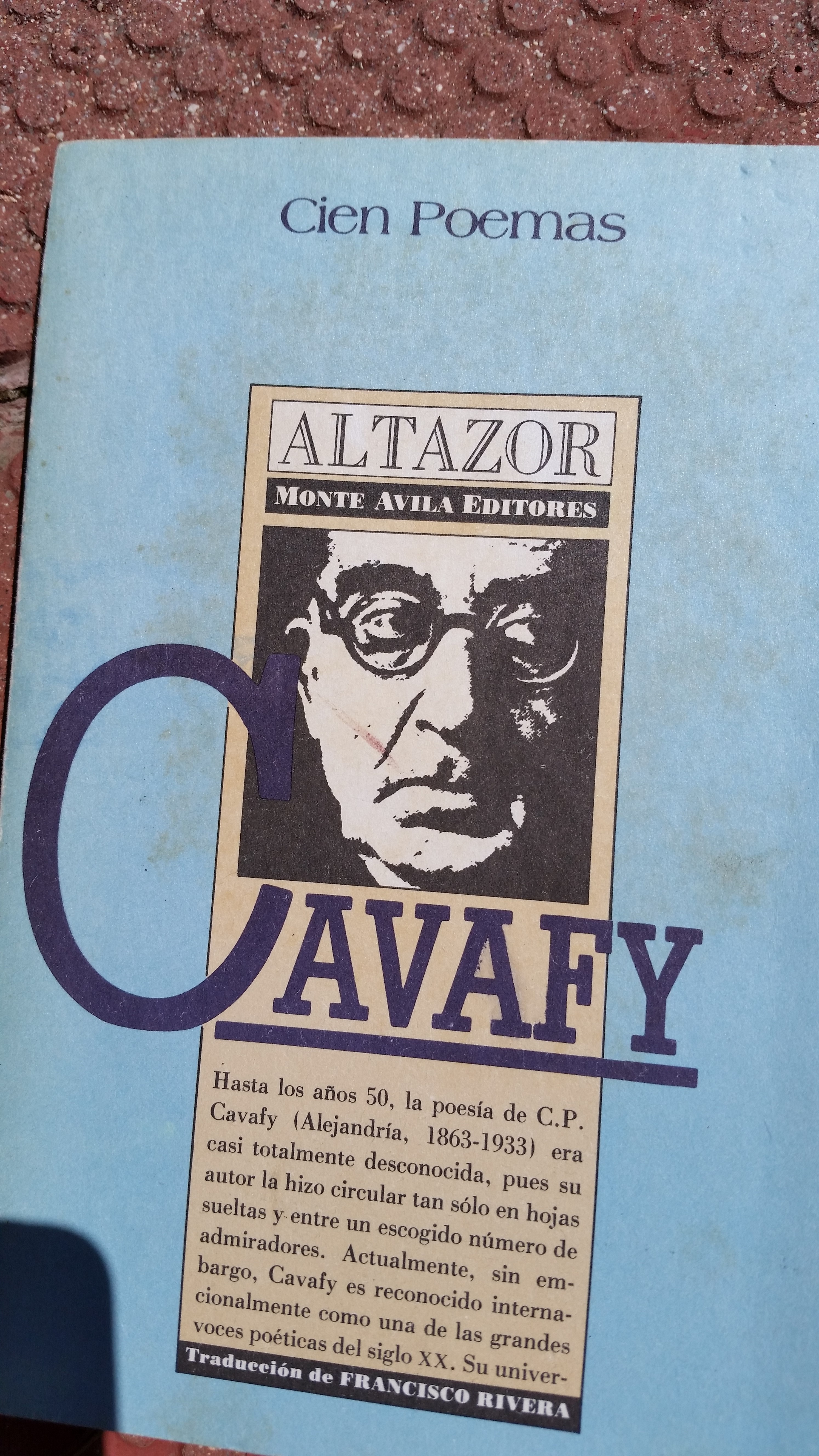
my old Cavafy

my old Cavafy

Sad and melancholic after returning from Greece, I found my old Cavafy book and I am re-visiting it!

My brother Theo introduced me to Constantine Cavafy years ago – through his poem Ithaka (which I posted on this blog on August 19, 2011). Now as I reread poems I discover new beauty in his words. The poem which has struck me the most during this re-reading has been God Abandons Antony or God Forsakes Antony, published in 1911. The story is of a defeated Marc Anthony in Alexandria (which centuries later would be home to Cavafy). After being moved by its elegance I remarked on the importance of the story of Marc Anthony and Cleopatra. Of our fascination with that love story, with ancient Egypt, with the Roman Empire, and so on, so I started thinking of my favorite connections to this story…

The first one that came to mind where the lyrics from one of my favorite Rolling Stones songs: Blinded by Love, when Mick Jagger sings:

The queen of the Nile

She laid on her throne

And she was drifting downstream

On a barge that was burnished with gold

Royal purple the sails

So sweetly perfumed

And poor Mark Antony’s

Senses were drowned

And his future was doomed

He was blinded by love

Of course Cavafy’s poem is born from Plutarch’s telling of the story. Canadian singer-songwriter Leonard Cohen used the poem for one of his songs, but changed Alexandria, the city, to Alexandra, a woman. Of course there is Shakespeare’s play Antony and Cleopatra born from a translation of Plutarch, there is Elizabeth Taylor and Richard Burton, and so on and so forth, but for now I leave you with Cavafy in his own translation:

If unexpectedly, in middle night,

an unseen company be heard to pass,

with music and with voices exquisite, —

turn not away and uselessly lament

your fortune that is giving in, your work

that came to nothing, the projects of your life

that proved illusory from first to last.

As one prepared long since, as fits the brave,

bid now farewell to the departing city,

farewell to the Alexandria you love.

And above all, do not deceive yourself:

say not that your impression was a dream,

that, it may be, your hearing played you false:

to futile hopes like these never descend.

As one prepared long since, as fits the brave,

as most fits you who gained so great a city,

approach the open window steadily,

and with emotion, but without the plaints

and supplications of the timorous,

listen — knowing it to be your last delight —

listen to the elysian sounds, the exquisite

instruments of the mystic company;

and bid farewell to the city you are losing,

farewell to the Alexandria you love.

The 18th Century as literary hinge

When I “discovered” 18th Century Spanish literature, something that really struck me was what a critical element it was in the history of literature and how little credit it gets. The 18th Century is a literary hinge in the evolution of literature. While it can be argued that every century, or era, is a “hinge” era, a time between times, the 18th Century exercises as a flexing point in what has been called the pendulum of literary movements. Being the philistine that I am, I can only use Spanish literature for my example:

The ilustrados (18th C educated Spaniards), whether they liked it or not, were actually building on the shoulders of the Baroque, with its chiaroscuro and trompe l’oeil, which they hated. This, in turn, was a reaction to the Renaissance which was short lived in Spain in favor of the more mysterious and why not, fun, Baroque, more suited to the Spanish temperament (perpetuating stereotypes, the Spanish are a Baroque people. Disagree? Go watch an Almodovar film). For the Spanish literati, the solution to what they considered centuries of muddle was to build a one way bridge to the classic ancient Greeks and Romans as Luzán proposed in his Poética (1737). As much as the Enlightened writers wanted to, they could not get there without the rich legacy of medieval letters and art and everything that followed. For example, my man, Padre Isla (1703-1781), a precursor to the ilustrados, indeed goes back to the ancients, but he also relies heavily on St. Bonaventure, St. Thomas Aquinas, and especially Cervantes and Quevedo, creating his narrative from a blend of centuries of letters. Consciously or not these are the foundations the 18th Century had to build on.

On the other hand the Enlightenment’s obsession with societal good which even led to the elimination of the novel in Spain due to its reliance on the first person singular, is the launching pad for the Romantic movement where that “I” is all important. Equally, the Enlightened enthusiasm for scientific enumeration led to the naturalists. The reaction to those developments will be realism, modernism and postmodernism.

In big bold brushstrokes there are the Classics, Medieval, Renaissance and Baroque eras leading up to the Enlightenment, and the Romantic, Naturalist, Realist, Modernist and Postmodernism after it. How do I then explain the fact that my sides, arms or rays of my angle are lopsided? Well it must be taken into account that both the Classical and Medieval periods encompass centuries, while the last big three movements occurred within the 20th C. due to the advances in communications and technology, so just counting movements is not the same as considering the influence and repercussion of  those movements. This of course is taking into account all the differences in labeling periods and movements. No style is 100% unique, as one genre blends into another.

Thus, a solid grasp of 18th Century literature opens up an understanding to what happened before and after on the literary continuum. From a teaching standpoint, understanding the enlightenment offers the key to the past as well as to the future of literary history.

P.S.: When I explained this idea to my thesis director during one of our coffees, she liked it so much she took a picture!

Museo Sorolla

Literally a block away from my parents’ flat in Madrid is the Museo Sorolla. A little jewel of a museum. It is the urban palazzo of turn of the century painter Joaquín Sorolla which now houses his museum.

Once cleared the gate you are welcomed into a small refreshing garden. An oasis in the middle of downtown Madrid, surrounded by apartment buildings, shops and offices.

If being in the garden seems like a departure from the city, walking into the museum takes you to Sorolla’s beloved Mediterranean coast, where he painted most of his oeuvre. Some of the paintings are massive, but more important is the artists’ grasp of light. You see, light on the Mediterranean is quite different from light anywhere else – if you have not seen it, you will have to trust me on this one. Sorolla captures that light, that breeze, that heat, and puts it on the canvas, which is the reason he is called the “painter of light”. While some people label him an impressionist, he is beyond impressionism. The house also holds a lot of art that was given to him, his great collection of Valencia ceramic, where he was from, and many of his random knick-knacks.

Since I was a teenager, having the museum so close to home was a blessing and a curse. I did not always go into the museum, I just stayed in the garden, reading. But knowing that it was there I took it for granted and did not visit for a long time. A couple of years ago my sister Susana and I took our niece and nephew for a nice visit. This May, during a coffee run, I sneaked in for a few moments of escape.

My beloved Greece

What does one do when one of your most dear friends from university invites you to his housewarming party in a Greek seaside village? You tell them you are too busy working on your dissertation, that you have family obligations and that your graduate student budget does not allow for adventures in Greece. What does one do when he insists and ends up sacrificing his last frequent flier miles to get one’s sorry ass over in business class? You humbly and eagerly accept and pack some serious sun protection.

This is exactly what happened to me this summer (except the sun protection bit). My dear friend Matthew, who has been patient enough with me to be a groomsman at my two weddings and who came to visit me in Madrid last summer did just that.

I had not been to my beloved Greece since the mid-nineties, so going back – and for such an event was very especial. Mark Miller, the third musketeer, came in from New York on the same day as me, and Matthew drove us a couple of hours to his house in the lovely village of Toló, near the old Greek capital of Nafplio, on the Peloponnese mainland.

The house is more of a compound, high on a hill overlooking the sweet village of Toló, the sea and the beautiful islands. It includes Irina’s 8 Cooking Hats Cooking School and the house. When we arrived, construction crews were working frantically to finish all the last-minute details, and they would continue for the next two days before the grand opening party (but not before I befriended the construction guys – soccer is the key here – and they let me sign my name on some wet cement!)

The cooking school building has a bunch of guest rooms. Mark and I settled into the gym / Pilates / Zumba room and also temporary storage and staging area for all pre-party supplies: liquor and wine, fireworks, furniture, and random nick knacks. Not to mention two queen sized pull down beds and our own bathroom.

The first two days I must confess where hectic: Helping Matthew and Irina prepare everything for the party: peeling pistachios, making big paper flower pompoms – and hanging them up, shopping for enough supplies to feed a hungry Roman Legion, chopping and prepping all sorts of food with Alex (who would become a dear friend, my little grasshopper), Susanna and George, buying and transporting enough alcohol to fuel a year of parties in Ibiza, helping the DJs set up speakers and cables, organizing. Lots of organizing and cleaning. Lots of cleaning. Unfortunately Mark was suffering from acute chronic jet lag so he seemed to spend the first days just eating and sleeping. But he is such a fantastic sport that he took all our joking on the subject in stride.

For me, preparations for the party continued until even after the first few guests arrived, with just time for a quick shave and shower before helping to pass around mountains of food. Once the party started I could finally enjoy a gin and tonic, a cigar, and dancing. Lots of dancing.

Matthew’s wife Irina learnt about Toló from Nelly, a classmate at hotel and culinary school in Switzerland. Nelly owns an adorable boutique hotel on the beach with her brother Manolis where Matthew and I would stop in between chores (remember, Mark was mostly sleeping) for a coffee, or frappé. Petros, Nelly and Manoli’s dad who adores Matthew, would insist on cooking us some eggs. It will be hard for you to find a nicer family than the Vlachakis.

Irina is a popular food blogger in the Russian Interweb, so we received plenty of Russian food bloggers and friends (picking them up and shuttling guests around was another fun chore!). We were also lucky that Alfonso, another of our dear friends from university was in the area with his sailing boat: the beautiful, sleek, state of the art Athina, so he also came, bringing with him his friend Alessio, a true Italian bohemian, ex actor, world traveler and master storyteller and his captain José.

All in all Irina and Matthew gathered an awesome group of beautiful, high energy people. The days after the party we went on excursions to the ancient Greek theater of Epidaurus, to George Skouras’ vineyard and winery, to the town and castle of Nafplio, even on a boat cruise to a remote island, with its obligatory Greek Orthodox chapel on top – where coincidentally the aforementioned Nelly was baptized. Neither my hack writing, nor my hack photos can do justice to the time we had.

For me, to use a Greek word, my visit to Greece was cathartic. It had been about twenty years since I had been to Greece and I have such fond memories that I can now add to. This summer also marks the fifth anniversary of my full catastrophe (to use Zorba’s expression), so having ten days of fairly carefree sun and sunshine was a welcome relief.

Besides meeting a bunch of phenomenal people, I managed to go to church the morning after the party (getting up was a bit rough) for a beautiful Greek Orthodox service, eat lots and lots of delicious Greek food, spent the day sailing on Alfonso’s boat from Toló to Spetses (returning on his speedboat), visiting with friends and basically forgetting all my responsibilities for ten days.

It is at times like these, when you relax, let your defenses down, that life comes creeping back in, you can joke, laugh, feel, allow yourself to love and appreciate friends and allow yourself to be loved and appreciated by friends.