A mystical experience on the Camino

The only good thing about the A Pociña de Muñíz albergue when I stopped for breakfast was that while they ripped me off with a 2 Euro filtered coffee when their real coffee machine sat idle right there, was that they recommended that I take the Soutomeride variant that goes through an ancient forest and by an equally ancient church instead of by the “main” Camino.

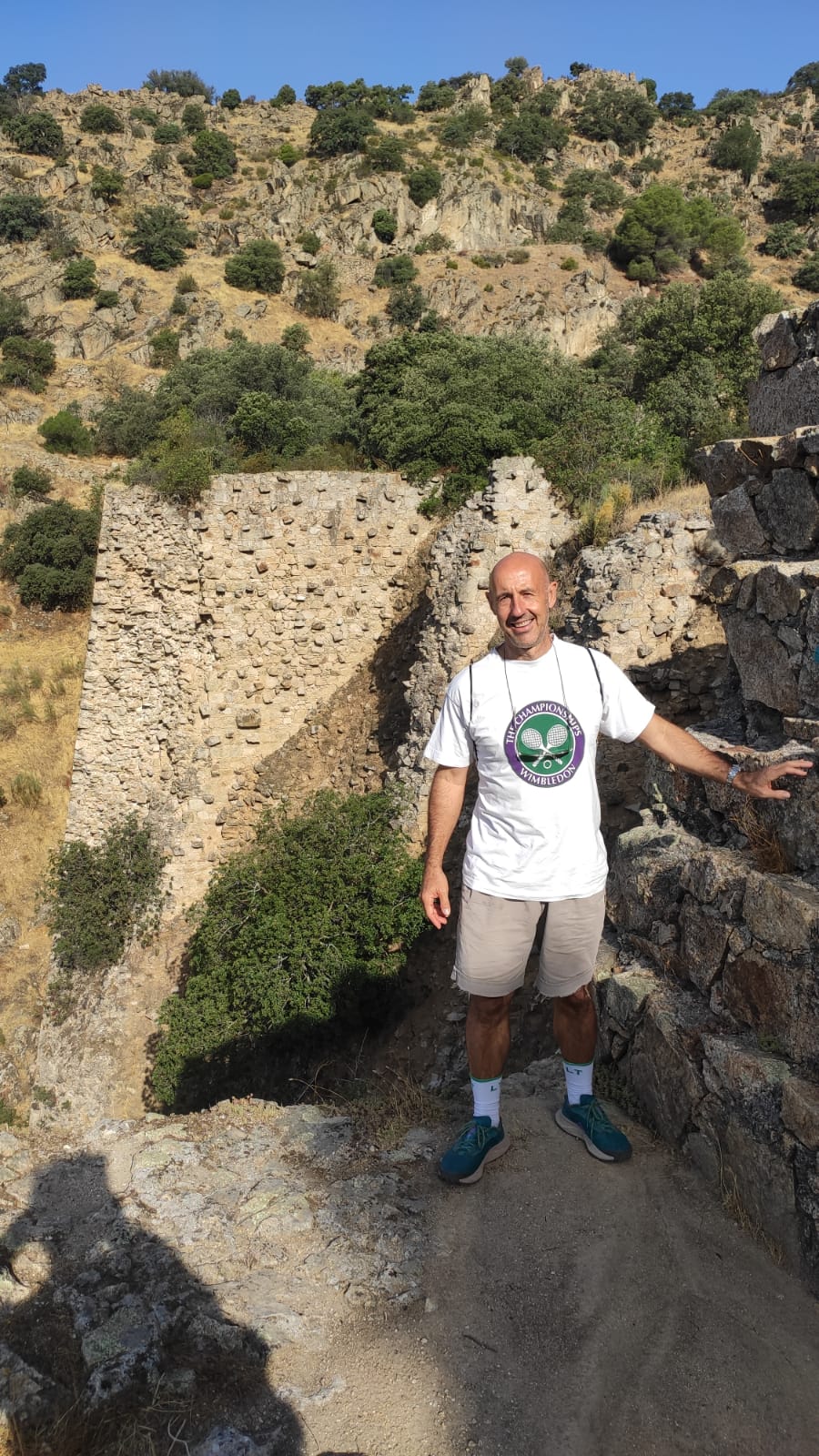
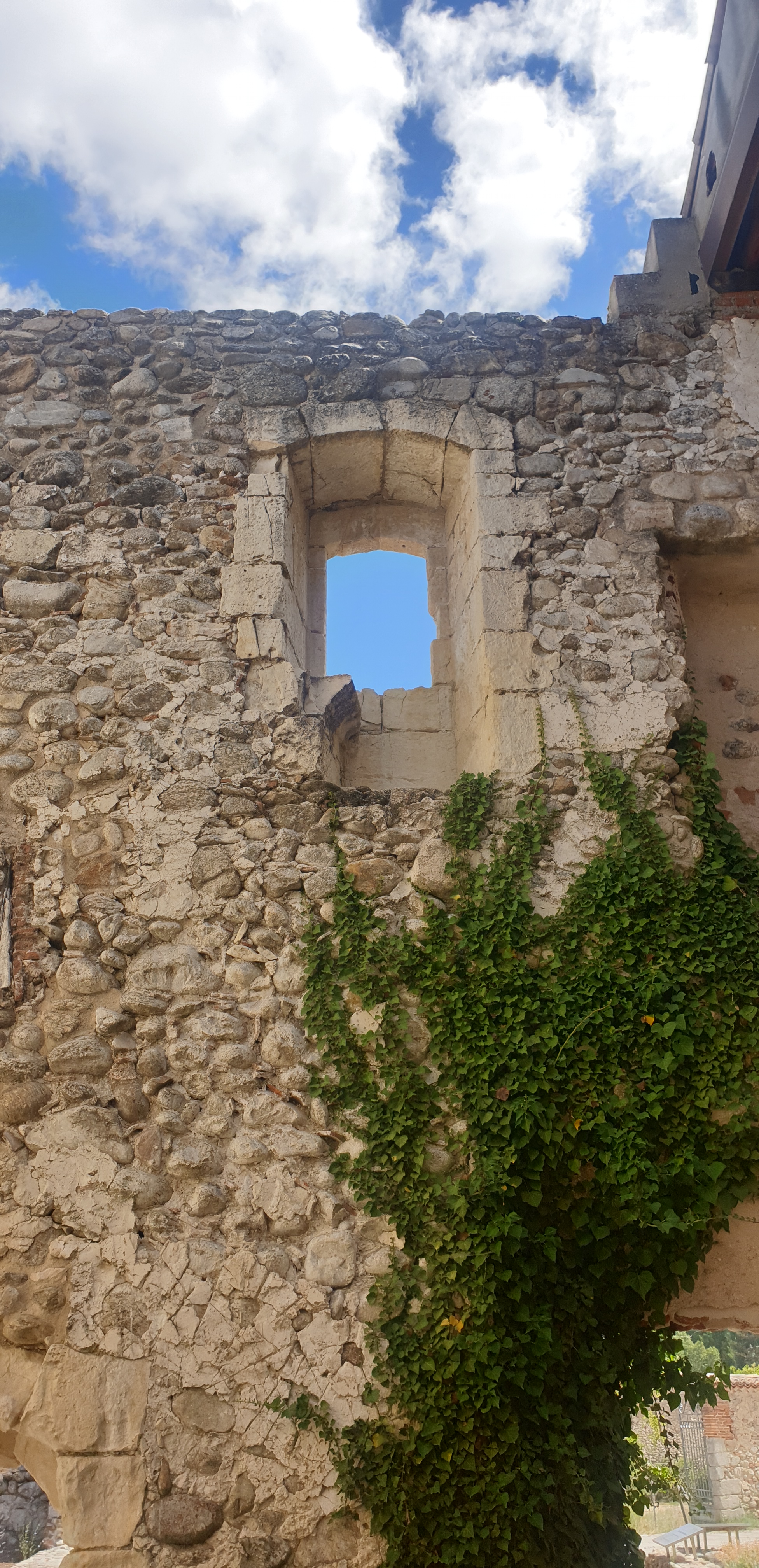
So there I was, still fairly early in the morning, walking and meditating as I entered this age-old forest with 350-year-old chestnuts, among long ago ruined buildings covered with every plant imaginable that I arrived at the back of the aforementioned church of San Salvador de Soutomerille. I was stopped in my tracks by the beauty of four pre-Romanesque horseshoe windows. Never had I seen such beautiful, old windows on a building, in what appeared a semi abandoned church in the middle of an enchanted forest.

But wait. At that moment as I approached the church taking a picture of the window, I heard an angelical voice coming from inside.

What is going on? How can this old church that probably does not even have electricity, in the middle of a forest have music? Do they have some sort of record player? Spotify? And the voice, it is angelical, and the music, sounds like Hildegard von Bingen. I am mystified, baffled, confused, and ecstatic all at the same time. The singing stops and I slowly walk around the tiny church. There, by the door is Ingrid, a German pilgrim and amateur singer who was singing through a broken panel on the door to check out the acoustics. A very human and perfectly reasonable occurrence, but for me it was a mystical experience.

You do not believe my story? Turn up the volume and watch the video below…

BTW if Ingrid or anybody that knows German pilgrim, amateur singer Ingrid reads this please leave a comment below!

Camino de Santiago #3, the Camino Primitivo

The Camino Primitivo is not only the original Camino, but also the most intense. Yes, it is half the distance of the other “main” Caminos, The Francés and the Norte, but what it lacks in length, it makes up plenty in beauty, ruggedness, physicality, and authenticity.

As you know I had been planning this Camino since I finished the North route last year. It did not disappoint. Here is the story:

Around the year 800, a hermit in Galicia called Paio (or Pelagius) was guided by lights and angels to St. James’ tomb. After telling his local bishop, king Alfonso II “El casto” went to check out what the fuss was about, thereby creating the first pilgrimage. As the Reconquista developed, new routes were established leading to the North and eventually the Francés route, which is today the most popular.

So, I took a train to Oviedo, the ancient capital of Spain during the Moorish occupation. It is a high-speed train only halfway, as the mountains that separate the plateau from the shore has not been breached by the high-speed line yet, making it is a five-hour journey. I arrived in Oviedo just in time to run to the albergue -an old seminary- before it closed!

I shared room with Vicente, a retiree from Valencia whom I would continue to bump into well into the Camino.

Downtown Oviedo is lovely, clean, and full of sculptures! It is so cool! The walk out of town was pleasant enough, and soon you are in the middle of the countryside in total pilgrim mode. The first day is an easy 24Km to Grado, where I had been years ago with my Land Rover. A dip in the frigid river quickly got rid of the day’s hiking inflammation. The albergue is an old horse brokerage house, and there is a cute town square with restaurants and a working church where the priest is happy to give me a pilgrim’s blessing.

The second day brings the first important climbs of the pilgrimage. With hot temperatures and sun, the last climb took a toll, but fortunately I would not have to tackle it first thing next morning.

The next five days are a thing of beauty. I chose the Hospitales variant which takes you up over the tree line for a day of ridging 1000 mts over sea level. Amazing, you do not even miss the cafés! The following three or four days are just as impressive: natural, rugged, and fairly uncivilized. although without the altitude,

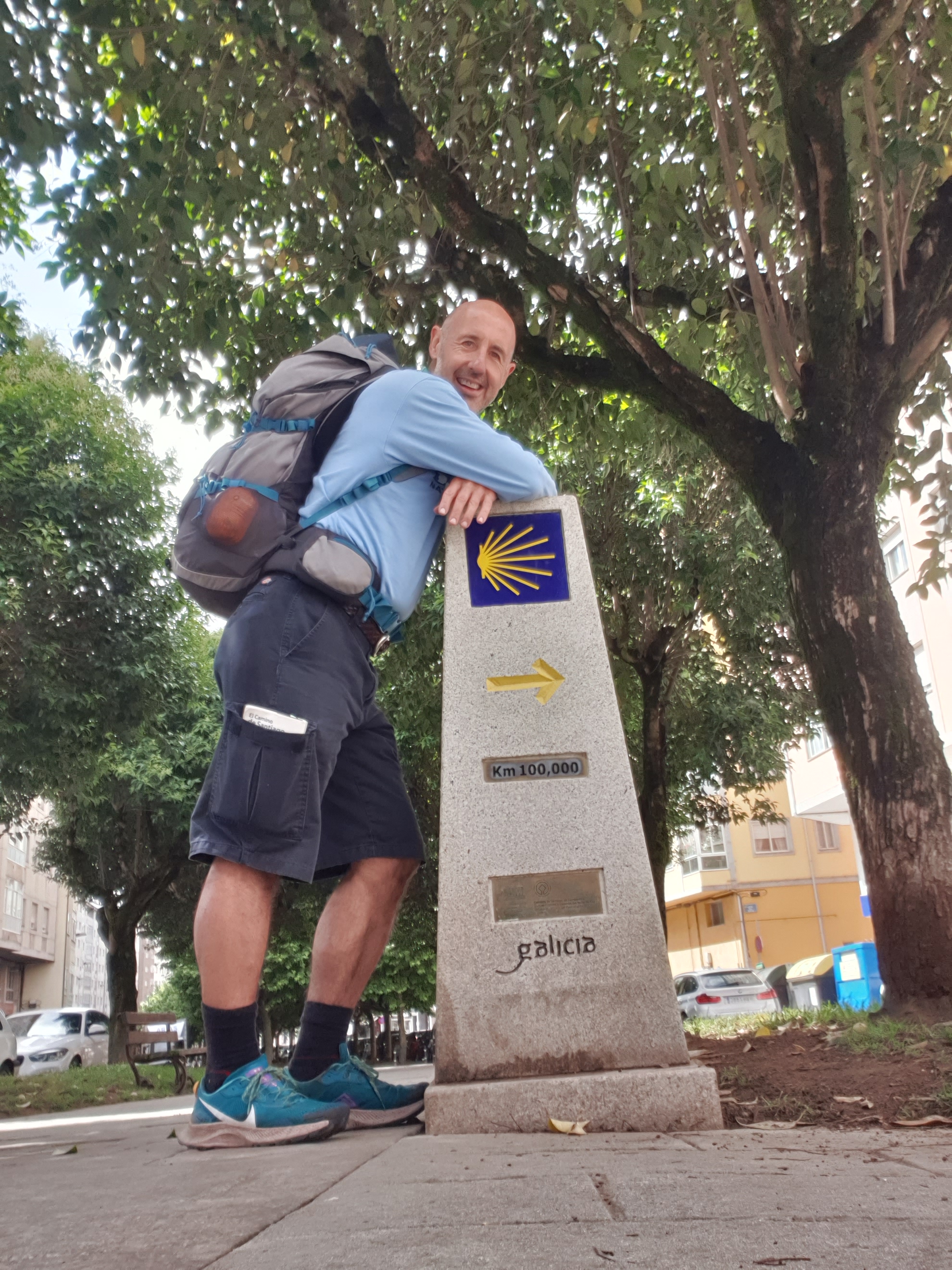
About halfway through you cross the grassy paths of Asturias to the dense forests of Galicia. After the city of Lugo with its amazing Roman walls, you have a day of a lot of asphalt, although the views are lovely, your feet pay the price. Then you have a final day of hillside living, before merging into the popular Camino Francés with all the “tourists” doing just the last 100 km (62 miles) to say they have done the Camino. So, the last three days are crowded and rainy on top of that.

But nothing compares to arriving at the plaza del Obradoiro and standing in front of the Cathedral. For me it was 310 km (200 miles) in 11 days.

The Cathedral has been totally renovated and I could finally go down to the crypt to see the tomb of St. James third time is the charm –it had been closed for restoration all my previous times. Lunch was at the amazing Santiago market, where I had the best hake I have ever tasted. With no train spots available that day, a flight to Madrid that afternoon ended my adventure.

How does it compare to the other Caminos? Well, the obvious facts are that while shorter, it is indeed more intense, beautiful, natural, and rugged. I loved every step of it, even the hard climbs and descents.

La casa de Bernarda Alba by Federico García Lorca

Federico García Lorca is Spain’s greatest 20th C playwright (his poetry is also right up there). He is arguably one of the best in his business, period.

La casa de Bernarda Alba is the play I have read and seen the most. Teaching in Boston, every year I would drive my advanced students to New York city to see Repertorio Español‘s production. I have even seen a version done by illiterate Roma women, I also saw a bilingual production by UNC students while I taught and studied there.

The Teatro Español is the oldest running theatre in Europe (since 1583, 439 years ago!), so imagine my surprise when I found out that I was going to be in Madrid during a run of La Casa de Bernarda Alba! I wasted no time in buying tickets and inviting my girlfriend and my eldest niece.

The theatre is right downtown, in the middle of the aptly named Letras neighborhood (Barrio de las letras) because Cervantes and Lope de Vega and others lived there. My niece and I rode a rental scooter there and we met Celia at the theatre.

The presentation was top notch, possibly the best I’ve seen. But, like other times, the director took some liberties with the text, for example cutting out the maid and beggar woman characters, or cutting out dialogue, which I find insulting to the text and the author, grrr. The setting was very minimalist, basically the patio of Bernarda’s house.

After the play we went to dinner to my grandad’s favorite bar, the Viva Madrid, around the corner from the theatre.

It was a great evening, the show was amazing, and we all had a great time!

What is your favorite play? Tell us in the comments section.

Sor Juana Inés de la Cruz, a conference

One of the great benefits of being in Madrid for my Summer break is being able to attend all sorts of events that are difficult to find in South Florida.

I recently had the pleasure of attending a great series of conferences on Sor Juana Inés de la Cruz, the brilliant Mexican Baroque writer (and musician, architect, scientist, and cook!), whom I studied a bit for my PhD at UNC.

The conference was hosted at the great Fundación Juan March (which I have already mentioned here) and the speaker was Esperanza López Parada, professor of Latin American literature at the Complutense University in Madrid.

The first lecture was on Sor Juana’s time, her life, and her writings in general. It is always interesting to learn new facts and perspectives on someone you have studied.

The second lecture focused on the poem Primero Sueño, and it included actor Beatriz Arguello reading the poem. The commentary and the reading were masterfully interwoven, making for an extremely rewarding experience!

López Parada cited my UNC professor (and PhD Committee Member Rosa Perelmuter, which was very moving for me). We even chatted a bit after the conference, which was a nice little plus.

Here is a video López Parada showed us of the adaptation into song of one of Sor Juana’s most famous poems: Hombres necios.

The best present ever, Rome.

Confession time: I had never been to Rome before last week when my girlfriend invited me for a few days. I had been to Milan, Lake Cuomo, and Sicily, I spent a lot of time for work in Florence. But I had never been to Rome.

My mind was blown. The absolute beauty, even in the apparent anarchy and chaos of traffic, mopeds, rental scooters, and tourists. Every little piazza, every big piazza, every sculpture, every cobble stone street, one is surrounded by inebriating beauty.

We stayed at a cute and quirky hotel on Largo de Torre Argentina, where Julius Caesar was assassinated, and although Celia had been there before, she was still game to walk all over town to the Pantheon, Forum, Jewish neighborhood, Piazza Venezia, Colosseum, Trastevere, Isola Tiberina, Piazza Navona, Spanish Steps, Trevi, Villa Borghese, the Vatican, St. Peter’s, Piazza del Popolo, Castel St. Angelo, and church after church, you name it, we saw it!

We had delicious meals: my first real carbonara, my first real Jewish artichokes, amazing! Excellent coffee, great wines, an Aperol Spritz when evening started, lick your fingers pastries and gelato, you get the idea.

Two memorable experiences were seeing Velazquez’s Inocencio X at the Doria Pamphili Gallery and Michelangelo’s Pieta in St. Peter’s. Although I was a bit disappointed in the Sistine Chapel: the crowds and the noise make it difficult to enjoy, if on top of that the Vatican cops are yelling “Silenzio!!” and “Move along!!” on their megaphones, then the moment is totally lost, sad.

Overall, I am still in awe. My senses are still aglow with the beauty, tastes, and sounds. I can’t wait to go back, which I should because I dropped a coin in Trevi fountain.

My favorite? Michelangelo’s Pieta in St. Peter’s, but that might merit its own blog post.

My favorite painting

The Prodigal Son, from my friend Irina

This might sound heretical coming from a Spaniard, but my favorite painting is not by Goya or Velazquez or Picasso or Murillo or Dalí or Miró, it is by Rembrandt (Leiden 1606 – Amsterdam 1669), and it is not even in a Spanish museum.

Unfortunately, I did not realize I was looking at what would be my favorite painting when I saw Rembrandt’s Return of the Prodigal Son when I was seventeen and visiting The Hermitage Museum in St. Petersburg with a handful of school friends. I was probably more concerned with looking at pretty girls or wondering about the evening’s plan with cheap Soviet Vodka -ah yes, the year was 1983, with Leonidas Brezhnev in charge of the Soviet Union!

Not long after, my father gave me a book: The Return of the Prodigal Son: A Meditation on Fathers, Brothers, and Sons by Henri Nouwen and I was deeply moved. I understood the painting and it became my favorite. Nouwen, a priest (1932-1996), threads the parable of the Prodigal Son (Luke 15:11–32) with the painting, covering each detail, each character in Scripture and the painting.

The father’s hands gently placed on the boy’s back, the brother’s jealous, angry stare, the servant, the mother, even another person almost invisible in the background, the son’s broken sandals, the capes, everything has a purpose and a meaning. The painting, painted in Rembrandt’s last years, is as spiritual as they get. It asks for your meditation, it questions our behaviors as sons and daughters. You feel the weight of the father’s hands on your back, their warmth. The painting forgives you.
What was my surprise when I discovered that a poster of the painting hangs in my school’s library, right outside my office! I walk by it many times every day, and every day I am reminded of Rembrandt, of the Prodigal son, and of my trip to Russia many years ago.

Some of my other favorite paintings are Velazquez’s Meninas in the Prado, pretty much anything by Goya, Velazquez´s Inocencio X in the Doria Pamphili Gallery in Rome, every Sorolla painting, I’ve already mentioned Frida Kahlo in this blog, etc., etc., etc., the list goes on and on. But this one wins.

What is your favorite painting? Comment below, I would love to know!

Poster next to my office!

Mahler 5, New World Orchestra, and Michael Tilson Thomas

In a previous post I talked about Mahler’s Symphony Nº 5 (click here for that post). Well, I recently experienced it -one experiences more than listens to Mahler.

It had been about four years since I saw Mahler 5 at the Naples Philharmonic. I had also lived it with the great Benjamin Zander and the Boston Philharmonic Youth Orchestra years ago, but this was a whole other level:

The occasion was Michael Tilson Thomas “retirement” concert by his own New World Symphony. Now, some explanations:

Michael Tilson Thomas is a prodigy musician, Mahler savant, who founded the New World Symphony Orchestra in Miami in 1987. He is just one of those visionary geniuses who overflow with talent. He conducted the whole symphony without the sheet music. In fact, his notebook was closed on his stand the whole time in a show of “I have the music, but I do not need it” it was hugely impressive to have around 68 minutes of music for many, many instruments memorized.

The New World Symphony is a place for brilliant young musicians to do a three or four-year fellowship performing lesser-known works, more adventurous programing, and just out there stuff, just do not call it Avant Garde!! This is an orchestra with personality. Every musician is an accomplished and talented artist who is not afraid to make his or her voice heard, it makes a massive difference when you listen to them.

As for Mahler 5, this is the most “Mahlerian” of his works. As I said before, one feels the whole spectrum of emotions on this symphony: from the funeral march that opens, the Adagietto which is arguably one of the loveliest love songs ever, victorious scherzos… it is a roller coaster of emotions.

Well, my dear friend and old student Bill invited me to Michael Tilson Thomas’ farewell concert featuring Gil Shaham playing Joseph Boulogne Concerto n. 9 in G major for Violin and Orchestra, Op. 8 (c. 1775) as an appetizer and then Mahler 5…

As an added bonus, another one of my old students, Margeaux was there playing the violin!! I had not seen her since she graduated high school twelve years ago. I caught up with her at the artists’ exit and managed to say hi and get a picture with her!!

What an amazing experience to see Mahler 5 with Michael Tilson Thomas and his New World Symphony, and with one of my old students in the orchestra! Memorable.

Welcome to Miami

Miami is fun. It is just that getting in and out is such a headache. But once you are there it is playful fun. The other day I had the chance to walk around, right before the Formula 1 Grand Prix weekend.

South Beach might be the first thing we think of when we think of Miami; the Art Deco architecture, the amazing beach, the people. I testify to all of them.

If I had to define Miami, I would talk about the vibe, the throbbing energy, the vibrancy. It is a bold, loud, colorful place. The food options are improving constantly, better representing the cultural melting pot it is (haha pun intended).

Sure, if you walk around South Beach most of the folks are turistas, but, and here is one of Miami’s tricks: it is difficult to separate the turista from the local, granted part of it is because of the general lack of clothing one sees, but it also speaks to the diversity of the locals and their hedonist lifestyle.

A fairly unique feature of Miami is the “Ventanita” a window on the side of a restaurant, shop, or bar where you can order a coffee “cafecito”, a fruit juice, and in some cases a shake or a smoothy. These ubiquitous “ventanitas” allow you to have a quick coffee “sportello” style on the sidewalk or sitting at a nearby bench -so long as it is in the shade!

Other areas of Miami are more touristy like Bayfront and Bayside, but the beauty of Miami Beach is the mingling of folks. Enjoy!

Spanish teaching hack #752: using songs to memorize verbs

Most of what I know about teaching Spanish I learnt from Tracy years ago, and I am eternally grateful for that. One of those things is the importance of music in the classroom as a teaching tool. Sure, we learn songs and watch YouTube videos, but a lesser-known quality of music is as a mnemonic tool.

It is a well-known fact that irregular verbs in any language are difficult to memorize; there are so many! They are so hard! So, one way of helping to learn and memorize them is with songs, even if they are silly, basic melodies.

Here are a couple of examples of using basic melodies to help memorize irregular verbs: one is for the past tense preterit, and the other one for affirmative “tú” commands. Enjoy.

West Palm Beach, a celebration

Within the suburban wasteland that is South Florida, Palm Beach stands out as a beacon of civilization. Developed in the early 20th century by rich northerners who were scaping the cold and snow, it soon became the place for really rich folks to build winter homes (think Post cereal heiress Marjorie Merriweather Post’s Mar-a-Lago). If you were not rich enough to own a home you could always spend a few days at the iconic Breakers hotel. Nowadays, the Palm Beaches boast the Norton Museum which I have talked about already, and great dining venues.

I recently had the chance to explore Palm Beach at night. A colleague’s birthday was all it took to get three guys to go explore, improvise, and enjoy some drinks and a great dinner. Sure, there was some shop talk and some philosophy talk (they are both professors of philosophy, I am just an amateur) but mostly we just chatted and shared and enjoyed breaking bread together.

Pre-dinner drinks were had at the great rooftop Spruzzo bar atop the Ben hotel. The views were amazing, the drinks chilly, and the vibe great!

From there we walked around Clematis Street checking out the fun atmosphere, before settling down for dinner at Elisabetta’s Ristorante for a great Italian meal.

Overall, a fun time was had by all. I must say I was impressed by the cosmopolitan and sophisticated feel of West Palm Beach, I’ll be back.