An evening at a Van Morrison concert

Van Morrison was featured in this blog back in June 2014 because he is my favorite contemporary musician. Well, it is time to revisit the Lion of Belfast, as I recently had the opportunity to see him at a concert in Madrid. I had not been to a Van Morrison concert since the mid-2000s!

My dear friend Paco notified me, and I immediately bought a ticket, without knowing if I would be in Spain by June 4th. Fortunately, I was. A couple of days before, Paco’s wife pulled out of the concert, so I invited my sister, Rocky. We had a blast.

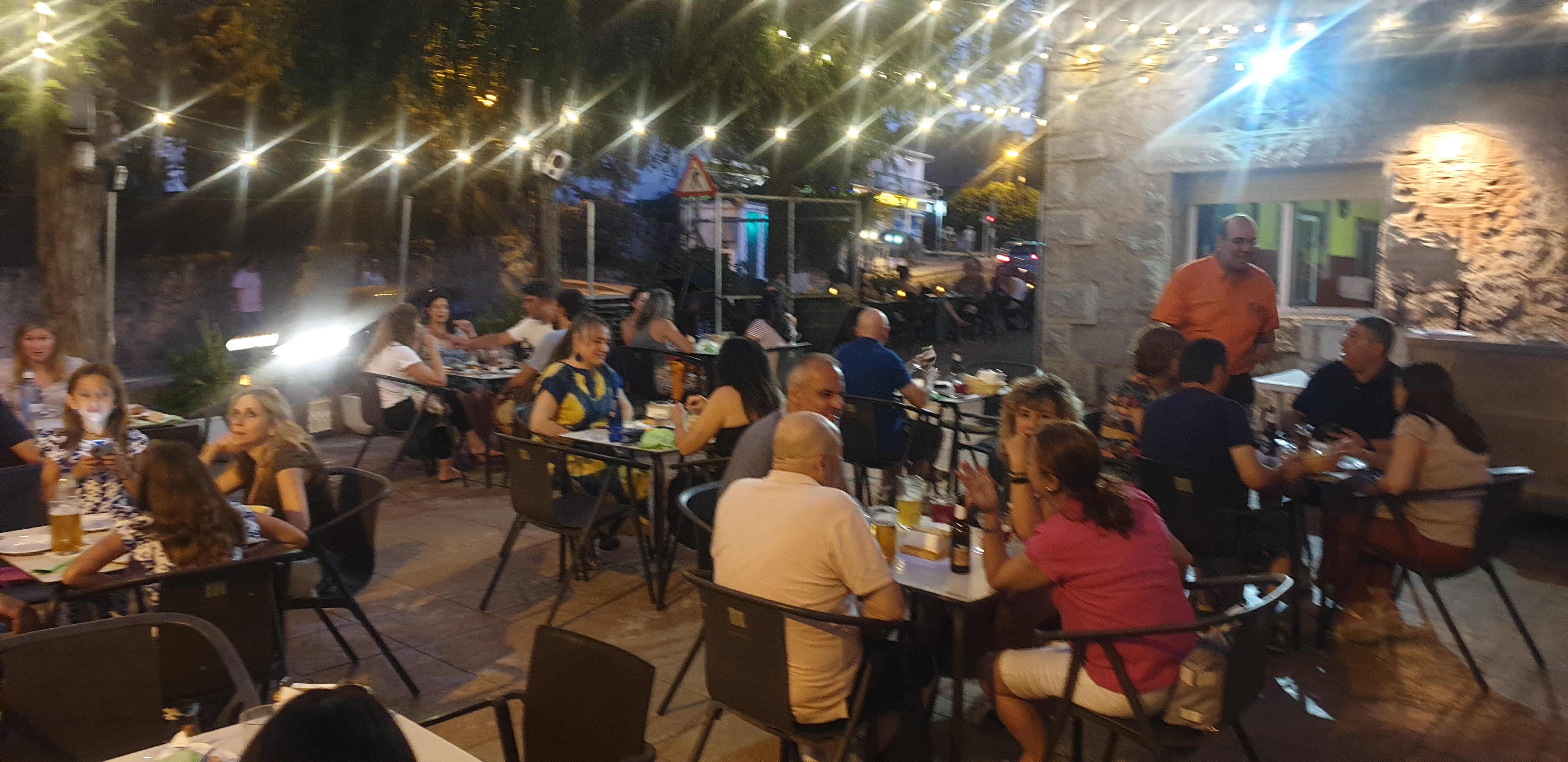
The concert was held at the university’s botanical garden, which features a large amphitheater-like stage area in the center. Surrounding it, they have placed all sorts of food trucks and bars, making for an awesome, cool (literally) experience on summer nights. They host a variety of concerts (see photos).

Van played a few of his big hits, such as “Days Like This,” “In the Afternoon,” or “Raincheck.” He also played a couple of his new songs, including “Cutting Corners.” He played a few covers, including Ray Charles’ “What Would I Do Without You” and Hank Williams’ “Cold, Cold Heart”.

Van had an amazing 9-piece band with him, which shone at the end of the concert, when they performed “Gloria”. Van then left them to each do their solos, which was mind-blowing and amazing!

Van sang for a very respectable hour and a half in the beautiful Madrid evening and light. This was my fourth time seeing Van the Man, and it was certainly my favorite concert. With his melodies, he takes you on wonderful spiritual journeys, letting you daydream in the beauty of the songs, he is really unique and unparalleled.

This was the playlist (thanks to setlist.fm)

Only a Dream

Cutting Corners

Back on Top

What Would I Do Without You (Ray Charles cover)

Days Like This

Real Real Gone

In the Afternoon / Raincheck / Sittin’ Pretty

Cleaning Windows

Green Rocky Road (traditional cover)

No Other Baby (Dickie Bishop and His Sidekicks cover)

Cold, Cold Heart (Hank Williams With His Drifting Cowboys cover)

Ain’t Gonna Moan No More

Broken Record

Wild Night

Help Me (Sonny Boy Williamson cover)

Gloria

Celebrating 20 years of teaching – some takeaways

This year marks my 20th year of teaching. It has been a total blessing. I have talked a lot about it here, but there should be at least some celebratory comments.

The first observation is that teaching is a vocational endeavor; if your heart is not in it, you will struggle and not be the best teacher for your students. I have taught almost 50/50 in secondary and university settings with brief stints in Middle school, and even primary school! (Read about it here.) My observation is that most teachers do it because they love it —we don’t do it for money. If you do not know if teaching is for you, try it out!

I have said this ad nauseam: all teaching is relational. We learn from a place of trust, that trust comes from the teacher-student relationship and that relationship comes from the teacher being open, better yet, vulnerable (within boundaries, of course), and honest.

Just because students are not masters of the subject matter does not make them stupid; they can see right through the teacher if you do not know the subject matter, regardless of your teaching style. So know and prepare your material, and if they ask something you do not know, get back to them with an answer. This recently happened to me, no shame in it.

Something that always motivates me is thinking of who I consider to be the best two teachers in history: Socrates and Jesus. They did not have hi-tech classrooms, which makes me always ask myself: Could I teach this with just a stick in the sand? If the answer is no, then I must rethink my lesson plan. Everything else on top of that is glitter and show…

I could probably write a book about this, but for now, I hope you liked this blog post.

So while not every moment of my 20-year teaching career has been easy, I am looking forward to the next 20, let’s go!!

An evening watching Inter Miami

When Lukas arrived at Seacrest from Lithuania, he was a skinny 16-year-old with a lightning-quick dribble, a phenomenal shot on goal, and a way above-average soccer IQ for his age, which means he had an outstanding situational awareness and was able to “read” the game at a collegiate level. But he was skinny, so it only took a glance from an opposing defender for him to fall over. So I convinced him to work out with me after school. Within weeks, he was bulking up and able to stand up to defenders’ charges and body checks. Oh, he was also my Spanish student.

That was last decade. Nowadays, we talk about life, work, girls, Naples, old colleagues, and teachers, but we still share a passion for football. So we organized a trip to an Inter Miami game in Fort Lauderdale.

Interestingly, it was against Montreal, which was the only other Inter Miami game I had been to.

Chase Stadium is a bit of a misnomer, as the “Stadium” is a scaffolding structure, a Meccano set, surrounded by a bunch of way overpriced food trucks and bars. But we were there for the friendship, the soccer, and admittedly, to see Leo Messi play.

The game was as expected, not particularly good. Luis Suarez and Messi each scored a couple of goals, but Montreal managed to score a “dignity” goal. Although Lukas and I are both hardcore Cristiano Ronaldo fans, I must admit it was amazing to see Messi play; his skill level, how deceptively easy he made those goals look, was very impressive.

At the end of the day, driving down to Fort Lauderdale and spending a small fortune on tickets, food, and parking was well worth it to hang out with a dear friend.

Budapest

Budapest had long captivated me, and I have been fascinated by Hungary’s history, geography, culture, food, and people for many years. Well, I finally had the opportunity to go this summer for a few days. I loved every minute of my visit!

Celia and I stayed at the Alice Hotel, an old, restored palazzo on elegant Andrássy Avenue, a couple of blocks from City Park.

Yes, we visited all the obligatory sites: Parliament, Royal Palace, St. Stephen’s (and St. Stephen’s hand), St. Matthias, the Fisherman’s Bastion, the market, the funicular, the Synagogue, the cafés, Margaret Island, the baths, etc., etc. But more importantly, we explored further: the Cemetery, which is amazing, the different neighborhoods, walking and exploring both Buda and Pest, sneaking into university buildings, and having coffee with the locals at neighborhood cafés. This is where you get to know the country, its people, and its culture. And it is beautiful.

We ate with the Budapesti: Goulash, chicken paprikash, sausages, funnel cakes, palinka, all the pickled foods you can think of, including the tiny peppers that look like innocent baby tomatoes and then blow a hole in your skull because it is the spiciest thing you will ever eat, etc., etc.

We returned to the cathedral one evening for an awesome organ concert which featured Mozart, obviously Budapest’s treasured child, Liszt (who also lived in Madrid for a stint), and of course, Bach, including the Toccata and Fugue as the grand finale!!

We became great users of the subway / public transport system which includes the oldest subway in continental Europe (London was first).

Probably one of the most moving moments for me was walking along the Danube and tripping (metaphorically) with the “Shoe Memorial,” bronze sculptures of shoes lined up along the Danube in remmeberance of when the Nazis shot jews into the river —having ordered them to take off their valuables and shoes beforehand.

Overall, it was an amazing experience, and I highly recommend a visit.

A Streetcar Named Desire at the Teatro Español

I read Streetcar in high school, and there are a lot of tangential references to it in Almodovar’s Todo sobre mi madre, one of my favorite Almodovar films, which incorporates Streetcar as a narrative thread. Then there is, of course, the film: Marlon Brando and Vivien Leigh at their best, with an excellent supporting crew like Karl Malden.

When you walk around New Orleans, there are many Tennessee Williams references: he drank a coffee here, he smoked a cigarette here, he tied his shoelaces here, you get the idea. So, I remember being fascinated by this author, having such a presence in New Orleans when I travelled there for work years ago. That presence worked both ways, as you could argue that New Orleans is another main character in the play.

But I had never seen it until last week when I saw a billboard at the Teatro Español, no less. I got tickets for Celia and me —admittedly, I got them late, so they were not the best…

It was fantastic! Nathalie Poza as Blanche drives the play with all the subtleties of her character. Pablo Derqui is not Marlon Brando, but he puts up a solid effort. The set, the direction, the sound, it all works out perfectly. The stage manager even has rain, “real” rain, which, while impressive, ends up being a bit of unnecessary gimmick. And, with this being the Teatro Español, the world’s oldest (mostly) continuously running theatre (since 1583), there is an added aura, added magic.

So if you are in Madrid before July 27, see A Streetcar Named Desire. You are welcome.
Are you really living if you are not volunteering and/or helping others? Pancreatic Cancer Action Network – PanCAN

Last summer, my dear friend Paco gave me Stefan Zweig’s great 1922 short story “The Eyes of My Brother, Forever” (“Die Augen des ewigen Bruders”), and it confirmed what I have known for a long time: volunteering and helping others might be the best thing you can do not only to get out of your shell but also to live your fullest life.

This was my third year volunteering for the Pancreatic Cancer Action Network – PanCAN. They host the national Purple Stride event every Spring, and it is a great time! I serve as the Registration Lead volunteer, so everybody who has not registered for the event has to come to our tent. I must get up at 4 in the morning to be in Boca Raton at 5, but it is worth it. I had a blast with my sidekick Rona, whose son, like me, went to Bentley. She is a hilarious New Yorker, and I have a great time collaborating with her.

Listening to the radio, I recently learned that only 20% of the US population participates in “formal” that is, organized volunteering, as opposed to mowing your elderly neighbor’s yard. That number seems to me terribly low. Yes, you must turn off the TV and get off the couch, but it is worth it!!

So, look for volunteering options in our neighborhood: soup kitchens, food banks, or helping children with their studies. Whatever it is, it will fill your heart with joy. You are welcome.

“Not all of us can do great things. But we can do small things with great love.” — Mother Teresa

Faith, Family, and Friends

Pondering the pillars of personal stability and growth, I thought of Faith, Family, and Friends. I was excited about my alliteration until I looked it up online and found a ton of “Faith, Family, and Friends,” so it’s nothing new; I am not that original.

But the concept is still good. These are the three pillars to base one’s life on:

Faith: that there is something bigger than oneself, that you are not the center of the universe. That you stop and realize, and appreciate, that you are grateful for what you have, the blessings that you enjoy, like being able to read this blog!

There is a really deep well inside me. And in it dwells God. Sometimes I am there, too…. Dear God, these are anxious times…. We must help You to help ourselves. And that is all we can manage these days, and also all that really matters: that we safeguard that little piece of You, God, in ourselves.

—Etty Hillesum, An Interrupted Life

Or

In God alone is my soul at rest.

God is the source of my hope.

In God I find shelter, my rock, and my safety.

—Psalm 62:5–6

Friends: this is a situation where less is more, where quality is more important than quantity, where you can share and get advice, sometimes without asking for it! In fact, friends is the reason this blog post came about. I recently drove to Naples (the Florida one), my old stomping ground, to visit some friends: Lukas, my old student, and Edu, my old boss, now dear friends. Yes, I had a 2-hour drive each way, but it was worth it. As a follow-up, I am going to an Inter Miami game with Lukas, not so much for soccer as for friendship.

Family: goes without saying.

So, make sure you are working on your relationships, all three of them! You are welcome.
Reading Lolita in Tehran, four books in one.

Reading Lolita in Tehran

On a Sunday in January 1979, my dad and I were puttering around the garden, collecting, and chopping wood for the fireplace, listening to the radio. The news came on and explained that the Shah of Iran had fled the country into exile. I looked over at my dad, who had dropped the ax and was running up the stone stairs into the house. He took off to work at the bank -on a Sunday morning! My dad was a foreign exchange trader, and he knew the news of the Shah leaving Iran was going to cause a lot of market turmoil.

Growing up in London in the early 80s, there were many Iranian exiles. I remember going to school with a few of them. I also remember the SAS operation to liberate the Iranian embassy in 1980, a few blocks away from my best friend’s house. Even my mom’s English teacher was a beautiful, tall, elegant Iranian who brought me pistachio nuts and gave us a beautiful edition of the Rubaiyat of Omar Khayam.

After leaving London for college in Boston in 1983, I mostly forgot the Iranian revolution. A few weeks ago, I finally picked up a copy of Azar Nafisi’s Reading Lolita in Tehran, which had been waiting on my shelf for years, not knowing really what to expect. I loved every page. (Spoiler alerts)

The book is really four books woven into one magnificent narrative, like a-forgive the cheap simile-a fine Persian rug.

The main and overarching story is the author’s own story, her memoirs, from a child in Tehran, to studying in Europe and America, to teaching in Iran, and returning to the US. It is a fascinating life story.

The second thread of that biography is Nafisi´s job as a university professor of English literature, teaching: Lolita, The Great Gatsby, Pride and Prejudice, Emma, Daisy Miller, and Washington Square… in the classroom and eventually in her living room! which is where the name of the book comes from. But Nafisi does not stop at explaining that she taught (she still does); she gives her literary critiques of all the authors mentioned! It is a brilliant and amazing third layer, reading her interpretations of all these books. Yes, I felt jealous, as I have the same job as Nafisi, but I have nowhere near her capacity or talent.

The fourth story is the history of the Iranian revolution, the origins of the Islamic Republic, the persecutions, the disappearances, the crackdowns, etc. This story reminded me of Khaled Hosseini’s 2003 novel The Kite Runner, as he describes the crumbling of Afghanistan.

Yes, Reading Lolita in Tehran came out in 2003, but if you have not read it yet, I recommend it. You are welcome.
“Do not, under any circumstances, belittle a work of fiction by trying to turn it into a carbon copy of real life; what we search for in fiction is not so much reality but the epiphany of truth.”
― Azar Nafisi, Reading Lolita in Tehran: A Memoir in Books

The Quixotic in David Lynch’s The Straight Story

The Straight Story poster

When people think of David Lynch, they think of surreal, dream sequences and noir-style classics like Blue Velvet or Mulholland Drive. Because it is in essence a documentary, The Straight Story is the exception to the rule. It is based on the real story of a fellow, Alvin Straight—thus the name—who travels to visit his brother 300 miles away on a riding lawnmower!!
Due to Lynch’s recent passing, we just celebrated a David Lynch month in Film Club, and it was fantastic, a little homage, our tribute. We saw Elephant Man, Blue Velvet, The Straight Story, and Mulholland Drive.

One of the many things I learned during this month’s research is how much of a jokester Lynch was—what a character! But did he know how much of a Quixotic journey his film represents?

The few outward, visible clues that Straight Story is a Midwestern, late 20th-century Quixote story are that Straight is an older, skinny, rough-bearded fellow with an existential need to embark on this trip. Like Don Quixote, he has a false start to his adventure, returning home before starting his quest. He has a cohort of naysayers -hanging out at the local hardware store, the hardheadedness, a boring home life; although he has a loving daughter in Sissy Spacek, a phenomenal, but underrated actress.

The Straight Story poster

Along the way, he has many adventures: he encounters a group of cyclists, reminiscent of Quijote’s encounter with the herd of sheep, the lady who keeps running over deer, a few close encounters with 18-wheelers, giants? Etc.

But at the end of the day, this is a story of a man seeking his redemption, it is a physical representation of an inner journey, it is an existential, transcendental quest. It is important to know that while most road films represent an escape, in this case, like in Quijote, the journey is a necessary trip of personal realization.

The film is beautifully shot with great photography of the vast Midwest, not unlike the plains and hills of La Mancha. Straight camps out most nights, and like Quijote depends on the charity of strangers to progress on his trip.

One could argue that most road trip films are in some way Quixotic, but I argue that Lynch’s Straight Story is particularly so.

Rene Magritte at the Baker Museum in Naples

René Magritte might not be a household name, even though you might have his iconic Ceci n’est pas une pipe print hanging in your room or have seen his images many times.

Magritte (1898-1967) was a Belgian surrealist painter known for his amusing but ingenious surrealism, the body of a man in a suit with an apple for a head, the pipe painting, and so on.

On a recent trip to Naples (the Florida one), I had a bit of time in between meeting friends, so I snuck into the Baker Museum (which I write about here).

The Magritte exhibition was admittedly small, with just half a dozen paintings sandwiched inside a much bigger exhibition about the Everglades and its environment. But it was still worthwhile and beautiful to sit down for a while and contemplate these paintings that make you think about the metaphysical.

Magritte: Reflections of Another World comprises six paintings — five oils and one gouache — by Belgian artist René Magritte (1898-1967). Renowned for his witty Surrealist paintings of everyday objects in strange surroundings, Magritte preferred that his artworks remain mysterious and open to interpretation. These works are from the collection of Jean Van Parys, a collector of avant-garde art and a close friend of Magritte, and they are on a five-year loan to Artis—Naples, The Baker Museum from Van Parys’ daughter. The paintings have never previously been shown in North America, and none have exhibited publicly in over 48 years. Baker Museum