Guilty pleasures II – Vanity Fair

I have already written about National Geographic and The New Yorker magazines. They are both brilliantly written and very particular in their coverage, but there is a third magazine I love to read that, while beautifully written, might be a bit more, how should we say? superficial.

In the mid or late 90s, I must have picked up an issue of Vanity Fair magazine at some American airport, probably enticed by a great cover photograph, I loved it and have subscribed ever since!

That era, with Graydon Carter as editor, was a golden era for the magazine. Dominick Dunne, Sebastian Junger, and Christopher Hitchens wrote amazing pieces. Equally amazing photos by Bruce Weber, Annie Leibovitz, Mario Testino, and Herb Ritts decorated the magazine, and great exposés made for exciting reading: Deep Throat, the tobacco industry (which led to the film The Insider (1999), with Al Pacino and Russell Crowe), in-depth interviews, and overall simply great reporting!

Nowadays, maybe because we are in the 21st century, the magazine seems less edgy, the photography is more digital, and the content is more politically correct, trying to cater to everybody. I still read it cover to cover, but maybe not with the same excitement, it is still a guilty pleasure since I could (and should) be reading more enriching stuff…

If you are bored in an American airport and walk by a newsstand, get an issue of Vanity Fair, and let me know what you think in the comments below!!

PS: Conde Nast now publishes some international numbers, but they are not the same…

Joseph Pieper, Leisure; The Basis of Culture and The Philosophical Act. Are you really living?

Piping hot coffee and Pieper

Are you schlepping it on the day-to-day? grinding the 9 to 5? Or are you taking opportunities to experience beauty, to marvel, to wonder? It might be a simple, quick gesture such as looking at a cobweb, and marveling at its beauty, or taking a few deep breaths in the morning. If you are rushing through life to get more things done, you might be sacrificing your enjoyment of life.

Being Mediterranean, living in the US is a constant cultural shock. Despite my many years living here, I never got used to it. The go go go, work work work mentality is quickly exposed as this society’s Puritan, Calvinist, Protestant DNA. The first sign of this is when you notice that your colleagues at work do not take a coffee break mid-morning, they continue chugging from their Big Gulp gallon of coffee. You notice when you have not finished your meal at a restaurant and the waiter brings you the bill -kicking you out- with a courteous “Whenever you are ready” and you have not even ordered dessert!!

I had this discussion years ago with one of my students, when they mentioned a book they were reading for one of their classes: Joseph Pieper’s Leisure; The Basis of Culture. I just finished reading it.

Pieper condones the work for work mentality, the worker bee lifestyle. Writing in mid-20th C Germany, Pieper saw with concern the evolution of the labor trends at the time.

Leisure, it must be remembered, is not a Sunday afternoon idyll, but the preserve of freedom, of education and culture, and of that undiminished humanity which views the world as a whole.

Joseph Pieper

Pieper does a great job of defining leisure as not being idle, and how philosophy, a sense of wonder, is the root of culture. He advocates for education in the Humanities, Classics, Philosophy. However, Pieper is careful to note that we must give meaning to leisure. While making work a religion is bad, so is being a sloth (his word!)

Pieper’s second essay is The Philosophical Act, which follows on the Leisure essay. Both essays weave the beautiful tapestry that is Humanism. Not only beauty but thought as well. In this essay, Pieper underlines the importance of wonder and of hope in our “philosophizing.”

This is a short and highly recommended read. It will help you understand what leisure and philosophy is -it is not that boring, scary stuff you read in old books!

Andrei Tarkovsky’s The Mirror

You have been a member of Film Club for 4 years now, you have seen many movies throughout your life, and you have even taken a couple of film classes -in graduate school! So you consider yourself a bit of a film connoisseur, a snob. You have seen the mesmerizing photography of The Proposition, the achingly beautiful La Grande Belleza, The Godfather trilogy, Oscar winners, you name it. Then you watch Andrei Tarkovsky’s The Mirror, and you realize that you have never seen a film like that, that you had no clue of what can be done with film, of how a story can be told through film. You feel like a beginner, an amateur. And it’s a 1975 film!

Imagine sitting on a long road trip and your travel partner reciting childhood stories, dreams, memories, and the like, nonstop, with no transitions, oh, and with beautiful music playing like Bach’s St. Matthew’s Passion. And that partner is Russian, so they have a very acute sense of the absurdity of life, and of history; of the Spanish Civil War, of WWII, that film is The Mirror.

If you read the reviews, they all mention stream-of-consciousness as the driving technique in this film, but this being a film, not printed page, it does not fully convey the power of the images, the ambiguity, the anxiety, and most importantly the beauty of the film.

Although the film is not about Magical Realism, it feels that way, like you are reading a Gabriel García Márquez novel (I have yet to see a good representation of Magical Realism on film, if you have a recommendation, drop in the comments, thanks). Yes, the camera work, the tracking angles, the lighting, it is all there, and you can talk about the technical bits, but at the end of the day, it is a beautiful film, one that blows your mind and changes the way you experience film forever.

I cannot wait to see more Tarkovsky films.

Don Quixote’s influence on Existentialist Philosophy Part II – José Ortega y Gasset

One of the most popular posts on this blog is Don Quixote’s Influence on Existentialist Philosophy, which is a bit embarrassing because it is not very good. I wrote it very early on in my master’s, and while the idea, the thesis is good, I did not develop it very deeply nor fully. It is mostly my gut feeling, my intuition that comes through.

I have thought and thought about this since 2008, and more importantly, I have read a lot that I would not have had the time to read for that little essay. I have read more Dostoyevsky, Sartre, Kierkegaard, El Quijote desde Rusia with three brilliant essays by Turgenev, Dostoyevsky, and Merejkowsky, more Unamuno, Graham Greene, and on and on.

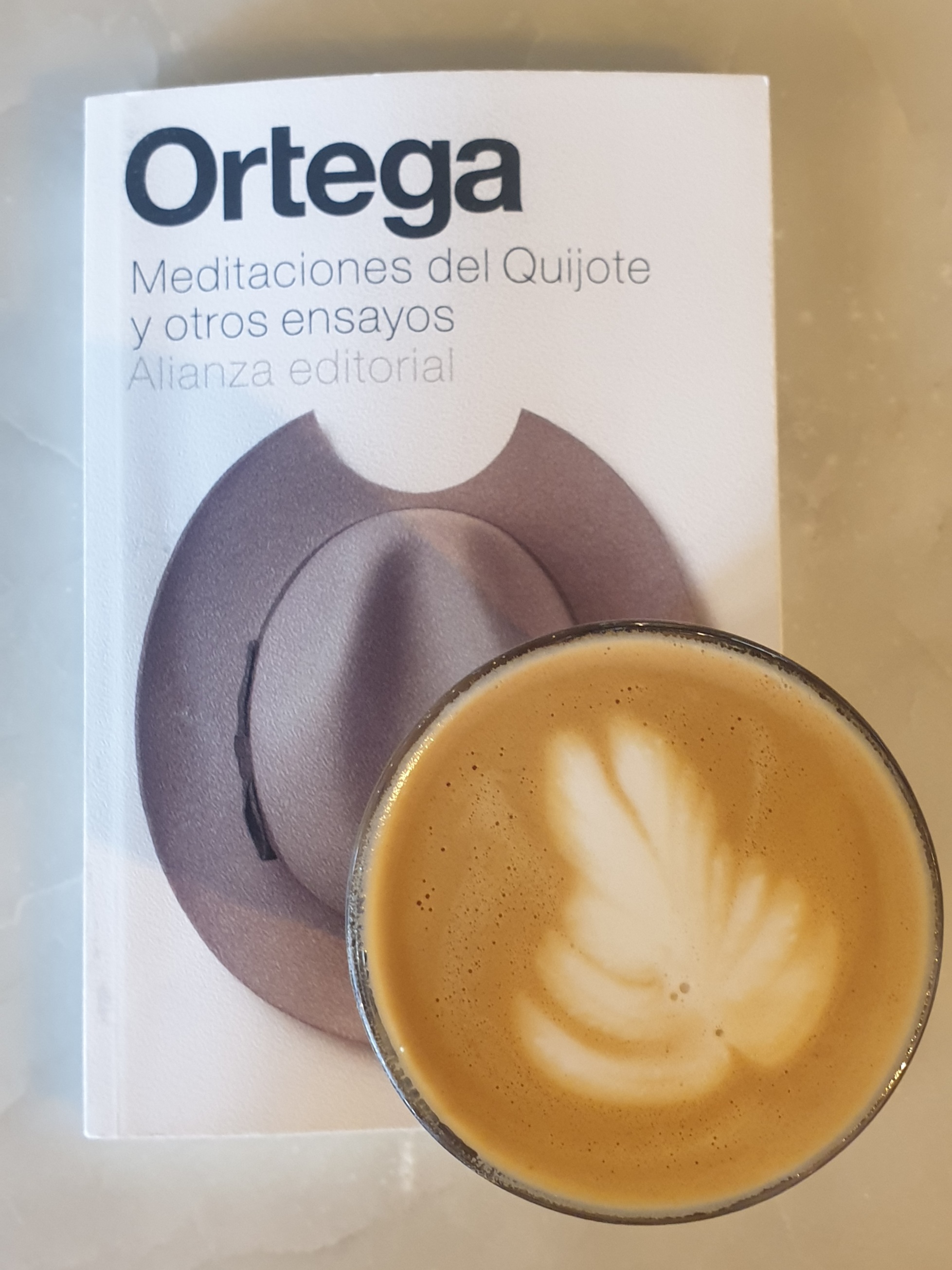
For Christmas, Celia gave me José Ortega y Gasset’s Meditaciones del Quijote y otros ensayos, which I had wanted to read for years.

All this reading confirms the theory that Cervantes crystallizes the thoughts of the preceeding centuries, from the ancient Greeks on Liberty to the early Christians on Free Will, where the Self is swimming in the primordial waters of philosophy, floating around until Cervantes’ electric genius gave abiogenesis form to Don Quixote, consciously creating his fortune, bringing about the concept of existentialism. The textbook example of this is the beginning of chapter VIII. Read it carefully, what does Quijote see? He sees them. What are they? Windmills or giants…

Don Quixote is the proverbial Tetrapod fish walking onto earth. It will be up to Kierkegaard, Dostoyevsky, Nietzsche, Unamuno, and Ortega before Simone de Beauvoir and Jean-Paul Sartre finally come up with the label that puts a nice bow on the Darwinian evolution of thought that delivers Existentialist theory.

Meditaciones has the famous quote “yo soy yo y mi circunstancia, y si no la salvo a ella no me salvo yo”.  So, yes, you are responsible for what you do in life, with life, but you also must deal with the circumstances surrounding your life. But Meditaciones is not what you expect. It is not a direct essay on Ortega’s thoughts on El Quijote -although it is also that- it is that in a meandering, roundabout way. Ortega talks about the Mediterranean culture, compares it to the Germanic culture as he lived in Germany for many years. This is evident when he quotes Nietzsche’s “Live dangerously”, which is, of course, the whole premise of Quijote’s adventures.

As a good philosopher, questioning El Quijote, Ortega ends up asking more questions than answering them. One key observation comes when he compares Cervantes to Shakespeare, something commonly done, as they were, after all, contemporaries. And here is the difference: Shakespeare explains himself, Cervantes not so much. Some of that difference might be due to the difference in genres: Theatre vs the modern novel, but nonetheless, there it is. Another common assumption is the Spanishness of Quijote, which leads Ortega to call Spain the “spiritual promontory of Europe”.

Another of Ortega’s brilliant observations, connections are between two Baroque masterpieces: Quijote and Velazquez’s Meninas, how we can step into each work and see it from the inside. This imaginary stepping into these makes them realistic. That realism is what makes us, and understanding ourselves in that work, that singularity, is what makes us heroes, a full hymn to Existentialism!

So what I wrote 17 years ago, although not the most brilliant, not the best written academic paper, still stands. Cervantes, by creating Don Quijote, is setting the cornerstone of Existentialist philosophy.